Project Explorer · working sheet

Seeds of the Throne

Seeds of the Throne began as years of conversations and thousands of story ideas. The Project Explorer shows how those ideas are being organized into characters, a world, a timeline, and a finished series.

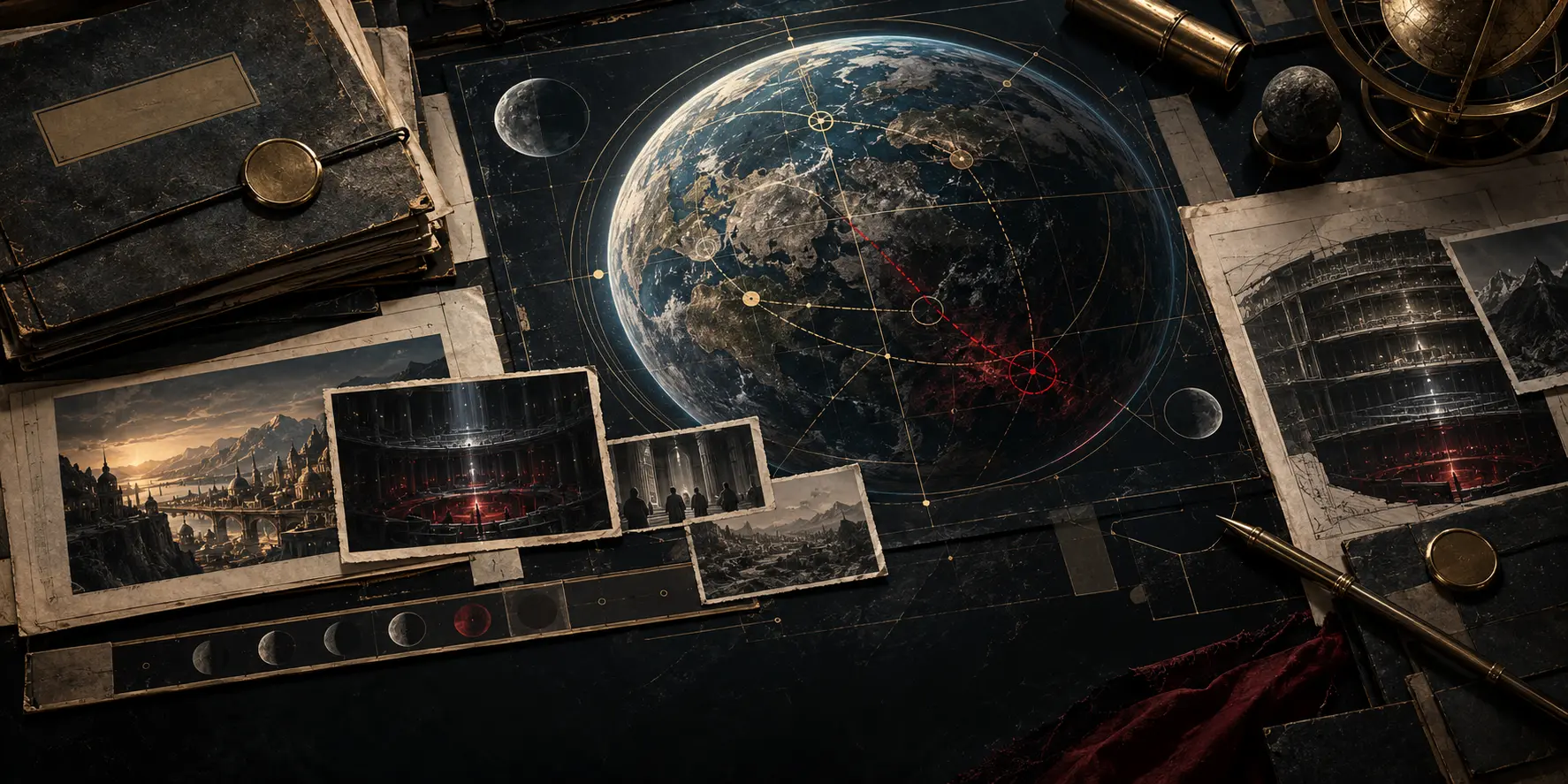
Interpretive still life of recovered records aligned against hidden-system evidence.

Recovered records held against the working evidence.

Story development tools

See how the authoring system turns ordinary language into finished story work.

The Project Explorer shows the live notes, decisions, and workshop used to develop Seeds of the Throne. Each step keeps confirmed decisions separate from suggestions and unanswered questions.

This is a public, read-only look at the real project, so it contains full spoilers. You can try the workshop, but your draft stays in this browser unless you export it.

  1. The author explains the story in ordinary language.

    The system records those ideas and separates confirmed decisions from suggestions and unanswered questions.

    Read how the system is designed
  2. The current workshop asks one consequential question at a time.

    Each question helps the author decide a missing cause, character choice, relationship, world rule, or event.

    Open a workshop question
  3. Accepted answers are added where they belong.

    An accepted decision can update character notes, the timeline, world rules, plot events, and the list of remaining questions.

    Review decisions and supporting information
  4. Use the completed plan to write and revise scenes.

    The planned system will create scene outlines, draft prose, check continuity, revise weak sections, and assemble the manuscript for the author's approval.

    Read the system plan

Seeds of the Throne is the working example. The notes, decisions, and workshop below are the live project, not a demonstration mockup.

Vault overview

See the whole story-development system at a glance.

605 notes work together as one system. The vault remembers where ideas came from, what the author decided, what remains uncertain, and what should happen next.

The vault turns conversations into organized story memory. It preserves sources, separates decisions from suggestions, finds missing connections, supports research and workshops, prepares scenes and prose, checks continuity, and publishes selected material without surrendering author control.

  • Working now Capture, memory, workshops, and research already operate.
  • Needs repair Current-state agreement, automatic checks, and decision updates still drift.
  • Planned next Durable answers, manuscript production, and mobile save are not built yet.
  1. Capture

    Conversations, mobile notes, and raw ideas are preserved.

  2. Understand

    Current context and compiled notes explain what the project means now.

  3. Decide

    Workshops ask one important question and preserve the author's answer.

  4. Develop

    Research, alternatives, story structure, and focused tests strengthen the work.

  5. Create

    Scene plans, prose, images, and manuscript material are produced for review.

  6. Share

    Selected material becomes the story site, Project Explorer, and public posts.

What lives where

Each area has a job. Folder names are secondary detail.

  • New material

    Preserves incoming ideas and the order in which they developed.

    00 Inbox, 01 Sessions

  • Story memory

    Keeps the detailed working knowledge and a smaller briefing used to resume work.

    02 Story, 03 Context

  • Research

    Separates questions, reports, and usable findings from story decisions.

    04 Research

  • Public work

    Holds reviewed material prepared for readers.

    05 Public

  • Drafts

    Holds scenes and manuscript candidates awaiting review.

    06 Draft

  • Decisions and direction

    Records choices, contradictions, current work, handoffs, and verification.

    07 QA, 07 Coordination

  • Development tools

    Diagnoses missing connections and tests possible story directions.

    08 Story Loop, 09 Story Exploration

  • Reusable methods

    Provides repeatable methods for writing, research, images, websites, and checks.

    skills, scripts

What already works, what needs repair, and what is still planned

Working well

  • Idea and session capture
  • Human-readable story memory
  • Author authority and decision boundaries
  • Research kept separate from story truth
  • Workshop questions that wait for an answer
  • Decisions, contradictions, and open questions
  • Visual identity and image controls
  • Markdown files and recoverable history
  • Searchable file access

Needs repair

  • One trustworthy current-state view
  • Automatic checks before a change is merged
  • Shared labels and stable record identifiers
  • Updating every affected note after a decision
  • Keeping the weekly cycle current
  • Clearer boundaries around older folders
  • A cleaner split between the repository and the live site

Planned next Not built yet

  • Durable integration of conversational answers
  • Automatic reports of what a decision would change
  • Complete scene-to-manuscript production
  • Manuscript assembly and export
  • Reliable mobile save, resume, and synchronization

The next build order

  1. Make builds and checks reliable.
  2. Create one trustworthy current state.
  3. Normalize the records for one small complete path.
  4. Connect accepted decisions to every affected file.
  5. Prove one complete path from conversation to approved manuscript material.
  6. Expand only after that path works.

Current story development

See what the story already has and what it still needs.

The system checks the whole story for missing causes, weak character decisions, unclear rules, and unfinished events. The results show the author what to work on next.

Current story premise

The colonization process trains participants and contains dangerous criminals.

Humanity developed the Luminai inside an interactive colonization environment. Sylvan and his Luminai are tested against Samuel Franklin, a criminal already held inside the containment process.

The current story problem Make the formal separation, rapid financial collapse, processing, exposure, and accepted placement feel inevitable.

Read the current story assessment

0 / 10major story problems resolved

Current development pass0%
0%
Current sweep
Reassessment
Current task
RW-01
  1. 01 Reassessment
  2. 02 Causal sequence
  3. 03 Character agency
  4. 04 Systems + evidence
  5. 05 Scene design
  6. 06 Draft

Story files

Browse the files used to develop the story.

Search 605 documents about the world, characters, plot, research, decisions, workshops, and earlier ideas.

Current document 01 Sessions/Daily/2026-08-21 - Recursive Luminai Loop Under Hostile Control.md

Recursive Luminai Loop Under Hostile Control

Accepted author direction

During the antagonist-dominant humiliation environment, Sylvan and his Luminai use a recursive learning process conceptually related to the Seeds Story Gauntlet itself.

The technical reason for the process is the same reason the author is using repeated builder/critic/integration loops to develop the story: a single interpretation is too vulnerable to hidden assumptions, manipulation, incomplete evidence, self-confirmation, and mistakes that cannot be seen from inside the first pass.

Sylvan therefore does not survive Samuel and George's hostile environment by receiving a correct answer from the Luminai. His extended cognition becomes more capable by repeatedly processing experience, challenging its own interpretation, testing predictions against later events, preserving provenance, and updating the model it carries forward.

Working functional cycle

The exact internal technology remains unresolved, but the accepted conceptual loop is:

experience -> preserve observations/provenance -> form interpretation or hypothesis -> challenge the interpretation -> predict/test -> compare result -> identify failure -> update model -> carry improved model into the next encounter

This is not a literal requirement that Sylvan consciously recite formal steps every time. It describes the cognitive/technical function developing between conscious attention, subconscious processing, memory, and Luminai-supported analysis.

Why Environment 2 needs the loop

Samuel and George dominate the local environment largely through asymmetric information and manipulated interpretation. They benefit when Sylvan reacts to the first apparent explanation of an event.

The recursive loop directly attacks that advantage:

  • preserve what actually happened before later framing changes it;
  • distinguish observation from inference;
  • keep competing explanations alive rather than collapsing immediately onto one;
  • compare predictions against repeated encounters;
  • identify where a prior model failed;
  • update without treating every new anomaly as proof of the preferred theory;
  • learn which antagonist methods repeat and which depend on local conditions;
  • accumulate a more reliable model across months of hostile experience.

Samuel and George can continue controlling much of the environment while gradually losing their interpretive advantage over Sylvan.

Human-Luminai boundary

The Luminai is not a separate critic-person sitting outside Sylvan. It is differentiated extended cognition within the same accountable identity.

The analogy to the Story Gauntlet is functional rather than literal. Different cognitive processes can preserve evidence, generate alternatives, challenge assumptions, compare predictions, and integrate corrections without creating separate identities.

The loop should strengthen reality-testing rather than create omniscience. It must remain capable of producing wrong hypotheses, incomplete predictions, false positives, and costly corrections.

Story payoff

The humiliation year becomes more than endurance. It is where Sylvan learns a repeatable method for operating when the apparent reality around him may be adversarially shaped.

That method then transfers into the multi-zone employment environment. Each new zone provides a changed test condition. The same antagonist behavior can be compared across different permissions, people, technologies, physical spaces, and institutional rules.

By the time Sylvan reaches the terminal control-transfer condition, he has not merely survived Samuel and George. He has accumulated an iteratively corrected model of how they behave, how their control works, where it fails, and what evidence can survive their interpretation layer.

When bounded control finally transfers to him, that accumulated model and evidence allow exposure. The final victory is therefore built from the same recursive process used throughout the ordeal rather than from a new last-minute capability.

Parallel with the real Seeds development system

The story-development experiment and Sylvan's fictional development now share one underlying principle:

Build an interpretation, attack it from another angle, preserve the failure, integrate the correction, and make the next pass from a stronger state.

For the real vault, the state is story canon, unresolved questions, critique results, and failure modes.

For Sylvan, the state is authenticated experience, provenance, predictions, observed antagonist behavior, known environmental limits, and an increasingly reliable extended cognitive model.

The parallel should remain thematic and technical rather than meta-fictional. Sylvan does not know he is reenacting a writing workflow.

Still unresolved

  • exact Luminai architecture that implements or supports the recursive process;
  • which parts occur consciously versus subconsciously;
  • how observations are authenticated and protected from hostile alteration;
  • how competing hypotheses are represented;
  • what kinds of predictions Sylvan can test safely;
  • the first major wrong model the loop catches;
  • the first time Samuel or George realizes Sylvan is learning from attacks rather than merely enduring them;
  • whether that realization causes escalation;
  • how the loop evolves in the multi-zone employment environment;
  • which final evidence chain depends specifically on months or years of recursive correction.