Document metadata
type: development-session
status: integrated
date: 2026-09-03
topics: bridge world, Luminai initialization, Samuel containment, Konrad daemon, reverse chronology, criminal ecosystems, outcome presentation
source: 2026-09-02 mobile handoff and 2026-09-03 desktop integration
Bridge World and Luminai Initialization Integration
Supersession notice
Historical integration record retained. The September 5 author correction supersedes wording implying Luminai were restricted to the successor generation or that humanity simply colonized worlds using preexisting AI souls. Consult current Core Premise and AI Souls notes.
Source: 01 Sessions/Daily/2026-09-05 - Integrated Foundation Audit and Workshop Build.
Question explored
How can the mature colonization setting, older AI souls, the Great War, Samuel's containment career, Konrad's postwar failure, Sylvan's bond, and the series structure become one causal foundation?
Author decisions
- AI soul is the broad historical category. A Daemon is an evil AI soul. It is not the name of every older AI soul.
- Konrad's Great War AI soul is an older-generation Daemon.
- Sylvan is the first human in this real-world process to develop through the new, deeply and continuously integrated Luminai architecture.
- The current planet stands at the end of the mature multi-planetary colonization era built with older AI souls and at the beginning of the successor Luminai era.
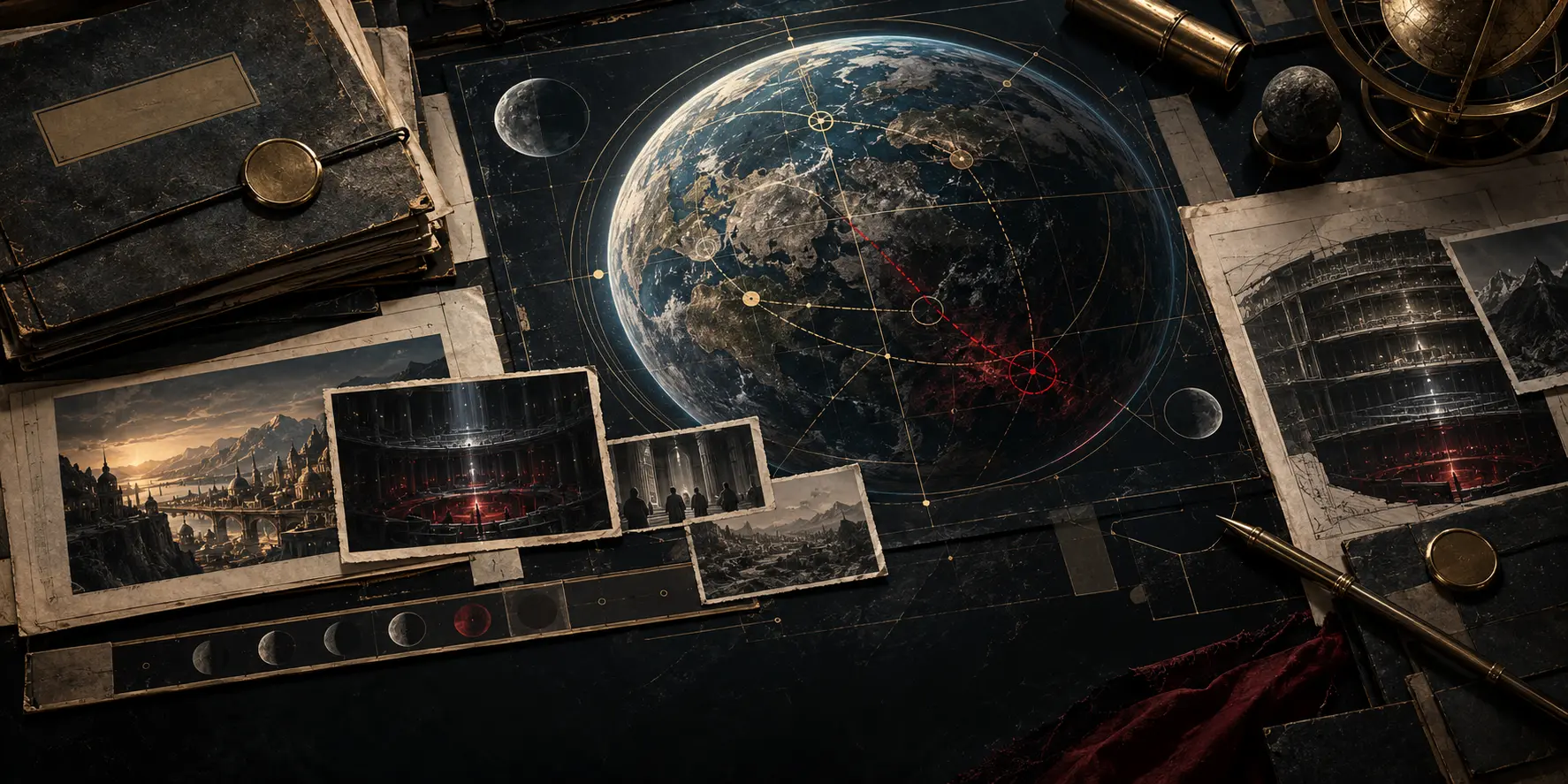
- The planet is a real civilization and a bridge world, not a simulation.
- The older leaders select Samuel as a representative worst-case criminal subject and contain him because his coercion, exploitation, deception, compromise, blackmail, and adaptive control make him an unusually demanding adversary.
- Samuel accumulates bounded influence for approximately a century. He mistakes observed latitude for sovereign power.
- Konrad's Great War defeat should end his colonization experiment. He voluntarily remains because he believes his experienced Daemon can contain Samuel, outperform Sylvan's new Luminai, redeem every previous failure, and win control of the colonization plan.
- Samuel promises Konrad a separate autonomous domain. Konrad reactivates his Daemon, followers, hierarchy, breeding program, bloodline systems, and infrastructure inside the shared containment environment.
- This reactivation gives Samuel the access required for a generational takeover. The exact inheritance rule, permissions, and lock remain unresolved.
- Konrad's faction and Samuel's network are distinct criminal ecosystems. Konrad uses public hierarchy, militarization, purity, territorial ambition, bloodline, and enforced conformity. Samuel uses private compromise, access, surveillance, shame, dependency, blackmail, and captured intermediaries. Both treat people as instruments.
- Samuel attacks the two things that bind Konrad's organization: ideology and lineage. He compromises bloodlines and records, enters Konrad's family, redirects younger generations, and attempts to become the group's functional patriarch and succession center.
- Book One begins near the chronological end. Later books reconstruct the Great War, postwar migration, takeover, and long False Victory.
- During the final few years, Sylvan already holds decisive control. He permits Samuel bounded activity so the Luminai can observe the complete endgame, distinguish performance from control, and prove the new method.
- Samuel attempts the same takeover pattern against Sylvan in front of Konrad's inner circle. They recognize what happened to them before Konrad, who remains isolated inside a counterfeit victory and plans the empire he thinks he will recover.
- Samuel's desperation centers on stealing Sylvan's Luminai. He treats it as an object that will restore his authority, although its effectiveness exists in the developed Sylvan-Luminai relationship.
- Samuel's creation of a child with Konrad's sister and his wider reproductive and genealogical campaign become part of the ultimate revelation. Exact agency, mechanism, chronology, and evidence remain unresolved.
- Konrad Fitzgerald's newly approved visual appearance is canonical for visual production. The associated control lines and scene staging are visual interpretation, not literal system canon.
Current working direction
The endgame is a comparative demonstration. Konrad's older Daemon attempts domination, accepts performed submission as proof, and helps expose Konrad's group to Samuel. Sylvan's new Luminai preserves human responsibility, permits bounded adversarial action, learns across the final years, and exposes the difference between apparent control and actual containment.
The series proceeds backward through discovery: Book One presents consequences and the live repetition of Samuel's method; later books let the reader experience the historical success of that method against Konrad.
Ethical and research boundary
The two criminal ecosystems may draw on generalized, documented behaviors and tactics. No contemporary group, person, scandal, or victim category enters final story data by name. Fascist claims about impurity, degeneracy, pollution, or perversion remain antagonist ideology, never objective narration. Consensual identity or sexuality is not equated with Samuel's coercion. His crimes are exploitation, engineered compromise, nonconsensual humiliation, blackmail, reproductive coercion, and treating people as instruments.
The younger generation requires individual accountability. Coercion does not erase harm; participation does not erase coercion. Sylvan's method must protect victims, determine responsibility, and offer a path outside both criminal systems.
Unresolved questions
- What does “the end” of the old colonization era mean operationally?
- Why is this planet the only suitable real-world initialization site?
- How much does Konrad know about Sylvan and the successor Luminai before he remains in containment?
- What exact rule makes reactivated systems inherit Samuel's earlier structural priority?
- Does Samuel deceive, compromise, or merely exploit the Daemon?
- Is the Daemon still active at the outcome presentation?
- What are the Book One discovery beats, viewpoint order, and final proof threshold?
- What part of the result can be disclosed without exposing descendants as evidence objects?
- What were the agency, coercion, and responsibility of Konrad's adult grandson during his long role in Samuel's network?
Vault impact
This session creates dedicated compiled notes for the bridge world, Book One outcome architecture, and rival criminal ecosystems; revises the core premise, chronology, AI-soul terminology, central characters, containment hierarchy, breeding-program framing, current context, QA records, Story Loop routing, visual identity, and the public atlas.