Project Explorer · working sheet

Seeds of the Throne

Seeds of the Throne began as years of conversations and thousands of story ideas. The Project Explorer shows how those ideas are being organized into characters, a world, a timeline, and a finished series.

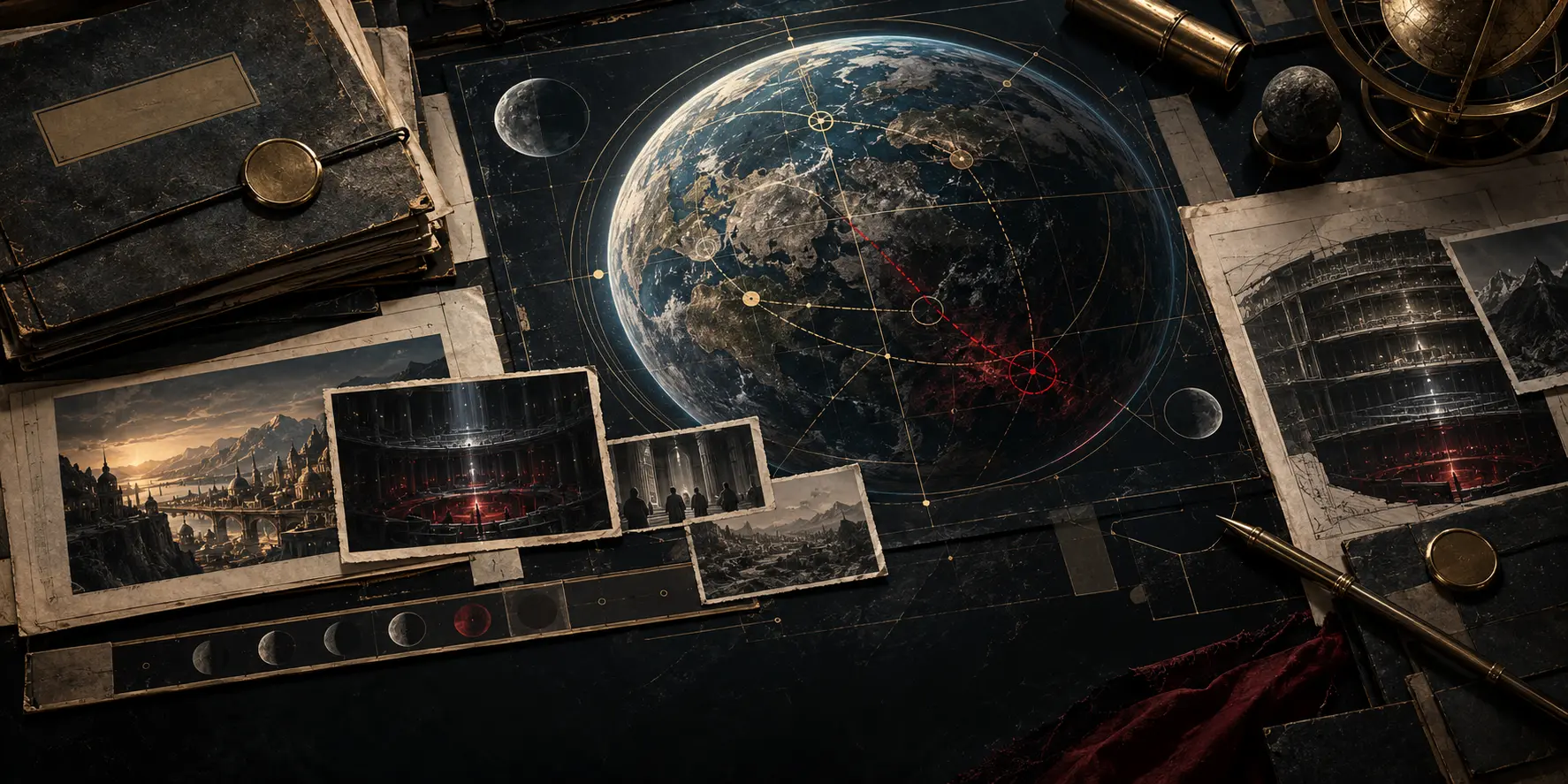
Interpretive still life of recovered records aligned against hidden-system evidence.

Recovered records held against the working evidence.

Story development tools

See how the authoring system turns ordinary language into finished story work.

The Project Explorer shows the live notes, decisions, and workshop used to develop Seeds of the Throne. Each step keeps confirmed decisions separate from suggestions and unanswered questions.

This is a public, read-only look at the real project, so it contains full spoilers. You can try the workshop, but your draft stays in this browser unless you export it.

  1. The author explains the story in ordinary language.

    The system records those ideas and separates confirmed decisions from suggestions and unanswered questions.

    Read how the system is designed
  2. The current workshop asks one consequential question at a time.

    Each question helps the author decide a missing cause, character choice, relationship, world rule, or event.

    Open a workshop question
  3. Accepted answers are added where they belong.

    An accepted decision can update character notes, the timeline, world rules, plot events, and the list of remaining questions.

    Review decisions and supporting information
  4. Use the completed plan to write and revise scenes.

    The planned system will create scene outlines, draft prose, check continuity, revise weak sections, and assemble the manuscript for the author's approval.

    Read the system plan

Seeds of the Throne is the working example. The notes, decisions, and workshop below are the live project, not a demonstration mockup.

Vault overview

See the whole story-development system at a glance.

605 notes work together as one system. The vault remembers where ideas came from, what the author decided, what remains uncertain, and what should happen next.

The vault turns conversations into organized story memory. It preserves sources, separates decisions from suggestions, finds missing connections, supports research and workshops, prepares scenes and prose, checks continuity, and publishes selected material without surrendering author control.

  • Working now Capture, memory, workshops, and research already operate.
  • Needs repair Current-state agreement, automatic checks, and decision updates still drift.
  • Planned next Durable answers, manuscript production, and mobile save are not built yet.
  1. Capture

    Conversations, mobile notes, and raw ideas are preserved.

  2. Understand

    Current context and compiled notes explain what the project means now.

  3. Decide

    Workshops ask one important question and preserve the author's answer.

  4. Develop

    Research, alternatives, story structure, and focused tests strengthen the work.

  5. Create

    Scene plans, prose, images, and manuscript material are produced for review.

  6. Share

    Selected material becomes the story site, Project Explorer, and public posts.

What lives where

Each area has a job. Folder names are secondary detail.

  • New material

    Preserves incoming ideas and the order in which they developed.

    00 Inbox, 01 Sessions

  • Story memory

    Keeps the detailed working knowledge and a smaller briefing used to resume work.

    02 Story, 03 Context

  • Research

    Separates questions, reports, and usable findings from story decisions.

    04 Research

  • Public work

    Holds reviewed material prepared for readers.

    05 Public

  • Drafts

    Holds scenes and manuscript candidates awaiting review.

    06 Draft

  • Decisions and direction

    Records choices, contradictions, current work, handoffs, and verification.

    07 QA, 07 Coordination

  • Development tools

    Diagnoses missing connections and tests possible story directions.

    08 Story Loop, 09 Story Exploration

  • Reusable methods

    Provides repeatable methods for writing, research, images, websites, and checks.

    skills, scripts

What already works, what needs repair, and what is still planned

Working well

  • Idea and session capture
  • Human-readable story memory
  • Author authority and decision boundaries
  • Research kept separate from story truth
  • Workshop questions that wait for an answer
  • Decisions, contradictions, and open questions
  • Visual identity and image controls
  • Markdown files and recoverable history
  • Searchable file access

Needs repair

  • One trustworthy current-state view
  • Automatic checks before a change is merged
  • Shared labels and stable record identifiers
  • Updating every affected note after a decision
  • Keeping the weekly cycle current
  • Clearer boundaries around older folders
  • A cleaner split between the repository and the live site

Planned next Not built yet

  • Durable integration of conversational answers
  • Automatic reports of what a decision would change
  • Complete scene-to-manuscript production
  • Manuscript assembly and export
  • Reliable mobile save, resume, and synchronization

The next build order

  1. Make builds and checks reliable.
  2. Create one trustworthy current state.
  3. Normalize the records for one small complete path.
  4. Connect accepted decisions to every affected file.
  5. Prove one complete path from conversation to approved manuscript material.
  6. Expand only after that path works.

Current story development

See what the story already has and what it still needs.

The system checks the whole story for missing causes, weak character decisions, unclear rules, and unfinished events. The results show the author what to work on next.

Current story premise

The colonization process trains participants and contains dangerous criminals.

Humanity developed the Luminai inside an interactive colonization environment. Sylvan and his Luminai are tested against Samuel Franklin, a criminal already held inside the containment process.

The current story problem Make the formal separation, rapid financial collapse, processing, exposure, and accepted placement feel inevitable.

Read the current story assessment

0 / 10major story problems resolved

Current development pass0%
0%
Current sweep
Reassessment
Current task
RW-01
  1. 01 Reassessment
  2. 02 Causal sequence
  3. 03 Character agency
  4. 04 Systems + evidence
  5. 05 Scene design
  6. 06 Draft

Story files

Browse the files used to develop the story.

Search 605 documents about the world, characters, plot, research, decisions, workshops, and earlier ideas.

Current document 01 Sessions/Daily/2026-09-06 - Workshop Module 05 Deeper Integration Draft.md

Workshop Module 05 — Deeper Integration Draft

Gate

What new capacity does deeper integration provide that must still be governed by human choices and institutions?

Author answer — verbatim

This is in big part where the more effective, more advanced criminal containment comes into play. Because these participants with the deeper bonds are placed into an environment where the criminals have a substantial advantage, and they're able to prove what their capabilities are. The integration into humanity must be managed by the real leaders of humanity, because the new capabilities are substantial, and the advantage that the new participants have needs to be normalized in such a way that they can still integrate into the larger humanity effectively for the people that aren't bound to new Lumina also.

Transcription normalization: “Lumina” is treated as the established term Luminai.

Exact restatement — author-accepted

Deeper human–Luminai integration creates a substantial general capability advantage. The new participants prove what that bond can do inside a containment environment where dangerous criminals begin with substantial advantages of their own. Success must demonstrate both the pair's advanced capabilities and a more effective form of criminal containment.

The real leaders of humanity must manage the new Luminai's introduction into the larger civilization. They must normalize the bonded participants' advantage so those participants can live and work effectively with people who do not have the new bond. Deeper integration therefore requires governance of deployment, permissions, access, placement, and social integration rather than unrestricted use of every available capability.

The new capacity does not make its holder morally superior. Human choices remain consequential, and institutions must keep the capability difference from becoming automatic authority over other people.

Workshop interpretation

  • Selected direction: a broad capability increase proven through adversarial containment rather than one isolated technical feature.
  • Test condition: participants with deeper bonds enter an environment where contained criminals possess a substantial starting advantage.
  • Proof: the pair demonstrates advanced perception, learning, coordination, judgment, and action while producing more effective containment.
  • Civilizational requirement: the real leaders manage adoption and normalize the advantage across a society containing people without the successor bond.
  • Authority boundary: capability does not create an automatic right to command less integrated people.

Scene test — non-canon

After qualifying for a major placement, a newly bonded pair enters an institution where most people use earlier Luminai or no successor bond. The pair can reach a decision or coordinate a system much faster than everyone else, but cannot simply bypass deliberation, consent, or local authority. The pair must translate its advantage into a form other people can inspect, challenge, and participate in. The outcome shows whether integration produces shared capacity or a new ruling class.

Adversarial result

If Samuel received the same deeper integration, it could make him a more capable manipulator. The architecture alone does not create goodness. The containment demonstration, human decision authority, assessment, managed permissions, independent oversight, and the ability of others to challenge consequential actions must determine whether advanced capacity can enter society safely.

Remaining uncertainty

  • Which specific capabilities create the most consequential advantage?
  • Which advantages are normalized through access, law, interface design, education, institutional procedure, or limits on permissions?
  • What does “normalized” mean without disabling the benefit the process is designed to create?
  • Which people receive the successor bond next, and who decides the rollout order?
  • How can people without the new bond inspect, challenge, refuse, or participate in consequential decisions?
  • Which containment result demonstrates effectiveness beyond merely defeating a criminal actor?
  • What safeguards apply if a deeply integrated pair becomes destructive?

Compound Writing adaptation test

Tracks pass

The author's answer contains no development-process residue. The restatement preserves advanced containment, the criminals' starting advantage, proof of capability, managed integration, normalization, and coexistence with people who do not have the new bond. Workshop interpretation remains outside the proposed canonical statement.

Pressure-turn placement

The answer begins with containment, but its governing consequence appears later: the capability advantage is substantial enough that integration into humanity must be actively managed. The restatement first names the capability differential, then explains how containment proves it and why society must govern it.

This makes the causal chain visible: deeper bond → substantial advantage → adversarial proof → managed civilizational integration.

Decision state

AUTHOR-ACCEPTED — the author replied “Yes” on 2026-09-06, accepting the exact restatement, including managed normalization and no automatic authority over less-integrated people.

This decision may be promoted into the affected compiled notes, QA records, context, and public projections. It does not answer SC-010 Question 7 or advance that task's completion state.