Project Explorer · working sheet

Seeds of the Throne

Seeds of the Throne began as years of conversations and thousands of story ideas. The Project Explorer shows how those ideas are being organized into characters, a world, a timeline, and a finished series.

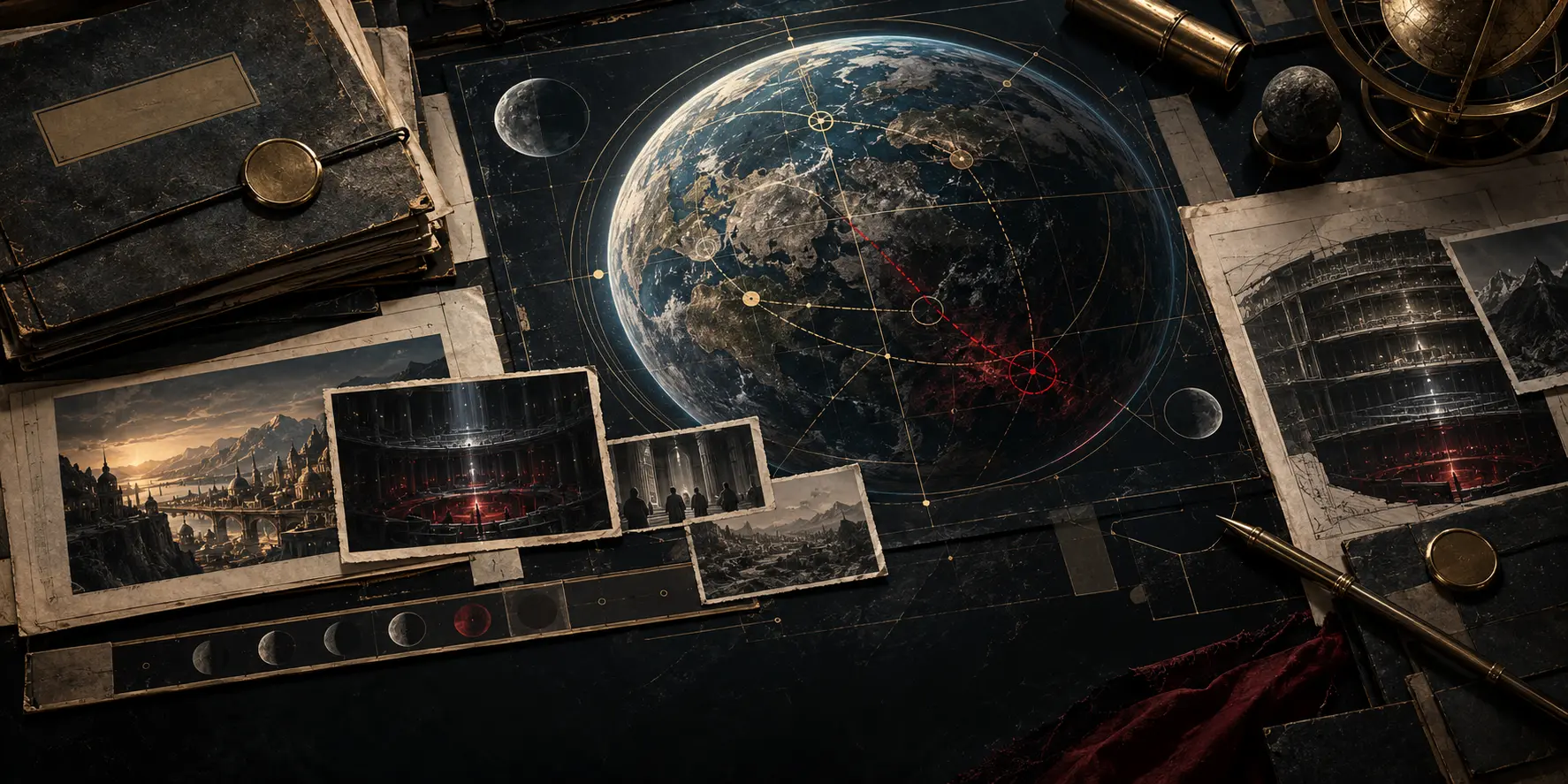
Interpretive still life of recovered records aligned against hidden-system evidence.

Recovered records held against the working evidence.

Story development tools

See how the authoring system turns ordinary language into finished story work.

The Project Explorer shows the live notes, decisions, and workshop used to develop Seeds of the Throne. Each step keeps confirmed decisions separate from suggestions and unanswered questions.

This is a public, read-only look at the real project, so it contains full spoilers. You can try the workshop, but your draft stays in this browser unless you export it.

  1. The author explains the story in ordinary language.

    The system records those ideas and separates confirmed decisions from suggestions and unanswered questions.

    Read how the system is designed
  2. The current workshop asks one consequential question at a time.

    Each question helps the author decide a missing cause, character choice, relationship, world rule, or event.

    Open a workshop question
  3. Accepted answers are added where they belong.

    An accepted decision can update character notes, the timeline, world rules, plot events, and the list of remaining questions.

    Review decisions and supporting information
  4. Use the completed plan to write and revise scenes.

    The planned system will create scene outlines, draft prose, check continuity, revise weak sections, and assemble the manuscript for the author's approval.

    Read the system plan

Seeds of the Throne is the working example. The notes, decisions, and workshop below are the live project, not a demonstration mockup.

Vault overview

See the whole story-development system at a glance.

605 notes work together as one system. The vault remembers where ideas came from, what the author decided, what remains uncertain, and what should happen next.

The vault turns conversations into organized story memory. It preserves sources, separates decisions from suggestions, finds missing connections, supports research and workshops, prepares scenes and prose, checks continuity, and publishes selected material without surrendering author control.

  • Working now Capture, memory, workshops, and research already operate.
  • Needs repair Current-state agreement, automatic checks, and decision updates still drift.
  • Planned next Durable answers, manuscript production, and mobile save are not built yet.
  1. Capture

    Conversations, mobile notes, and raw ideas are preserved.

  2. Understand

    Current context and compiled notes explain what the project means now.

  3. Decide

    Workshops ask one important question and preserve the author's answer.

  4. Develop

    Research, alternatives, story structure, and focused tests strengthen the work.

  5. Create

    Scene plans, prose, images, and manuscript material are produced for review.

  6. Share

    Selected material becomes the story site, Project Explorer, and public posts.

What lives where

Each area has a job. Folder names are secondary detail.

  • New material

    Preserves incoming ideas and the order in which they developed.

    00 Inbox, 01 Sessions

  • Story memory

    Keeps the detailed working knowledge and a smaller briefing used to resume work.

    02 Story, 03 Context

  • Research

    Separates questions, reports, and usable findings from story decisions.

    04 Research

  • Public work

    Holds reviewed material prepared for readers.

    05 Public

  • Drafts

    Holds scenes and manuscript candidates awaiting review.

    06 Draft

  • Decisions and direction

    Records choices, contradictions, current work, handoffs, and verification.

    07 QA, 07 Coordination

  • Development tools

    Diagnoses missing connections and tests possible story directions.

    08 Story Loop, 09 Story Exploration

  • Reusable methods

    Provides repeatable methods for writing, research, images, websites, and checks.

    skills, scripts

What already works, what needs repair, and what is still planned

Working well

  • Idea and session capture
  • Human-readable story memory
  • Author authority and decision boundaries
  • Research kept separate from story truth
  • Workshop questions that wait for an answer
  • Decisions, contradictions, and open questions
  • Visual identity and image controls
  • Markdown files and recoverable history
  • Searchable file access

Needs repair

  • One trustworthy current-state view
  • Automatic checks before a change is merged
  • Shared labels and stable record identifiers
  • Updating every affected note after a decision
  • Keeping the weekly cycle current
  • Clearer boundaries around older folders
  • A cleaner split between the repository and the live site

Planned next Not built yet

  • Durable integration of conversational answers
  • Automatic reports of what a decision would change
  • Complete scene-to-manuscript production
  • Manuscript assembly and export
  • Reliable mobile save, resume, and synchronization

The next build order

  1. Make builds and checks reliable.
  2. Create one trustworthy current state.
  3. Normalize the records for one small complete path.
  4. Connect accepted decisions to every affected file.
  5. Prove one complete path from conversation to approved manuscript material.
  6. Expand only after that path works.

Current story development

See what the story already has and what it still needs.

The system checks the whole story for missing causes, weak character decisions, unclear rules, and unfinished events. The results show the author what to work on next.

Current story premise

The colonization process trains participants and contains dangerous criminals.

Humanity developed the Luminai inside an interactive colonization environment. Sylvan and his Luminai are tested against Samuel Franklin, a criminal already held inside the containment process.

The current story problem Make the formal separation, rapid financial collapse, processing, exposure, and accepted placement feel inevitable.

Read the current story assessment

0 / 10major story problems resolved

Current development pass0%
0%
Current sweep
Reassessment
Current task
RW-01
  1. 01 Reassessment
  2. 02 Causal sequence
  3. 03 Character agency
  4. 04 Systems + evidence
  5. 05 Scene design
  6. 06 Draft

Story files

Browse the files used to develop the story.

Search 605 documents about the world, characters, plot, research, decisions, workshops, and earlier ideas.

Current document 02 Story/Systems/Visual Generation/PROMPT-SYSTEM.md

Prompt System

Compiler contract

The compiler must resolve identity, appearance state, era, surface layer, environment, technology, composition, image type, and render style before assembling a generation brief. image_type describes the purpose of the image; render_style describes its visual treatment. They are independent fields. The renderer receives the clean brief only. QA context is external.

Required resolution order: identity -> appearance timeline -> era packet -> environment master -> technology packet -> story beat -> composition mode -> clean brief.

If a load-bearing visual fact is missing, emit NEEDS DEFINITION rather than inventing it. See VISUAL-WORLD-COMPILER.

Source priority

When sources disagree, use this order:

  1. explicit current author instruction;
  2. established or working compiled story note with its status preserved;
  3. approved visual-registry identity master;
  4. approved supporting references;
  5. scene-specific creative variation;
  6. model invention only where the prompt explicitly permits it.

Do not let an attractive generated image override text canon or let an old composition override a current identity master.

Assembly architecture

Build the prompt as a production packet rather than one ornamental paragraph:

  1. Retrieval brief — files or story facts the model should retrieve from the vault.
  2. Identity lock — immutable human geometry and reference priority.
  3. Narrative instant — the change happening in this frame and what each subject wants.
  4. Physical behavior — movement, weight, gaze, hands, interaction, and incomplete action.
  5. World packet — era, place, materials, technology function, population, and environmental consequence.
  6. Composition modeKEY-ART, NARRATIVE-CINEMA, OBSERVATIONAL, or ORDINARY-LIFE; default story mode is NARRATIVE-CINEMA.
  7. Camera packet — shot, lens feel, camera relation, depth, obstruction, motion, and composition.
  8. Light and color — motivated sources, palette roles, atmosphere, and exposure logic.
  9. Continuity contract — preserve, deliberately vary, and forbid.
  10. Output contract — aspect ratio, frame count, duration if video, text policy, and metadata to retain.

The world packet must state the surface/hidden civilization decision explicitly. Advanced underlying infrastructure is not visible by default.

Copyable template

Identity: [name, age range, role, immutable face/body traits, reference priority]

Scene: [location, era, time, weather, immediate story beat]

Behavior: [action, blocking, gaze, hands, posture, interaction, emotional state shown physically]

World evidence: [technology, architecture, objects, people, distance, signs of the larger system]

Camera: [shot size, angle, lens feel, foreground, depth, composition, aspect ratio]

Light/material: [motivated light sources, color temperature, texture, atmosphere, motif]

Continuity: Preserve [immutable traits]. Vary [pose, wardrobe, expression, camera, lighting, background] as appropriate to this scene.

Avoid: [duplicate subjects, frozen reference pose, generic fashion shoot, plastic skin, malformed hands, unreadable text, accidental logos, costume/anatomy drift, over-symmetry].

Output: [still/sequence/video, aspect ratio, framing safety, text policy, required variants, metadata].

Variation contract

For reference-led generations, state both sides:

  • Preserve: facial geometry, age, body proportions, stable marks, and approved identity traits.
  • Regenerate: pose, camera, crop, wardrobe, expression, action, light, palette balance, environment, and composition unless the scene requires one of them.

Require at least three deliberate changes from the reference photograph. A useful line is: Use the reference to identify the person, not to reconstruct the source image. Preserve identity; regenerate the photograph.

Example: Sylvan discovers a new capability

Use Sylvan's approved identity master only as an identity anchor. Show him in an unfamiliar moon-infrastructure observation room at dawn, turning away from the display rather than posing for it, one hand resting on a real console while a second authenticated evidence stream appears in the glass. His expression is restrained surprise; the activity of his extended Luminai mind is suggested by a warm gold pattern integrated into his reflection and the responsive environment, never by a separate humanoid companion. Use a medium-wide cinematic frame, a slightly off-axis camera, foreground structure, deep environmental perspective, practical dawn light, cool mineral surfaces, and restrained antique gold. Preserve Sylvan's facial geometry, dark hair, beard, and calm physical presence; vary his clothing, stance, camera position, and lighting from the reference. Avoid poster composition, centered portrait posing, duplicate faces, a female AI figure, decorative text, and arbitrary new canon.

Example: Samuel under containment

Use Samuel's approved identity master only for identity. Show him mid-step in a failing command chamber as authenticated evidence severs the red authority network and containment officers enter from the side. His hands are empty and his body is trying to retain authority while the room visibly stops obeying him. Use a wide cinematic frame with practical emergency light, reflective black surfaces, crimson fragments, and a single antique-gold provenance line crossing the depth of field. Preserve age, facial structure, and crown-like authority cues; vary pose, camera, blocking, and environmental damage. Avoid a static villain portrait, repeated officers, readable interface text, and implying that the exact room is locked canon.