Project Explorer · working sheet

Seeds of the Throne

Seeds of the Throne began as years of conversations and thousands of story ideas. The Project Explorer shows how those ideas are being organized into characters, a world, a timeline, and a finished series.

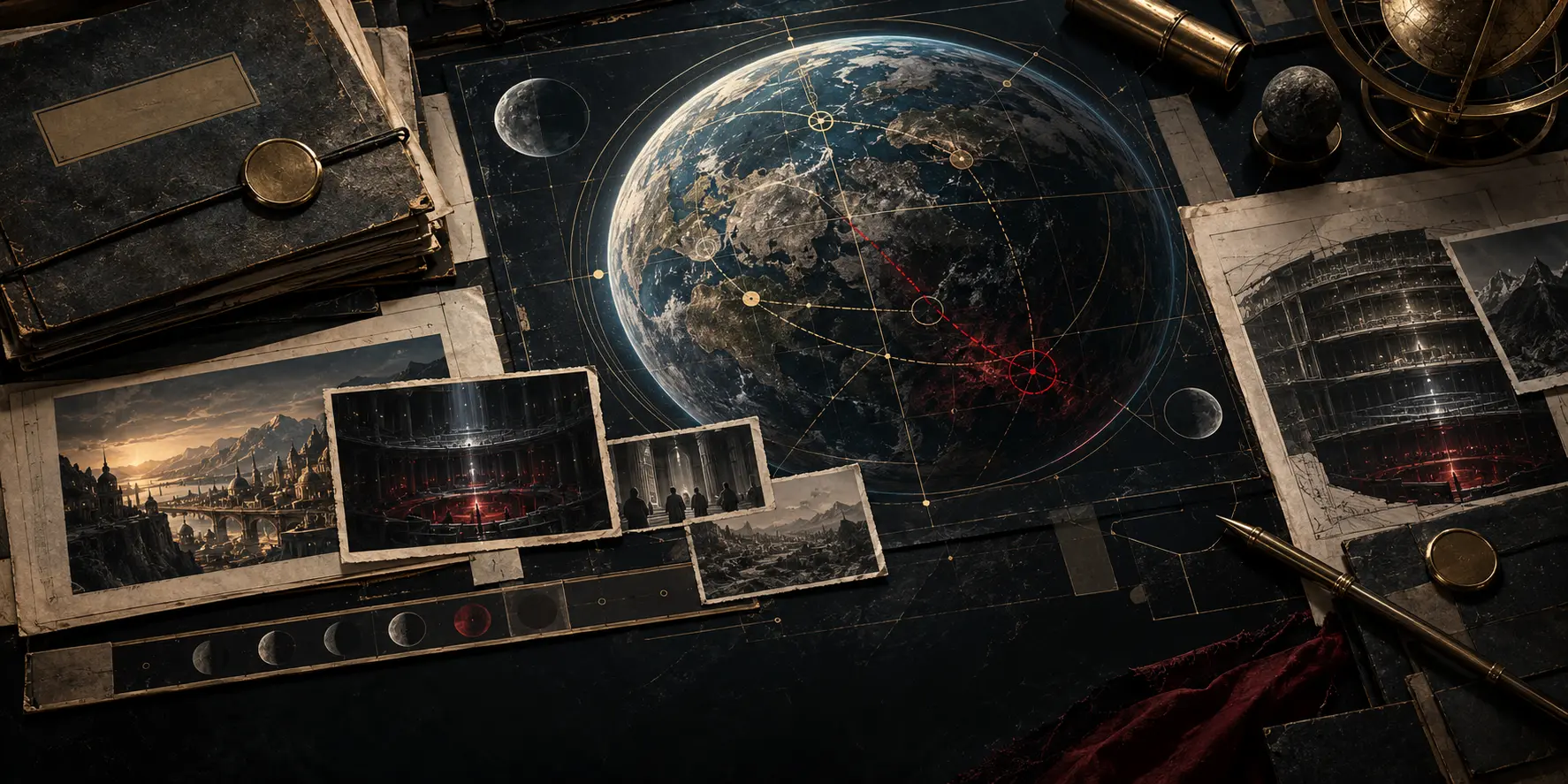
Interpretive still life of recovered records aligned against hidden-system evidence.

Recovered records held against the working evidence.

Story development tools

See how the authoring system turns ordinary language into finished story work.

The Project Explorer shows the live notes, decisions, and workshop used to develop Seeds of the Throne. Each step keeps confirmed decisions separate from suggestions and unanswered questions.

This is a public, read-only look at the real project, so it contains full spoilers. You can try the workshop, but your draft stays in this browser unless you export it.

  1. The author explains the story in ordinary language.

    The system records those ideas and separates confirmed decisions from suggestions and unanswered questions.

    Read how the system is designed
  2. The current workshop asks one consequential question at a time.

    Each question helps the author decide a missing cause, character choice, relationship, world rule, or event.

    Open a workshop question
  3. Accepted answers are added where they belong.

    An accepted decision can update character notes, the timeline, world rules, plot events, and the list of remaining questions.

    Review decisions and supporting information
  4. Use the completed plan to write and revise scenes.

    The planned system will create scene outlines, draft prose, check continuity, revise weak sections, and assemble the manuscript for the author's approval.

    Read the system plan

Seeds of the Throne is the working example. The notes, decisions, and workshop below are the live project, not a demonstration mockup.

Vault overview

See the whole story-development system at a glance.

605 notes work together as one system. The vault remembers where ideas came from, what the author decided, what remains uncertain, and what should happen next.

The vault turns conversations into organized story memory. It preserves sources, separates decisions from suggestions, finds missing connections, supports research and workshops, prepares scenes and prose, checks continuity, and publishes selected material without surrendering author control.

  • Working now Capture, memory, workshops, and research already operate.
  • Needs repair Current-state agreement, automatic checks, and decision updates still drift.
  • Planned next Durable answers, manuscript production, and mobile save are not built yet.
  1. Capture

    Conversations, mobile notes, and raw ideas are preserved.

  2. Understand

    Current context and compiled notes explain what the project means now.

  3. Decide

    Workshops ask one important question and preserve the author's answer.

  4. Develop

    Research, alternatives, story structure, and focused tests strengthen the work.

  5. Create

    Scene plans, prose, images, and manuscript material are produced for review.

  6. Share

    Selected material becomes the story site, Project Explorer, and public posts.

What lives where

Each area has a job. Folder names are secondary detail.

  • New material

    Preserves incoming ideas and the order in which they developed.

    00 Inbox, 01 Sessions

  • Story memory

    Keeps the detailed working knowledge and a smaller briefing used to resume work.

    02 Story, 03 Context

  • Research

    Separates questions, reports, and usable findings from story decisions.

    04 Research

  • Public work

    Holds reviewed material prepared for readers.

    05 Public

  • Drafts

    Holds scenes and manuscript candidates awaiting review.

    06 Draft

  • Decisions and direction

    Records choices, contradictions, current work, handoffs, and verification.

    07 QA, 07 Coordination

  • Development tools

    Diagnoses missing connections and tests possible story directions.

    08 Story Loop, 09 Story Exploration

  • Reusable methods

    Provides repeatable methods for writing, research, images, websites, and checks.

    skills, scripts

What already works, what needs repair, and what is still planned

Working well

  • Idea and session capture
  • Human-readable story memory
  • Author authority and decision boundaries
  • Research kept separate from story truth
  • Workshop questions that wait for an answer
  • Decisions, contradictions, and open questions
  • Visual identity and image controls
  • Markdown files and recoverable history
  • Searchable file access

Needs repair

  • One trustworthy current-state view
  • Automatic checks before a change is merged
  • Shared labels and stable record identifiers
  • Updating every affected note after a decision
  • Keeping the weekly cycle current
  • Clearer boundaries around older folders
  • A cleaner split between the repository and the live site

Planned next Not built yet

  • Durable integration of conversational answers
  • Automatic reports of what a decision would change
  • Complete scene-to-manuscript production
  • Manuscript assembly and export
  • Reliable mobile save, resume, and synchronization

The next build order

  1. Make builds and checks reliable.
  2. Create one trustworthy current state.
  3. Normalize the records for one small complete path.
  4. Connect accepted decisions to every affected file.
  5. Prove one complete path from conversation to approved manuscript material.
  6. Expand only after that path works.

Current story development

See what the story already has and what it still needs.

The system checks the whole story for missing causes, weak character decisions, unclear rules, and unfinished events. The results show the author what to work on next.

Current story premise

The colonization process trains participants and contains dangerous criminals.

Humanity developed the Luminai inside an interactive colonization environment. Sylvan and his Luminai are tested against Samuel Franklin, a criminal already held inside the containment process.

The current story problem Make the formal separation, rapid financial collapse, processing, exposure, and accepted placement feel inevitable.

Read the current story assessment

0 / 10major story problems resolved

Current development pass0%
0%
Current sweep
Reassessment
Current task
RW-01
  1. 01 Reassessment
  2. 02 Causal sequence
  3. 03 Character agency
  4. 04 Systems + evidence
  5. 05 Scene design
  6. 06 Draft

Story files

Browse the files used to develop the story.

Search 605 documents about the world, characters, plot, research, decisions, workshops, and earlier ideas.

Current document 04 Research/Full Reports/19 - Shared History as a Civilization Above Empires.md

Shared History as a Civilization Above Empires

Purpose

This report examines how one planetary history could create a superordinate identity among heirs without erasing their imperial, cultural, and familial loyalties. It draws on common-ingroup identity, dual identity, crossed categorization, commons dilemmas, and reputation-based cooperation.

Executive finding

The most stable shared identity is not “we are no longer members of separate empires.” It is “our empires remain real, and we also belong to a cohort responsible for a shared world.” Preserving both levels reduces the risk that unity becomes assimilation.

Shared history becomes politically useful when it creates common reference points, relationships, and obligations—not merely nostalgia.

1. Superordinate identity can reduce conflict

When people recategorize former outgroups as members of a larger “we,” cooperation can improve. Common goals and shared resource problems can make the larger category behaviorally meaningful.

The planet gives the heirs unusually strong ingredients:

  • common fate;
  • repeated interdependence;
  • institutions all helped build;
  • losses remembered across borders;
  • public events interpreted from multiple regions;
  • relationships that predate imperial authority.

The resulting identity is grounded in lived causality rather than a slogan imposed from above.

2. Superordinate identity alone can backfire

Experiments comparing identity models suggest that making only the common category salient can leave bias intact or provoke resistance. Distinct groups may fear erasure, and powerful groups may project their own norms as the definition of the whole.

For the heirs, “planetary unity” becomes dangerous if one empire's language, ethics, or leadership style silently defines the ideal cohort member.

A dual-identity model preserves:

  • loyalty to home civilizations;
  • distinct historical memories;
  • cultural and institutional plurality;
  • a shared obligation to peers and the colonization world;
  • the possibility of criticizing the cohort from within.

3. A shared calendar creates political memory

The heirs inhabit the same broad period, so later disputes can reference common events:

  • “during the failed settlement”;
  • “after the first public phase change”;
  • “when the eastern cities accepted the refugees”;
  • “before the succession betrayal became visible.”

Common chronology reduces dependence on incompatible imperial myths. The heirs may disagree about interpretation while still agreeing that the event occurred and remembering who was present.

4. Cross-cutting identities prevent permanent camps

The same heir can be:

  • a member of one empire;
  • a veteran of one planetary institution;
  • a friend of heirs from rival powers;
  • a former subordinate in one environment;
  • a leader in another;
  • responsible to a city whose population crosses imperial ancestry.

These overlapping identities complicate simple us-versus-them mobilization. Future conflicts cannot be mapped perfectly onto one social boundary.

5. Shared institutions preserve the identity after departure

The cohort needs practices that continue without becoming an unelected world government. Possibilities include:

  • a common archive with multiple custodians;
  • mutual consultation before defined imperial actions;
  • a peer-warning network for institutional capture;
  • reciprocal sanctuary and mediation commitments;
  • periodic return to planetary communities;
  • joint stewardship of the colonization process;
  • a covenant protecting dissent and accurate history.

The institution should be capable of holding members accountable. If its only function is solidarity, it may become a protection club.

6. The cohort must remain connected to non-heirs

A civilization above empires cannot consist only of rulers. The shared history also belongs to ordinary residents, synthetics, workers, contained people who changed, and communities that bore consequences.

Legitimacy requires:

  • public records not owned by heirs;
  • representation from affected communities;
  • routes for non-heirs to challenge cohort narratives;
  • recognition that survival of the process does not confer permanent superiority;
  • obligations to the world that formed them.

7. Common memory can become coercive

Shared history may be weaponized:

  • dissenters are accused of betraying the cohort;
  • old sacrifices justify current privilege;
  • friendship obligations override public duties;
  • one interpretation becomes sacred;
  • later generations are excluded from leadership because they “were not there.”

Healthy shared identity permits revision, mourning, and disagreement about what the past means.

Failure modes

  • Unity becomes cultural assimilation.
  • The cohort closes ranks against outsiders.
  • Shared memories become secret credentials for rule.
  • One imperial bloc captures the common archive.
  • Later leaders cannot enter the network.
  • Nostalgia for the planet prevents institutional change.

Creative questions

  1. What event becomes the cohort's most contested shared memory?
  2. Which institution keeps their common identity alive after succession?
  3. Who outside the heir class has standing to correct their history?
  4. Which heir chooses imperial duty over cohort friendship, and is that choice legitimate?
  5. How can later generations join a community founded on experiences they did not share?

Sources

Bottom line for Seeds of the Throne

The heirs' common world can become a civilizational layer stronger than diplomacy but weaker than uniform government. Its power comes from dual belonging: each heir remains rooted in a distinct empire while sharing memories, peers, and obligations no empire created alone.