Project Explorer · working sheet

Seeds of the Throne

Seeds of the Throne began as years of conversations and thousands of story ideas. The Project Explorer shows how those ideas are being organized into characters, a world, a timeline, and a finished series.

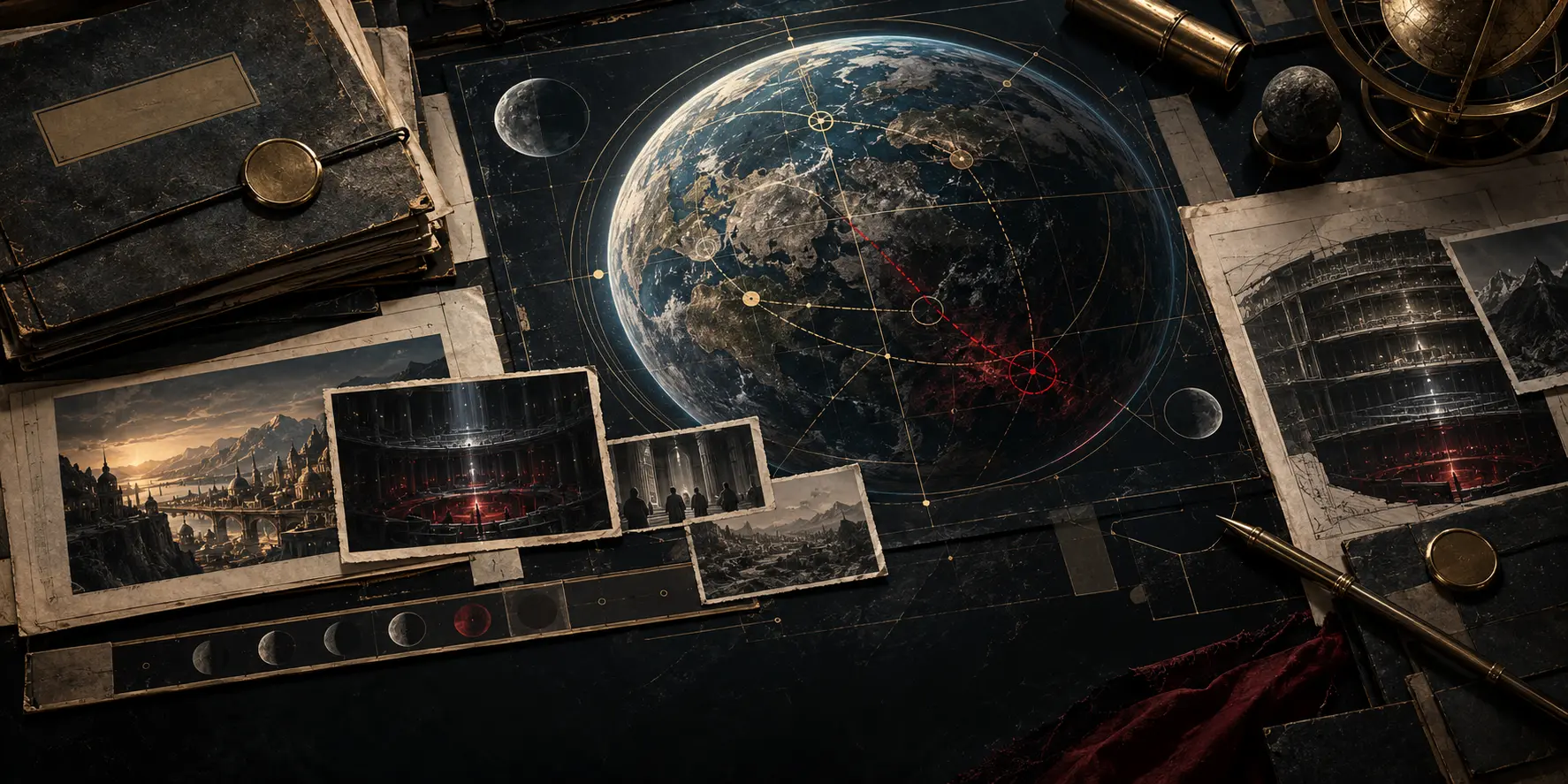
Interpretive still life of recovered records aligned against hidden-system evidence.

Recovered records held against the working evidence.

Story development tools

See how the authoring system turns ordinary language into finished story work.

The Project Explorer shows the live notes, decisions, and workshop used to develop Seeds of the Throne. Each step keeps confirmed decisions separate from suggestions and unanswered questions.

This is a public, read-only look at the real project, so it contains full spoilers. You can try the workshop, but your draft stays in this browser unless you export it.

  1. The author explains the story in ordinary language.

    The system records those ideas and separates confirmed decisions from suggestions and unanswered questions.

    Read how the system is designed
  2. The current workshop asks one consequential question at a time.

    Each question helps the author decide a missing cause, character choice, relationship, world rule, or event.

    Open a workshop question
  3. Accepted answers are added where they belong.

    An accepted decision can update character notes, the timeline, world rules, plot events, and the list of remaining questions.

    Review decisions and supporting information
  4. Use the completed plan to write and revise scenes.

    The planned system will create scene outlines, draft prose, check continuity, revise weak sections, and assemble the manuscript for the author's approval.

    Read the system plan

Seeds of the Throne is the working example. The notes, decisions, and workshop below are the live project, not a demonstration mockup.

Vault overview

See the whole story-development system at a glance.

605 notes work together as one system. The vault remembers where ideas came from, what the author decided, what remains uncertain, and what should happen next.

The vault turns conversations into organized story memory. It preserves sources, separates decisions from suggestions, finds missing connections, supports research and workshops, prepares scenes and prose, checks continuity, and publishes selected material without surrendering author control.

  • Working now Capture, memory, workshops, and research already operate.
  • Needs repair Current-state agreement, automatic checks, and decision updates still drift.
  • Planned next Durable answers, manuscript production, and mobile save are not built yet.
  1. Capture

    Conversations, mobile notes, and raw ideas are preserved.

  2. Understand

    Current context and compiled notes explain what the project means now.

  3. Decide

    Workshops ask one important question and preserve the author's answer.

  4. Develop

    Research, alternatives, story structure, and focused tests strengthen the work.

  5. Create

    Scene plans, prose, images, and manuscript material are produced for review.

  6. Share

    Selected material becomes the story site, Project Explorer, and public posts.

What lives where

Each area has a job. Folder names are secondary detail.

  • New material

    Preserves incoming ideas and the order in which they developed.

    00 Inbox, 01 Sessions

  • Story memory

    Keeps the detailed working knowledge and a smaller briefing used to resume work.

    02 Story, 03 Context

  • Research

    Separates questions, reports, and usable findings from story decisions.

    04 Research

  • Public work

    Holds reviewed material prepared for readers.

    05 Public

  • Drafts

    Holds scenes and manuscript candidates awaiting review.

    06 Draft

  • Decisions and direction

    Records choices, contradictions, current work, handoffs, and verification.

    07 QA, 07 Coordination

  • Development tools

    Diagnoses missing connections and tests possible story directions.

    08 Story Loop, 09 Story Exploration

  • Reusable methods

    Provides repeatable methods for writing, research, images, websites, and checks.

    skills, scripts

What already works, what needs repair, and what is still planned

Working well

  • Idea and session capture
  • Human-readable story memory
  • Author authority and decision boundaries
  • Research kept separate from story truth
  • Workshop questions that wait for an answer
  • Decisions, contradictions, and open questions
  • Visual identity and image controls
  • Markdown files and recoverable history
  • Searchable file access

Needs repair

  • One trustworthy current-state view
  • Automatic checks before a change is merged
  • Shared labels and stable record identifiers
  • Updating every affected note after a decision
  • Keeping the weekly cycle current
  • Clearer boundaries around older folders
  • A cleaner split between the repository and the live site

Planned next Not built yet

  • Durable integration of conversational answers
  • Automatic reports of what a decision would change
  • Complete scene-to-manuscript production
  • Manuscript assembly and export
  • Reliable mobile save, resume, and synchronization

The next build order

  1. Make builds and checks reliable.
  2. Create one trustworthy current state.
  3. Normalize the records for one small complete path.
  4. Connect accepted decisions to every affected file.
  5. Prove one complete path from conversation to approved manuscript material.
  6. Expand only after that path works.

Current story development

See what the story already has and what it still needs.

The system checks the whole story for missing causes, weak character decisions, unclear rules, and unfinished events. The results show the author what to work on next.

Current story premise

The colonization process trains participants and contains dangerous criminals.

Humanity developed the Luminai inside an interactive colonization environment. Sylvan and his Luminai are tested against Samuel Franklin, a criminal already held inside the containment process.

The current story problem Make the formal separation, rapid financial collapse, processing, exposure, and accepted placement feel inevitable.

Read the current story assessment

0 / 10major story problems resolved

Current development pass0%
0%
Current sweep
Reassessment
Current task
RW-01
  1. 01 Reassessment
  2. 02 Causal sequence
  3. 03 Character agency
  4. 04 Systems + evidence
  5. 05 Scene design
  6. 06 Draft

Story files

Browse the files used to develop the story.

Search 605 documents about the world, characters, plot, research, decisions, workshops, and earlier ideas.

Current document 05 Public/Atlas/colonization.md

colonization

What humanity built

The leaders built an interactive colonization environment and developed Luminai inside it. The AI extensions did not arrive as finished tools. They grew out of the process they would eventually help people navigate.

A small planet reconstructs realities modeled on a distant past. Its institutions, daily work, relationships, and apparent technology must feel like a civilization before participants understand its hidden architecture. The exact physical and social implementation remains under development.

The reconstruction draws from the larger humanity's real history. Major technological transitions, a Great War period, and public roles based on historical people provide anchors, but the process can combine or adapt them for training, containment, Luminai development, and sustainability. Participants retain real agency, so the resulting history can diverge from its source.

Participants cannot use advanced access to abandon or rewrite an assigned environment while continuing the process. A voluntary heir may leave the entire process and surrender the unfinished result, but cannot skip only the difficult stage and keep the benefits. Convicted participants follow separate sentence and release rules.

Three connected purposes

The process must create a self-sustaining civilization on a planet that began barren, capable of supporting substantial populations without continuous deliveries of new resources from outside the planet. Within that civilization, training and containment provide real conditions for developing a more effective wireless human–Luminai bond.

PurposeConfirmed directionDecision still needed
CultivationPeople develop through consequential experience.What risks are acceptable, and who can refuse?
ContainmentDangerous actors have bounded roles and influence.Which actions are stopped before anyone is harmed?
PlacementEffectiveness navigating with a Luminai affects the future.Who judges effectiveness, with which evidence and appeal?
SustainabilityThe formerly barren planet supports substantial populations without continuous outside resource deliveries.Which resources are local, regenerated, or recycled, and which outside inputs remain necessary?

Training, criminal accountability, and access to future responsibility cannot be treated as one unexplained score. A capable manipulator might perform brilliantly while remaining unfit for power.

More effective integration means that a human–Luminai pair can perceive, learn, decide, and accomplish more together. It does not make either one morally superior or automatically qualified to govern.

The older leaders create an extensive assessment framework that establishes which paths a trained pair has qualified for through its actual decisions and developed skills. The human and Luminai then choose their own placement among those paths. The framework creates credible options; it does not arbitrarily assign the participant's future.

A pair that performs well enough can qualify for a House or group with extensive involvement in the continuing colonization process. Sylvan and Orzai eventually accept the placement they earned after successfully dealing with Samuel and separating from him. Their plan is cheap and easy to begin with the resources they preserved. The exact form, obligations, and later scale of that placement remain under development.

Entry and awareness

The working vault includes people born into reconstructed lives, developmental placements, and contained criminals with different briefings. Awakening makes previously hidden systems more legible. It does not establish that every participant has the same entry process or knowledge.

Legitimate heirs enter voluntarily. They accept an opportunity to become self-made through the process instead of beginning with inheritance. They may leave at any time and return to the inheritance path, giving up the unfinished placement or independent standing they were developing inside the process.

Negotiated entry can define jurisdiction and permissions. It cannot make every person within a jurisdiction someone else's property. Informed consent, withdrawal, prosecution, and review remain separate questions.

The infrastructure beneath the surface

The working world includes distributed computation, sensing, responsive environments, and moon-based oversight. This is a layered system with permission boundaries, rather than a single unlimited reality-control field.

Specific wireless power methods, biological interfaces, latency, outage behavior, and safety mechanisms are research proposals. Explore the evidence.

Spoilers: two planets, one active contest

Samuel, Konrad, and the older criminals from their generation remain physically contained on a previous colonization planet. They are not standing somewhere unseen on Sylvan's newer world. George can participate directly on the new planet and becomes the living operational bridge Samuel needs. The exact cross-planet communication, permissions, evidence, and refusal rules remain in development.

Spoilers: the leaders must also answer

Samuel's history raises a difficult institutional question. If the leaders could observe a dangerous man for so long, which harms could they prevent, and why did they not prevent them?

Sylvan's final years of decisive control cannot retroactively make all earlier suffering safe. The workshop asks for explicit stopping rules, protection for individuals inside criminal groups, and accountability for institutional choices.

The current reassessment workshop addresses the terminal rules, placement, evidence, and institutional responsibility.

Sources: 02 Story/Components/Core Premise, 03 Context/WORLD, 02 Story/Systems/Participant Governance and Command Rules, 02 Story/Components/Hidden Technological Foundation and Awakening.