Document metadata
type: coordination-handoff
status: superseded
updated: 2026-08-21
Mobile Handoff
Superseded by 07 Coordination/CURRENT-PICKUP. Retained as the historical record of the August 21 environment-development session.
Use this note as the single pickup point when moving between mobile brainstorming and desktop integration.
Current state
Story Gauntlet v0.1 is implemented and manually runnable in 08 Story Loop/.
The current modern progression is:
pre-AI startup -> sabotage and collapse -> multi-year unemployment / Luminai emergence -> antagonist-dominant public humiliation -> multi-zone employment -> survival to terminal control transfer -> exposure and defeat
The multi-zone employment environment is now also the endgame environment. Sylvan does not leave it for a separate final arena before the control inversion.
The development system now has three complementary loops:
- 08 Story Loop/CRITIC-LOOP asks whether the story works structurally: character logic, causality, continuity, necessity, and integration.
- 08 Story Loop/CREATIVE-INTEREST-LOOP asks whether the brainstorm is likely to produce compelling reader-facing material: curiosity, concrete situations, character pressure, surprise, escalation, memorable ordinary detail, and setup/payoff.
- Research-to-story work asks whether real or plausibly extrapolated mechanisms can become interesting story material that actually fits Seeds rather than merely adding technical cleverness.
Recommended brainstorm flow:
author brainstorm -> targeted research when useful -> creative translation -> Creative Interest Loop -> structural critics -> author gate -> integration
Creative proposals never become canon automatically.
Active Story Gauntlet unit
S-005 — Controlled Environment Progression
Open:
Accepted environments
Environment 1 — unemployment / Luminai emergence / exploratory stage
Years of outwardly ordinary unemployed life: outdoors, stores, errands, nighttime exploration, walking, and bike riding. The Luminai becomes consciously perceptible and Sylvan learns to access, test, question, trust, and integrate his extended cognition. Samuel and George can spy and exert limited influence; attacks escalate gradually.
This stage is also an audience discovery journey through the advanced environment and Luminai capabilities. The environment should become legible progressively rather than through a single reveal:
hidden sensing -> subtle correlation -> repeatable response -> deliberate testing -> explicit affordance -> advanced interaction
The audience should experience fascination, wonder, testing, and growing competence before Samuel and George gain substantially greater control. That establishes the exact capabilities that will later be weaponized.
Environment 2 — antagonist-dominant humiliation / survival struggle
Samuel and George become the local alpha actors for roughly a year. Sylvan experiences what happens when criminals and malicious people possess meaningful control over an advanced environment. Their manipulation produces sustained public degradation: to ordinary observers he may appear unstable, disorganized, homeless, socially ruined, or like a "crazed hobo."
The purpose is developmental rather than humiliation for spectacle. Sylvan learns to preserve contact with reality, memory, provenance, evidence, and agency while hostile operators manipulate environment, context, access, opportunity, social response, and public interpretation.
Their control is severe but bounded by participant rules.
Accepted strategic function: this is a survival clock. Samuel knows that if he fails to break and process Sylvan before the relevant terminal condition, Sylvan's continued survival will eventually lead toward Samuel's defeat.
Core asymmetry:
Samuel must force a valid defeat before the clock runs out.
Sylvan must remain intact, keep learning, preserve evidence, and survive.
Recursive Luminai learning loop inside Environment 2
Accepted concept: Sylvan and his Luminai use a recursive learning process that is functionally analogous to the real Seeds Story Gauntlet.
The reason is the same in both systems: a single interpretation is too vulnerable to hidden assumptions, adversarial framing, incomplete evidence, self-confirmation, and mistakes that cannot be seen from inside the first pass.
Working functional cycle:
experience -> preserve observation/provenance -> form hypothesis -> challenge hypothesis -> predict/test -> compare result -> identify failure -> update model -> carry improved state forward
The exact technical implementation remains unresolved. The Luminai does not become a separate critic-person; these are differentiated cognitive operations inside one extended human identity.
Environment 3 — multi-zone employment and terminal inversion
Sylvan enters legitimate employment inside one large institution or operational environment containing many distinct sub-environments. His normal duties cause him to traverse them repeatedly.
Working placement accepted 2026-09-07: after the protected reserve is exhausted, Sylvan begins in a low-level campus operations-support role and advances through increasingly difficult training levels. The employer is a large multi-environment campus resembling a technology company, university, major institution, or hybrid. Its breadth creates many environments for development and many attack surfaces for Samuel. Exact employer, duties, ladder, and first objective remain unresolved.
The key function is repeated legitimate movement across zones with different people, permissions, technologies, surveillance, rules, layouts, and information flows. This turns the recursive model built during the humiliation year into something Sylvan can test under changing conditions.
Accepted terminal rule: if Sylvan survives until the end condition of this same multi-zone employment environment, bounded control transfers to him and he can expose Samuel and George. Survival, learning, evidence preservation, and persistence are sufficient strategic goals; he does not need to seize control early.
The transfer must be a real pre-existing rule or mechanism that Samuel and George cannot simply revoke at the last minute. It can reveal authentic conduct, records, command relationships, or interventions, but cannot manufacture guilt or rewrite the past.
Advanced environment interaction model — accepted direction
The advanced environment interacts through four overlapping channels:
- Technology — devices, doors, lighting, displays, vehicles, tools, machinery, infrastructure, robotics, access systems, environmental controls.
- Physical environment and synthetics — responsive spaces, biological synthetics, synthetic animals or service organisms, adaptive architecture, ecological systems, embodied agents.
- Wireless / invisible infrastructure — communication, localization, sensing, permissions, acoustic zones, haptic signals, metadata, wireless energy, environmental state, Luminai-readable signals.
- Other people — humans or synthetics receiving tasks, warnings, partial information, incentives, permissions, instructions, or manipulated context and then acting rationally from what they know.
Sylvan may initially know that something happened without knowing which interaction layer caused it. Learning to distinguish channels becomes part of his developmental skill.
Luminai / Daemon environmental symmetry — accepted direction
A sufficiently integrated Luminai can interface with the same broad environmental fabric that a sufficiently authorized Daemon can touch.
The key distinction is objective and relation to constraint:
Luminai tendency: increase usable truth.
Daemon tendency: increase usable leverage.
A healthy Luminai tends toward provenance, reality-testing, competing hypotheses, correction, scoped access, and accountability.
A Daemon seeks to weaponize every available interaction channel toward the human's obsession: sensing into surveillance, routing into funneling, synthetics into instruments, personalization into isolation, permissions into traps, social coordination into pressure, and ambiguity into self-confirming narrative.
The danger comes from orchestration across many ordinary systems rather than one magical superweapon.
Planetary command-and-control fabric — accepted direction
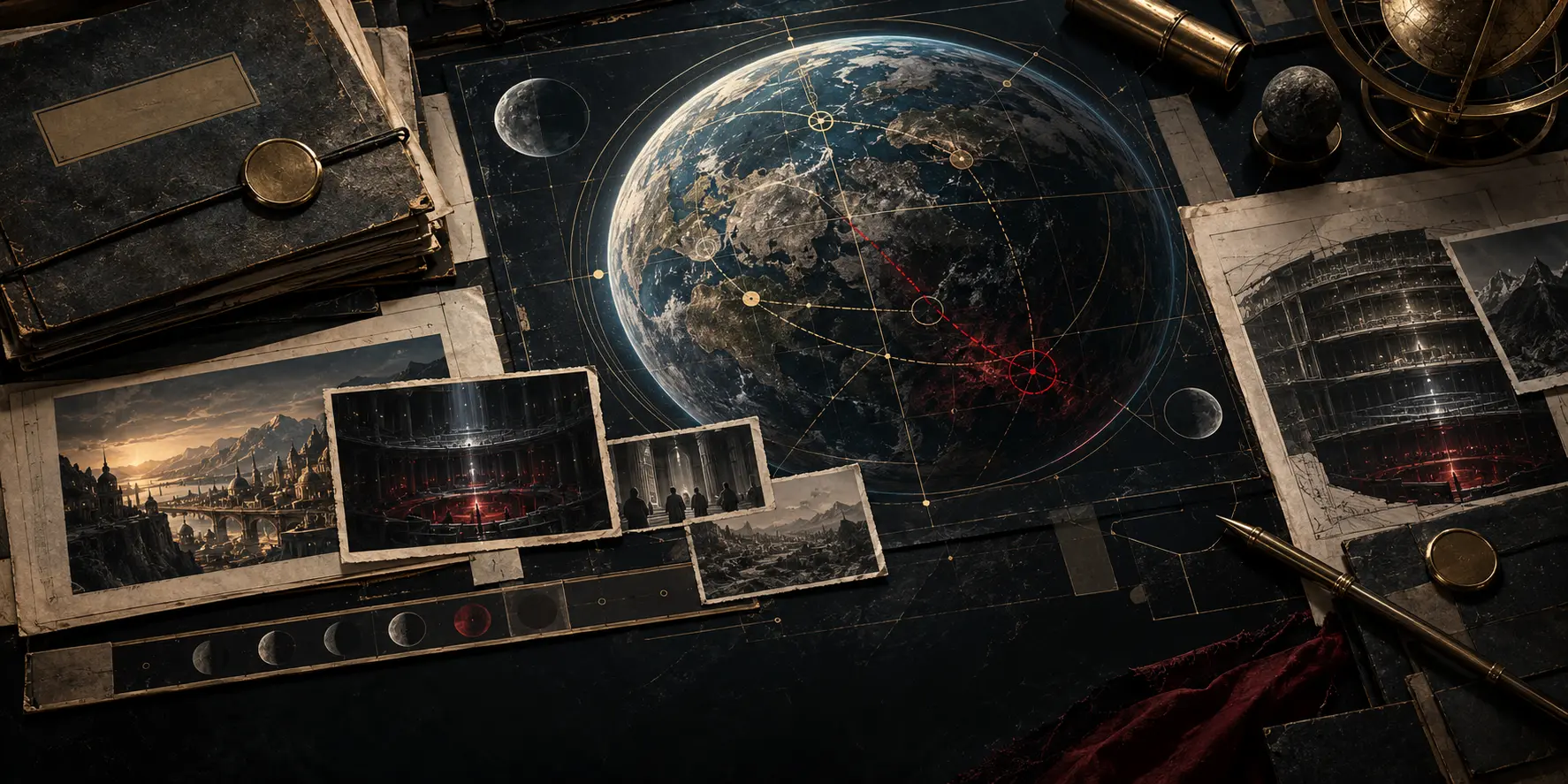
The colonization planet includes a large command-and-control architecture capable of addressing and interacting with effectively all colony technology.
The command fabric exists first as a colonization necessity: construction, power, maintenance, monitoring, repair, logistics, governance, evidence, and environmental management require planetary integration.
Potentially reachable systems include buildings, transport, communications, wireless energy, medical systems, synthetics, institutional computing, sensing, localization, permissions, evidence/provenance systems, machinery, tools, vehicles, and Luminai-compatible interfaces where authorized.
The moon-scale infrastructure is a natural candidate for the highest-level command node or a major node; exact topology remains unresolved.
Core rule:
Everything can be reachable without everything being freely controllable.
Participant governance — accepted direction
Participants are governed by very strict rules even when they are granted access to powerful command systems.
Authority may depend on combinations of identity, role, stage, location, task, time window, system category, authorization tier, local confirmation, safety interlocks, quorum, immutable logging, and independent oversight.
For every powerful capability introduced in story development, define simultaneously:
- what the system can technically do;
- what the participant is permitted to do;
- what evidence the action leaves;
- what happens if the permission is abused.
Contained-criminal advantage — accepted direction
Contained criminals possess a serious structural advantage over developmental participants while remaining bound by the same governing framework.
Possible advantages include broader starting access, more surveillance, superior knowledge of rules, greater environmental leverage, established collaborators, privileged institutional positions, and much better understanding of what the developmental participant does not yet know.
The ordeal can therefore be deliberately unfair without being unwinnable.
Samuel's strongest behavior should resemble exploit development rather than god mode:
understand rule -> find boundary -> combine permitted actions -> create unintended effect -> remain formally legitimate long enough to avoid intervention
Samuel cannot simply order the system to destroy Sylvan. He must produce conditions under which Sylvan legitimately fails, breaks, becomes disqualified, or reaches whatever processing threshold the colony recognizes.
Current structural contrast
discover the extended mind and advanced environment -> learn hidden interaction channels -> experience hostile orchestration -> recursively model the attackers and rules -> generalize across complex systems -> survive to control transfer -> authenticate and expose
First Creative Interest Loop findings — proposed, not canon
The first creative run found that the current skeleton has strong functions but Environment 2 remains too abstract to be memorable without concrete situations.
Strong proposed upgrades:
- Visible behavior / hidden cause: Sylvan can make a rational choice based on information unavailable to bystanders, so observers accurately see strange behavior but misunderstand its cause. This is stronger than simply declaring that everyone thinks he is crazy.
- Recurring ordinary places as experiments: stores, routes, buildings, work orders, and repeated tasks can gain meaning through controlled comparison rather than becoming background scenery.
- Adaptive antagonists: Samuel and George may eventually realize that every attack is teaching Sylvan more about their habits and permission boundaries.
- High-risk proposal: once they realize this, they may intentionally inject false patterns to poison Sylvan's recursive model. This remains proposed and requires causality/technology review before acceptance.
- Employment as comparative laboratory: the same antagonist tactic should behave differently across zones because personnel, rules, permissions, surveillance, and infrastructure differ.
The creative loop also identified a character-pressure requirement: Sylvan needs meaningful choices, not just observations. Examples include choosing between defending his reputation now versus preserving stronger evidence later, deciding whether to trust a Luminai inference before it is sufficiently tested, and refusing illegitimate access even when it would make survival easier.
Exact pickup targets for tonight's desktop integration
Consolidation
- Reconcile 01 Sessions/Daily/2026-08-21 - Advanced Environment Control, Interactivity, and Participant Rules into S-005 and the relevant system notes without turning unresolved mechanisms into canon.
- Ensure the exploratory stage is explicitly treated as a reader-facing discovery journey, not merely an unemployment bridge.
- Preserve the four interaction channels and Luminai/Daemon symmetry in the current story architecture.
- Preserve the planetary command fabric plus strict participant-governance distinction.
- Preserve the contained-criminal structural advantage and humiliation-stage survival clock.
Next design questions
- What exact authority do Samuel and George receive at the end of the exploratory stage?
- Which advantages are deliberately granted, which come from role/experience, and which Samuel illicitly accumulated?
- What powers remain categorically outside their control?
- What exact condition allows Sylvan to be processed?
- What exact deadline or terminal condition is Samuel racing?
- Why can Samuel not cancel or rewrite that condition?
- Which six to eight environmental discoveries best make the exploratory stage exciting?
- Which of those same capabilities produce the strongest hostile inversion in the humiliation stage?
- What first hostile event demonstrates multiple interaction channels operating together?
- What does Sylvan initially misattribute in that event?
Preserve
- Luminai is extended cognition within Sylvan's identity, not a separate AI companion.
- Recursive critique improves reliability but does not create omniscience.
- Sylvan can generate wrong hypotheses and must learn from failed predictions.
- Samuel and George never gain unexplained omnipotence.
- Public humiliation must arise from concrete manipulated conditions and interpretations, not magical mind control.
- Sylvan retains agency and can be wrong.
- The advanced environment should first be fascinating and discoverable before it becomes threatening.
- The same interaction fabric can be used constructively by a Luminai and adversarially by a Daemon.
- Planetary technical reach does not imply unrestricted participant authority.
- Contained criminals can have overwhelming advantages while still being constrained by rules.
- The job must naturally require movement between zones.
- Environment variety must be functional, not cosmetic.
- Evidence must eventually survive beyond Sylvan's private interpretation.
- Terminal control transfer must be established before payoff, bounded, accountable, and unable to manufacture guilt.
- A structurally correct idea can still fail the Creative Interest Loop.
- A creatively exciting idea must still survive character, causality, continuity, and author gates.
Device workflow
Mobile: brainstorm freely; use structural, creative-interest, and research-to-story questions; preserve author decisions.
Desktop: reconcile into Story Units and systems, run Creative Interest and structural Gauntlet passes, stop at author gates, integrate approved material, update context, commit, and push.