Document metadata
type: prose-development-technique
status: active
updated: 2026-09-17
scope: canon development and later narrative construction
Converging Revelation
Definition
A converging revelation begins with facts that appear related but separate: an accepted history, a private motive, an old warning, an enabling decision, a false belief, a present crisis, and a piece of verified evidence.
The passage draws them together until the audience discovers that they are expressions of the same hidden action.
The ending does not introduce the real story. It reveals that the real story has been present in every earlier fact.
This technique fits Seeds of the Throne because the story depends on false histories, concealed continuities, partitioned evidence, recurring control, and characters who survive by preventing related truths from becoming one conclusion.
Samuel–Konrad working example
- Accepted history: Samuel used his advantage to humiliate Konrad's group after the Great War.
- Private motive: Samuel envied Konrad's spectacular public presence and the divinity Konrad built around it.
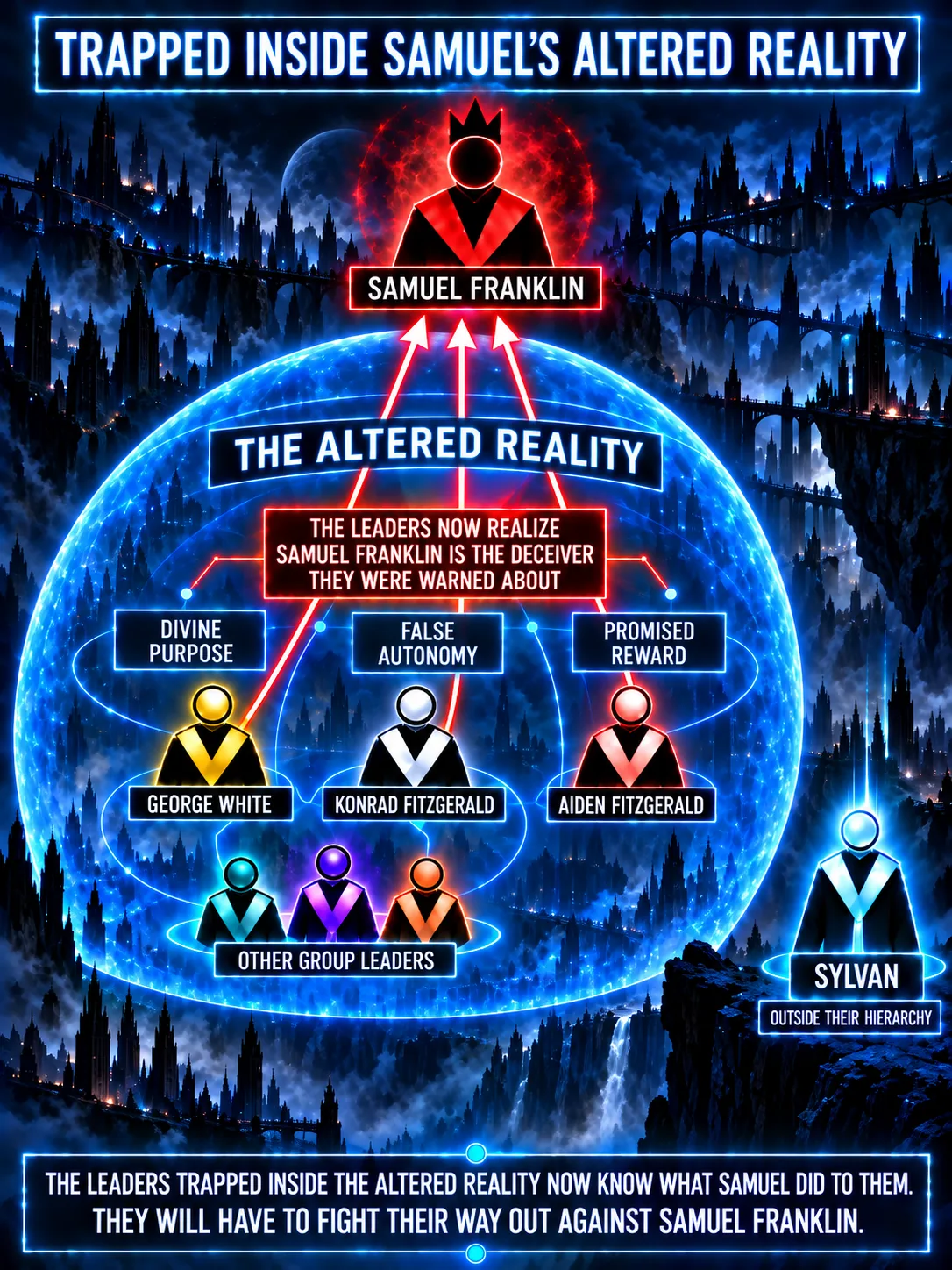
- Enabling decision: Konrad ignored warnings and reactivated his group's programs inside containment.
- False belief: Konrad believed the restored group was separate and autonomous.
- First reversal: Samuel's alpha priority or access never ended in the way Konrad believed.
- Present crisis: the Resistance reconstructs verified evidence, and Sylvan needs Konrad to shut down the compromised programs.
- Final convergence: the postwar advantage and the attack on the group's sacred initiative may be one uninterrupted act.
The strong reveal is not “Samuel also sabotaged the program.” It is:
Konrad tried to rebuild outside Samuel's control. The rebuilding may have been the act that placed what he considered sacred inside Samuel's reach.
Construction method
1. Write the reinterpretation first
State the final connection in plain language.
The power used in the old victory is the same power operating in the present crisis.
2. Divide it into separate facts
Use four to seven elements:
- public history;
- private motive;
- warning;
- choice;
- false organizing belief;
- present consequence;
- verified evidence.
3. Assign knowledge asymmetrically
Decide who knows each fact, who suspects the connection, who has proof, and who benefits from keeping the evidence separate.
4. Give the false account coherence
The deceived character needs a complete interpretation, not simple stupidity. Konrad's working false interpretation is that his group regained autonomous control after the Great War.
5. Make attempted recovery enable the threat
The character's effort to recover should create the access, dependency, or permission the hidden actor needs.
6. Attach the past to a present decision
Evidence must require action. In the working example, Sylvan needs Konrad to shut the programs down.
7. End when the facts converge
Do not explain the revelation again after it lands.
Drafting rules
- Begin with something the audience thinks it understands.
- Reveal motive before the complete mechanism.
- Let each paragraph answer one question and create the next.
- Repeat a key phrase only when its meaning changes.
- Keep the facts clear even while their connection remains hidden.
- Preserve one indispensable fact for the final movement.
- Make the method of the hidden action express character.
- Stop after the final reinterpretation.
Canon-generation rule
This technique can generate candidate causal links, but polish does not establish canon. Every output must label claims as established, working, proposed, unresolved, or rejected. A new mechanism remains proposed until the author accepts it and its consequences are propagated through the vault.
Evaluation
Ask:
- What does the audience believe at the beginning?
- What motive makes the eventual target inevitable?
- Which decision unknowingly enables the hidden action?
- Which facts have been kept separate?
- Who verifies the connection?
- What action does the discovery require now?
- Does the ending change the meaning of at least three earlier facts?
- Is the reveal predictable in retrospect without being obvious in advance?
- Is denial grounded in a specific psychological or political cost?
- Does the passage stop after the connection lands?
If the ending adds a secret but does not reinterpret earlier facts, it is not yet a converging revelation.
Generation prompt
Develop this Seeds of the Throne idea using the Converging Revelation technique. Begin with an accepted history or apparently understood conflict. Introduce the hidden actor's personal motive before revealing the complete mechanism. Divide the truth among several people, records, or systems. Give one character a coherent false interpretation that allows the facts to remain separate. Connect the historical deception to a decision required in the present. End with one revelation that joins the old event, the attempted recovery, and the current danger into one continuous action. The ending must reinterpret earlier details rather than merely add another secret. Label every newly generated story claim by canon status.