Project Explorer · working sheet

Seeds of the Throne

Seeds of the Throne began as years of conversations and thousands of story ideas. The Project Explorer shows how those ideas are being organized into characters, a world, a timeline, and a finished series.

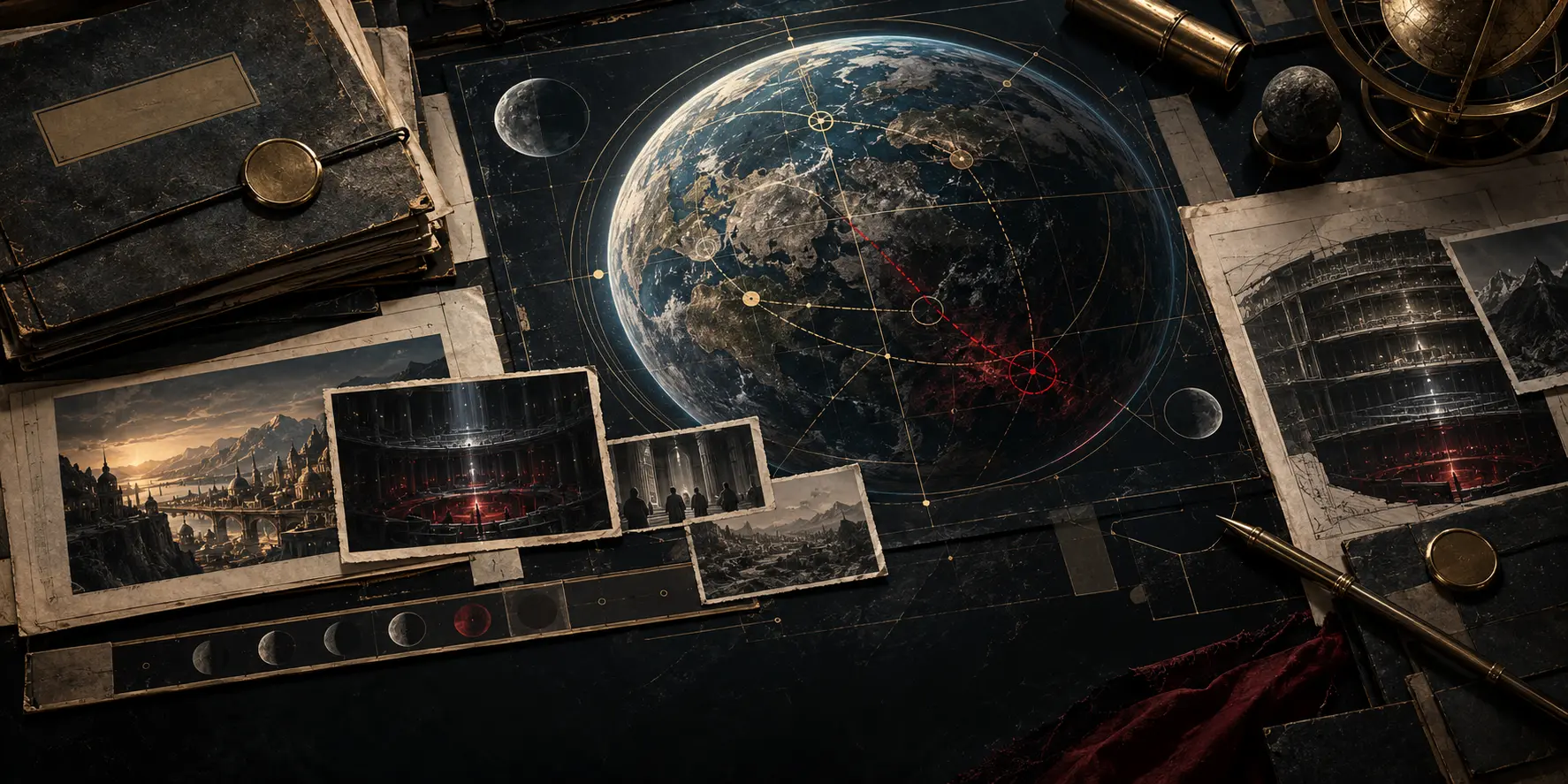
Interpretive still life of recovered records aligned against hidden-system evidence.

Recovered records held against the working evidence.

Story development tools

See how the authoring system turns ordinary language into finished story work.

The Project Explorer shows the live notes, decisions, and workshop used to develop Seeds of the Throne. Each step keeps confirmed decisions separate from suggestions and unanswered questions.

This is a public, read-only look at the real project, so it contains full spoilers. You can try the workshop, but your draft stays in this browser unless you export it.

  1. The author explains the story in ordinary language.

    The system records those ideas and separates confirmed decisions from suggestions and unanswered questions.

    Read how the system is designed
  2. The current workshop asks one consequential question at a time.

    Each question helps the author decide a missing cause, character choice, relationship, world rule, or event.

    Open a workshop question
  3. Accepted answers are added where they belong.

    An accepted decision can update character notes, the timeline, world rules, plot events, and the list of remaining questions.

    Review decisions and supporting information
  4. Use the completed plan to write and revise scenes.

    The planned system will create scene outlines, draft prose, check continuity, revise weak sections, and assemble the manuscript for the author's approval.

    Read the system plan

Seeds of the Throne is the working example. The notes, decisions, and workshop below are the live project, not a demonstration mockup.

Vault overview

See the whole story-development system at a glance.

605 notes work together as one system. The vault remembers where ideas came from, what the author decided, what remains uncertain, and what should happen next.

The vault turns conversations into organized story memory. It preserves sources, separates decisions from suggestions, finds missing connections, supports research and workshops, prepares scenes and prose, checks continuity, and publishes selected material without surrendering author control.

  • Working now Capture, memory, workshops, and research already operate.
  • Needs repair Current-state agreement, automatic checks, and decision updates still drift.
  • Planned next Durable answers, manuscript production, and mobile save are not built yet.
  1. Capture

    Conversations, mobile notes, and raw ideas are preserved.

  2. Understand

    Current context and compiled notes explain what the project means now.

  3. Decide

    Workshops ask one important question and preserve the author's answer.

  4. Develop

    Research, alternatives, story structure, and focused tests strengthen the work.

  5. Create

    Scene plans, prose, images, and manuscript material are produced for review.

  6. Share

    Selected material becomes the story site, Project Explorer, and public posts.

What lives where

Each area has a job. Folder names are secondary detail.

  • New material

    Preserves incoming ideas and the order in which they developed.

    00 Inbox, 01 Sessions

  • Story memory

    Keeps the detailed working knowledge and a smaller briefing used to resume work.

    02 Story, 03 Context

  • Research

    Separates questions, reports, and usable findings from story decisions.

    04 Research

  • Public work

    Holds reviewed material prepared for readers.

    05 Public

  • Drafts

    Holds scenes and manuscript candidates awaiting review.

    06 Draft

  • Decisions and direction

    Records choices, contradictions, current work, handoffs, and verification.

    07 QA, 07 Coordination

  • Development tools

    Diagnoses missing connections and tests possible story directions.

    08 Story Loop, 09 Story Exploration

  • Reusable methods

    Provides repeatable methods for writing, research, images, websites, and checks.

    skills, scripts

What already works, what needs repair, and what is still planned

Working well

  • Idea and session capture
  • Human-readable story memory
  • Author authority and decision boundaries
  • Research kept separate from story truth
  • Workshop questions that wait for an answer
  • Decisions, contradictions, and open questions
  • Visual identity and image controls
  • Markdown files and recoverable history
  • Searchable file access

Needs repair

  • One trustworthy current-state view
  • Automatic checks before a change is merged
  • Shared labels and stable record identifiers
  • Updating every affected note after a decision
  • Keeping the weekly cycle current
  • Clearer boundaries around older folders
  • A cleaner split between the repository and the live site

Planned next Not built yet

  • Durable integration of conversational answers
  • Automatic reports of what a decision would change
  • Complete scene-to-manuscript production
  • Manuscript assembly and export
  • Reliable mobile save, resume, and synchronization

The next build order

  1. Make builds and checks reliable.
  2. Create one trustworthy current state.
  3. Normalize the records for one small complete path.
  4. Connect accepted decisions to every affected file.
  5. Prove one complete path from conversation to approved manuscript material.
  6. Expand only after that path works.

Current story development

See what the story already has and what it still needs.

The system checks the whole story for missing causes, weak character decisions, unclear rules, and unfinished events. The results show the author what to work on next.

Current story premise

The colonization process trains participants and contains dangerous criminals.

Humanity developed the Luminai inside an interactive colonization environment. Sylvan and his Luminai are tested against Samuel Franklin, a criminal already held inside the containment process.

The current story problem Make the formal separation, rapid financial collapse, processing, exposure, and accepted placement feel inevitable.

Read the current story assessment

0 / 10major story problems resolved

Current development pass0%
0%
Current sweep
Reassessment
Current task
RW-01
  1. 01 Reassessment
  2. 02 Causal sequence
  3. 03 Character agency
  4. 04 Systems + evidence
  5. 05 Scene design
  6. 06 Draft

Story files

Browse the files used to develop the story.

Search 605 documents about the world, characters, plot, research, decisions, workshops, and earlier ideas.

Current document 07 Coordination/Story Completion Workflow/Workshop/02 - Participant knowledge and entry.md

02 · Participant knowledge and entry

Purpose

Establish what people can choose when they wake without a complete briefing.

This packet supports the existing Story Completion Workflow. The author accepted the result below on September 6. The original alternatives remain preserved as development history. Central synthesis: Astra, reviewed for integration on September 5.

Accepted result

The legitimate heirs enter voluntarily. The older leaders offer them an opportunity to become self-made through the colonization process instead of beginning with their inheritance. They may exit at any time and return to the inheritance path, but doing so means trading away the results, placement, or independent standing they were developing through the process.

This voluntary exit rule applies to heirs and other voluntary trainees. It does not automatically release convicted criminals from court-assigned containment. The entry and refusal rights of descendants born inside the process remain unresolved.

Source and full decision record: 01 Sessions/Daily/2026-09-06 - Workshop Module 02 Entry Draft.

Relevant source notes

Confirmed facts and current working constraints

  • Participants enter functioning reconstructed societies with incomplete knowledge.
  • Current channel note describes infancy formation and later conscious awakening.

These constraints inherit their source status. A working physical model, timing estimate, or accepted macro constraint does not establish every implementation detail.

Unresolved gaps and contradictions

  • Exact pre-entry briefing, memory withholding, re-entry, convicted-participant review, and locally born descendants. Voluntary heir entry and exit are now established.

Prerequisite decisions

Modules: 01. Read their accepted results before closing this gate. Open prerequisites can be explored provisionally, but do not mark dependent choices final. Module numbers are topic IDs; use the dependency order in the workshop index.

Central author gate

What did each class of participant knowingly accept before entry, and what can they refuse afterward? PARTIALLY AUTHOR-ACCEPTED 2026-09-06: voluntary heirs and trainees are settled; convicted participants and descendants retain separate open mechanics.

Ask this question alone during actual use. Do not ask every follow-up at once.

Possibilities and tradeoffs

PROPOSED: Participants accept broad risks and protected exit without learning scenario details. Preserves discovery and agency; requires a believable consent memory or trusted independent record.

2. Ordinary upbringing followed by renewed participation choice

PROPOSED: The childhood bond is developmental background, while conscious adulthood creates the first binding training choice. Strong human formation; must explain what a refusal permits and whether refusal damages placement.

3. Court-assigned containment, separately consented training

PROPOSED: Criminal jurisdiction and trainee participation follow different routes. Clarifies responsibility but creates multiple knowledge tracks that need simple reader cues.

4. Contested entry practice requiring reform

PROPOSED: Some withholding proves excessive and Sylvan challenges it. Gives leaders fallibility and a personal conflict; changes the positive civilization from established ethical model to institution under repair.

Targeted follow-up questions

  • Can a participant leave without confessing failure?
  • Can parents authorize what their adult child later rejects?
  • What do descendants born inside the process inherit: circumstances, permissions, or obligations?

Scene test

Non-canon situation: At awakening Sylvan asks what he agreed to; the Luminai can produce only part of the answer, so a real choice must occur before the next stage.

Record what each person wants, can know, can refuse, and can actually change. Name the observable difference between the selected alternatives.

Adversarial questions

  • Does uncertainty conceal the scenario, or conceal rights a person would need to exercise consent?
  • Which established constraint would this answer break, and what evidence would reveal that break before the payoff?

Completion checklist

  • [x] Answer the central question in the author's own words for voluntary heirs and trainees.
  • [x] Identify the chosen possibility, a modified combination, or a different answer; explain rejected tradeoffs.
  • [x] Resolve prerequisite 01.
  • [x] Run the scene test above and state the consequence for the people involved.
  • [x] Answer the adversarial challenge without granting unexplained knowledge or authority.
  • [x] Record what remains working, proposed, or unresolved.
  • [x] Obtain explicit author acceptance before updating canon or workflow progress.
  • [x] Trace the accepted answer through the affected notes and rebuild both projections.

Answer and decision record

Module: 02 · Participant knowledge and entry
Gate: What did each class of participant knowingly accept before entry, and what can they refuse afterward?
State: AUTHOR-ACCEPTED for voluntary heirs and trainees; other classes explicitly deferred
Author answer (verbatim): preserved in the linked session record
Exact restatement: accepted result above
Selected option or new answer: voluntary opportunity with a continuing right to exit and return to inheritance
Why this tradeoff: the process offers an independently earned future instead of compulsory preparation for inherited power
Rejected alternatives and reasons: criminal release and descendant obligations cannot be inferred from the heir model
Prerequisites resolved / deferred: Module 01 resolved
Scene test: an heir may leave after a setback but gives up the unfinished process result; a convicted participant requires a different legal route
Adversarial result: exit does not erase stakes because inheritance and independently earned placement are different futures
Remaining uncertainty: exact briefing, traded results, re-entry, stage refusal, criminal review and descendant rights
Explicit acceptance wording and date: “Yes, another great result, the improvements are good” — 2026-09-06
Workflow task and macro-depth effect: supporting workshop Module 02 accepted for voluntary entrants; SC-010 remains active and unchanged

Notes and website sections affected