Project Explorer · working sheet

Seeds of the Throne

Seeds of the Throne began as years of conversations and thousands of story ideas. The Project Explorer shows how those ideas are being organized into characters, a world, a timeline, and a finished series.

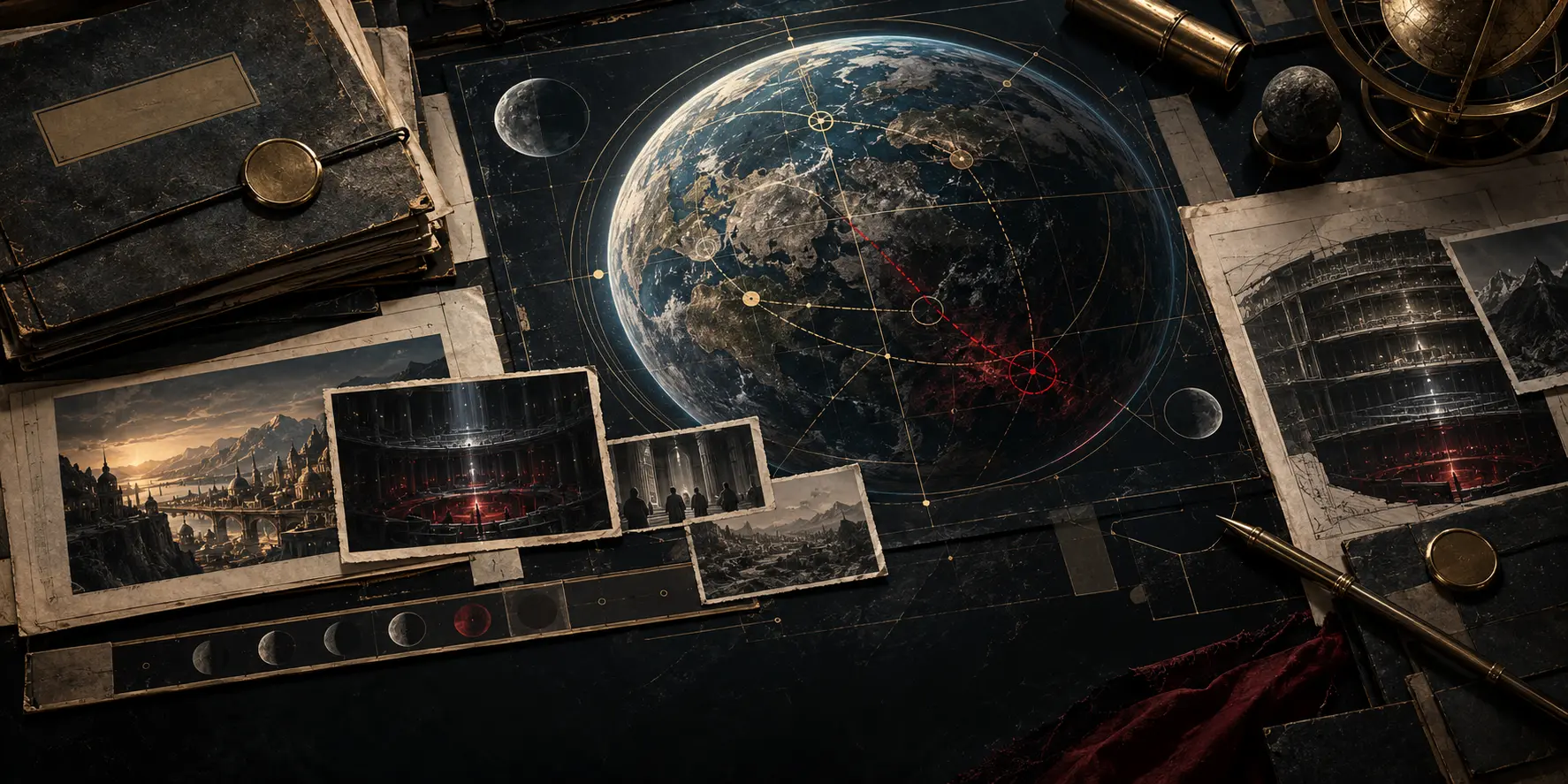
Interpretive still life of recovered records aligned against hidden-system evidence.

Recovered records held against the working evidence.

Story development tools

See how the authoring system turns ordinary language into finished story work.

The Project Explorer shows the live notes, decisions, and workshop used to develop Seeds of the Throne. Each step keeps confirmed decisions separate from suggestions and unanswered questions.

This is a public, read-only look at the real project, so it contains full spoilers. You can try the workshop, but your draft stays in this browser unless you export it.

  1. The author explains the story in ordinary language.

    The system records those ideas and separates confirmed decisions from suggestions and unanswered questions.

    Read how the system is designed
  2. The current workshop asks one consequential question at a time.

    Each question helps the author decide a missing cause, character choice, relationship, world rule, or event.

    Open a workshop question
  3. Accepted answers are added where they belong.

    An accepted decision can update character notes, the timeline, world rules, plot events, and the list of remaining questions.

    Review decisions and supporting information
  4. Use the completed plan to write and revise scenes.

    The planned system will create scene outlines, draft prose, check continuity, revise weak sections, and assemble the manuscript for the author's approval.

    Read the system plan

Seeds of the Throne is the working example. The notes, decisions, and workshop below are the live project, not a demonstration mockup.

Vault overview

See the whole story-development system at a glance.

605 notes work together as one system. The vault remembers where ideas came from, what the author decided, what remains uncertain, and what should happen next.

The vault turns conversations into organized story memory. It preserves sources, separates decisions from suggestions, finds missing connections, supports research and workshops, prepares scenes and prose, checks continuity, and publishes selected material without surrendering author control.

  • Working now Capture, memory, workshops, and research already operate.
  • Needs repair Current-state agreement, automatic checks, and decision updates still drift.
  • Planned next Durable answers, manuscript production, and mobile save are not built yet.
  1. Capture

    Conversations, mobile notes, and raw ideas are preserved.

  2. Understand

    Current context and compiled notes explain what the project means now.

  3. Decide

    Workshops ask one important question and preserve the author's answer.

  4. Develop

    Research, alternatives, story structure, and focused tests strengthen the work.

  5. Create

    Scene plans, prose, images, and manuscript material are produced for review.

  6. Share

    Selected material becomes the story site, Project Explorer, and public posts.

What lives where

Each area has a job. Folder names are secondary detail.

  • New material

    Preserves incoming ideas and the order in which they developed.

    00 Inbox, 01 Sessions

  • Story memory

    Keeps the detailed working knowledge and a smaller briefing used to resume work.

    02 Story, 03 Context

  • Research

    Separates questions, reports, and usable findings from story decisions.

    04 Research

  • Public work

    Holds reviewed material prepared for readers.

    05 Public

  • Drafts

    Holds scenes and manuscript candidates awaiting review.

    06 Draft

  • Decisions and direction

    Records choices, contradictions, current work, handoffs, and verification.

    07 QA, 07 Coordination

  • Development tools

    Diagnoses missing connections and tests possible story directions.

    08 Story Loop, 09 Story Exploration

  • Reusable methods

    Provides repeatable methods for writing, research, images, websites, and checks.

    skills, scripts

What already works, what needs repair, and what is still planned

Working well

  • Idea and session capture
  • Human-readable story memory
  • Author authority and decision boundaries
  • Research kept separate from story truth
  • Workshop questions that wait for an answer
  • Decisions, contradictions, and open questions
  • Visual identity and image controls
  • Markdown files and recoverable history
  • Searchable file access

Needs repair

  • One trustworthy current-state view
  • Automatic checks before a change is merged
  • Shared labels and stable record identifiers
  • Updating every affected note after a decision
  • Keeping the weekly cycle current
  • Clearer boundaries around older folders
  • A cleaner split between the repository and the live site

Planned next Not built yet

  • Durable integration of conversational answers
  • Automatic reports of what a decision would change
  • Complete scene-to-manuscript production
  • Manuscript assembly and export
  • Reliable mobile save, resume, and synchronization

The next build order

  1. Make builds and checks reliable.
  2. Create one trustworthy current state.
  3. Normalize the records for one small complete path.
  4. Connect accepted decisions to every affected file.
  5. Prove one complete path from conversation to approved manuscript material.
  6. Expand only after that path works.

Current story development

See what the story already has and what it still needs.

The system checks the whole story for missing causes, weak character decisions, unclear rules, and unfinished events. The results show the author what to work on next.

Current story premise

The colonization process trains participants and contains dangerous criminals.

Humanity developed the Luminai inside an interactive colonization environment. Sylvan and his Luminai are tested against Samuel Franklin, a criminal already held inside the containment process.

The current story problem Make the formal separation, rapid financial collapse, processing, exposure, and accepted placement feel inevitable.

Read the current story assessment

0 / 10major story problems resolved

Current development pass0%
0%
Current sweep
Reassessment
Current task
RW-01
  1. 01 Reassessment
  2. 02 Causal sequence
  3. 03 Character agency
  4. 04 Systems + evidence
  5. 05 Scene design
  6. 06 Draft

Story files

Browse the files used to develop the story.

Search 605 documents about the world, characters, plot, research, decisions, workshops, and earlier ideas.

Current document 08 Story Loop/CHARACTER-FACTORY.md

Character Factory

Purpose

Create characters at the level of detail the story currently needs, especially the many supporting and temporary characters required across centuries of colonization, the Great War, containment, advanced-environment development, and later arcs.

The system should avoid two opposite failures:

  • cardboard function-characters;
  • wasting development effort on full biographies for people who appear briefly.

Character tiers

Tier A — Anchor characters

Examples include Sylvan, Samuel, George, Konrad, Orzai, and other major long-range figures.

Develop deeply:

  • formative history;
  • contradictions;
  • relationships;
  • worldview;
  • recurring needs and obsessions;
  • developmental arc;
  • long-range causal role;
  • speech/behavior under different pressures;
  • how they change across eras.

Tier B — Arc characters

Important for one substantial era, institutional arc, war campaign, containment phase, or multi-chapter sequence.

Need:

  • clear backstory relevant to present conflict;
  • relationship web;
  • personal stakes;
  • competence;
  • contradiction;
  • specific pressure point;
  • arc beginning/change/end;
  • memorable behavioral texture.

Tier C — Recurring supporting characters

Appear intermittently and can become audience favorites without carrying the entire story.

Need:

  • occupation/function;
  • immediate worldview;
  • relation to anchor character;
  • one strength;
  • one vulnerability or contradiction;
  • one recognizable habit or preference;
  • one unresolved personal concern;
  • reason they plausibly reappear.

Tier D — Scene characters

Appear for one or a few scenes.

Need only enough detail to feel like a person rather than a delivery device.

Minimum six-point packet:

  1. role — why are they in this environment?
  2. want — what do they want right now?
  3. competence — what are they good at or unusually aware of?
  4. contradiction — one thing that prevents stereotype flattening;
  5. behavioral detail — one small concrete trait;
  6. story function — why does this scene need them?

Example form:

rail coordinator / wants the evacuation slot protected / excellent at capacity planning / ideologically loyal but privately hates ceremonial interference / counts available cars under her breath / forces Konrad's officers to choose between symbolism and logistics

That is often enough to produce readable dialogue.

The temporary-character formula

For fast generation use:

social role + immediate want + competence + contradiction + pressure + small human detail

Then add:

relationship to viewpoint + what changes because of them

The character should not be defined by appearance alone.

Memorable without gimmicks

Temporary characters become enjoyable when the reader can infer that they have a life outside the scene.

Useful signals:

  • they are already busy with something when the protagonist arrives;
  • they have an opinion unrelated to the protagonist;
  • they care about a small practical consequence;
  • they have a professional standard;
  • they disagree with someone on their own side;
  • they possess incomplete information and act rationally from it;
  • they remember a prior inconvenience;
  • they want to leave, eat, finish work, protect someone, avoid embarrassment, keep a promise, or solve a mundane problem.

Fast backstory generation

Backstory should explain present behavior, not exist for completeness.

For Tier C/D characters, generate only:

  • one relevant past event;
  • one current obligation;
  • one relationship outside the immediate scene;
  • one belief formed from experience.

Do not automatically generate childhood, parents, schooling, romantic history, or complete chronology unless required.

Voice differentiation

Differentiate through thinking and priorities before dialect or verbal gimmicks.

Possible dimensions:

  • terse vs explanatory;
  • cautious vs improvisational;
  • literal vs political;
  • technically precise vs socially perceptive;
  • deferential vs status-insensitive;
  • impatient vs procedural;
  • optimistic vs experienced pessimism;
  • notices people vs notices systems.

Use recurring phrasing sparingly.

Character-generation loop

When a story structure needs characters:

story function -> role candidates -> select plausible social position -> generate six-point packets -> test interaction -> critic pass -> deepen only survivors

Generate several options when the role materially changes the scene.

Supporting-character critic

Ask:

  • Could this person be replaced by a generic official without changing anything?
  • Do they want something besides delivering exposition?
  • Are they competent enough to deserve their position?
  • Does their behavior follow from what they know?
  • Do they create pressure or choice?
  • Is the contradiction subtle enough to feel human rather than quirky by formula?
  • Would one detail make them recognizable when they return twenty chapters later?
  • Do they accidentally duplicate another character's function?

Character promotion

A Tier D character can become Tier C or B if story generation discovers unusual value.

Promotion signs:

  • strong chemistry with an anchor character;
  • unique access to a recurring system;
  • unexpected thematic contrast;
  • naturally recurring institutional role;
  • audience-facing emotional value;
  • a choice with major downstream consequences.

Do not pre-plan every promotion.

Character retirement

Not every likable character needs a larger arc.

Some should:

  • complete their function;
  • transfer away;
  • survive and simply stop being relevant;
  • die when causally justified;
  • reappear much later;
  • remain an unresolved historical trace.

Long stories feel larger when not everyone stays attached to the protagonist forever.

Colonization-era application

The long colonization process can support dozens of vivid temporary and recurring people across:

  • terraforming;
  • synthetic deployment;
  • governance;
  • logistics;
  • research;
  • military operations;
  • early settlements;
  • command infrastructure;
  • witness/archive roles;
  • containment administration;
  • developmental-participant support;
  • Great War institutions;
  • postwar processing;
  • modern advanced-environment jobs.

This allows Seeds to feel populated without requiring dozens of equally deep protagonists.

Output template

Character ID / working name

Tier: A/B/C/D

Role:

Immediate want:

Competence:

Contradiction:

Pressure:

Human detail:

Relationship to viewpoint:

Relevant backstory:

What changes because of this character:

Status: PROPOSED / WORKING / ESTABLISHED

Success condition

The Character Factory succeeds when the development system can create a new supporting cast for a chapter or era quickly, make them enjoyable enough to test in story form, and deepen only the characters who prove they deserve more narrative space.