Document metadata
type: workshop-module
status: open
module: EG-07
title: Samuel's final counterplan
gate: What can Samuel still attempt after Konrad defects, and why does that attempt complete the case against him?
prerequisites: EG-05, EG-06
EG-07: Samuel's final counterplan
Purpose
Give Samuel a dangerous final strategy that grows from his remaining people, money, access, and obsessions without granting him authority over the governing process.
Established
Samuel cannot control participant identity, mature bond status, terminal balance, processing, Daemon deletion, or the governing evidence record. He can still manipulate people, local systems, interfaces, and interpretations. His final move is not literal theft of Sylvan's Luminai. He tries to place operational blame on George, use Samuel Jr.'s required presentation to transfer authorship of the bloodline campaign toward Konrad's family, and induce Sylvan to accept a customized bargain built from the concealed-access method used against Konrad. After formal separation, Samuel receives fifteen million dollars for an independent plan and exhausts it within days through escalating attempts to manufacture an apocalyptic culmination and prove his divinity.
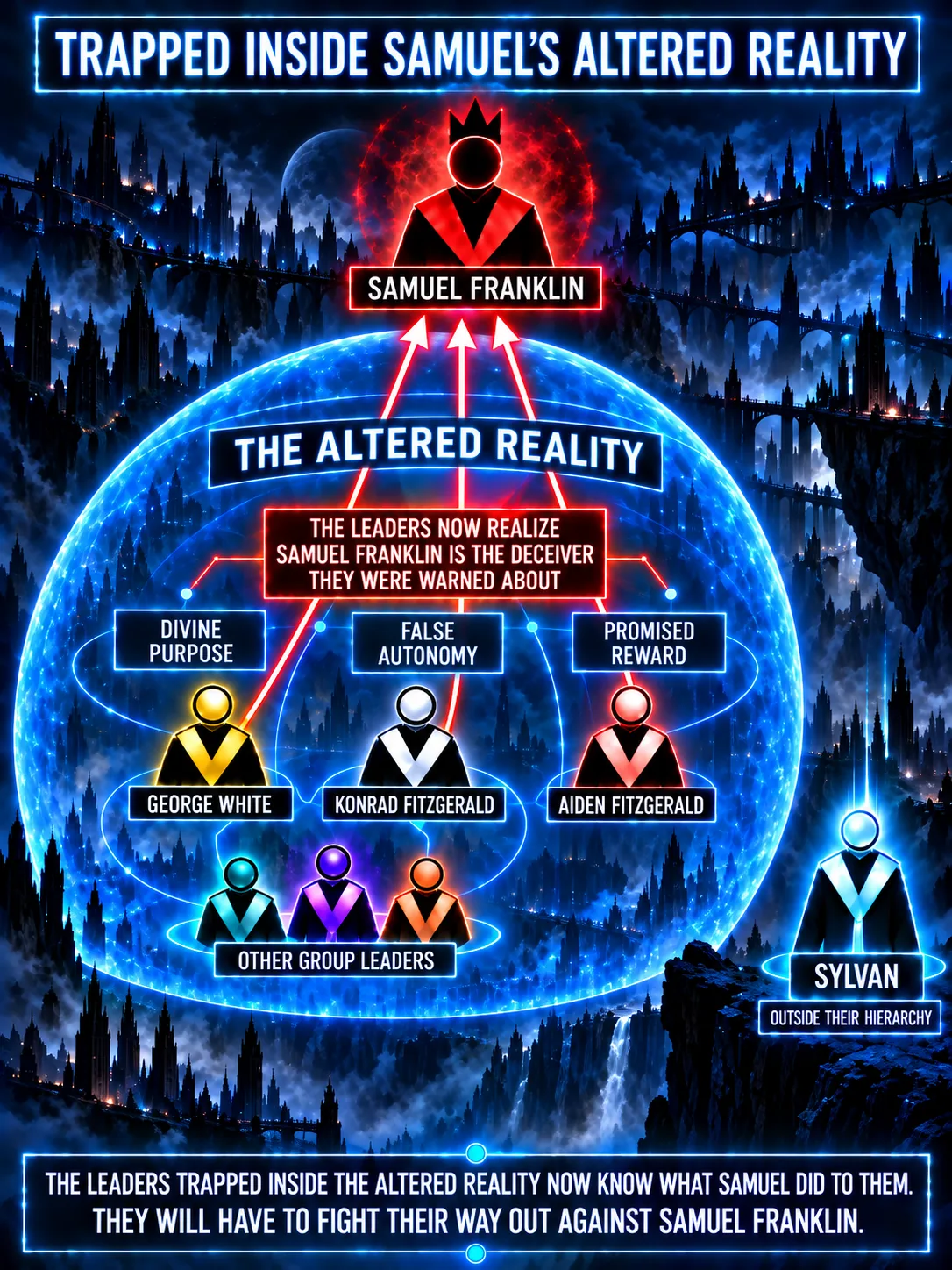
The customized bargain is now part of a larger repeated trap. Samuel uses story functionality to define a role for Sylvan inside the altered reality surrounding Konrad and Aiden. He tells them Sylvan is the enemy described by an existing religious prophecy and expects their dominance ideology to turn that identification into an attack. The attack pressures Sylvan to accept Samuel's apparent protection, explanation, or access. Samuel still requires a voluntary action from Sylvan; the exact consent or activation remains open.
Konrad and Aiden understand this altered reality as an original holy order placed by divine purpose. Samuel did not write the prophecy, and their group did not create it. His primary control method is to counterfeit the authority to apply it. He makes the identification of Sylvan appear as confirmation, permission, or fulfillment, then revises that application when reality contradicts it. The final counterplan designates Sylvan as the threat whose removal will earn or unlock the promised reward.
Sources: 07 Coordination/Story Completion Workflow/Reassessment Workshop/02 - Samuel rapid resource burn, 07 Coordination/Story Completion Workflow/Reassessment Workshop/07 - George and Konrad functions, 02 Story/Characters/Samuel Franklin.
Four possibilities
- Altered-reality bargain: Samuel uses stolen context to tailor a role, a fraudulent application of the existing prophecy, and a voluntary deal that would reproduce the authority transfer used against Konrad and Aiden.
- Scapegoat-centered sequence: he transfers visible responsibility to George while privately issuing the interventions that preserve the campaign.
- Continuity-centered sequence: he treats Samuel Jr. and the remaining network as proof that his authority can survive exposure.
- Divinity-collapse sequence: he promises one observable triumph and spends the terminal allocation escalating after each failed sign.
Central author gate
What part of the existing prophecy does Samuel apply to Sylvan, which trusted channel makes that identification appear authoritative, what role and protection does Samuel offer Sylvan, what consent would reproduce the concealed transfer, and which intervention proves Samuel still commands the operation?
Scene test
The counterplan produces immediate danger and a visible spending or access consequence, but cannot change the already completed Sylvan–Luminai result.
Adversarial test
If Samuel can seize the overall process, earlier limits are false. If he can do nothing consequential, rapid exhaustion becomes bookkeeping instead of climax.