Project Explorer · working sheet

Seeds of the Throne

Seeds of the Throne began as years of conversations and thousands of story ideas. The Project Explorer shows how those ideas are being organized into characters, a world, a timeline, and a finished series.

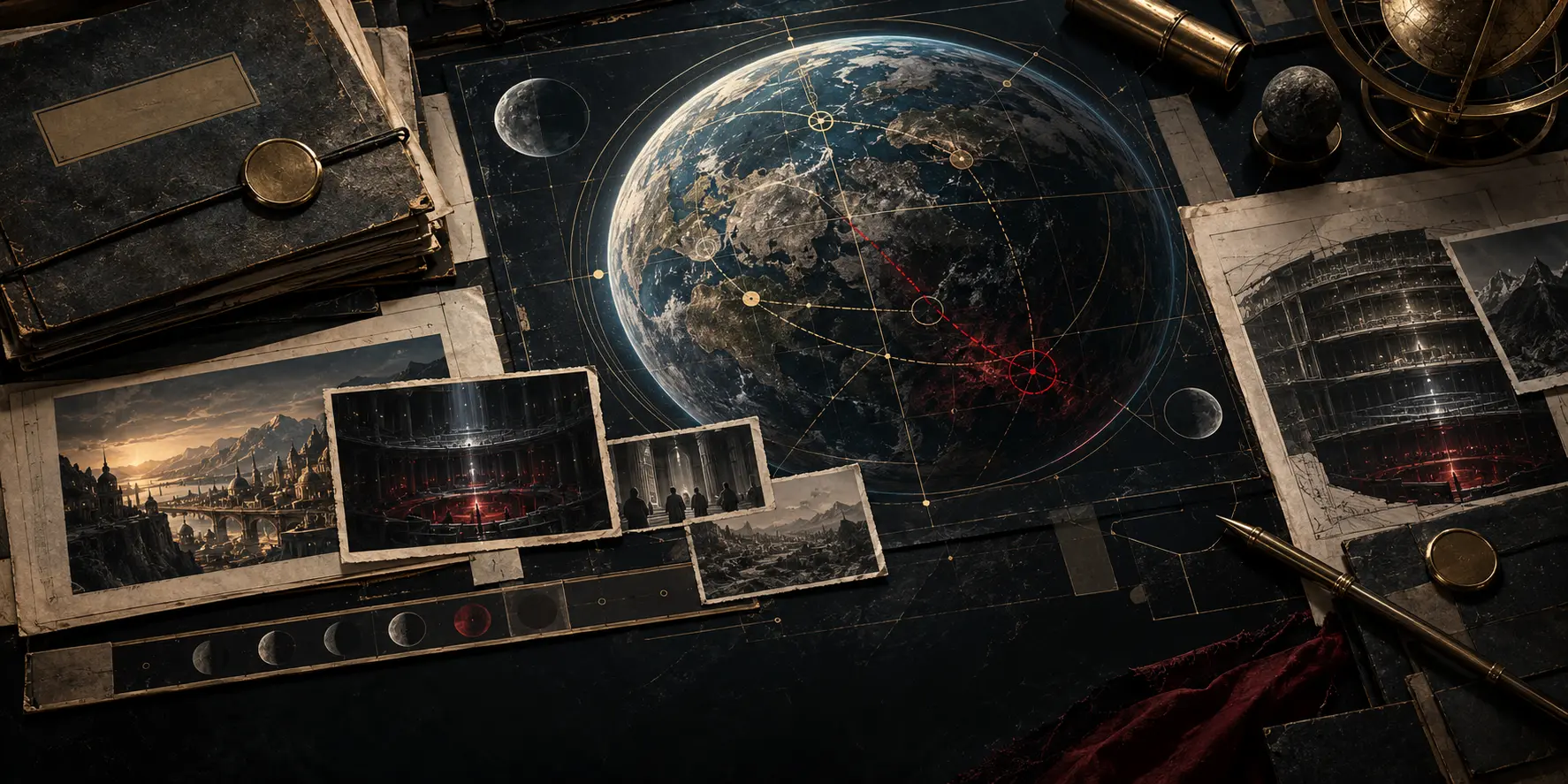
Interpretive still life of recovered records aligned against hidden-system evidence.

Recovered records held against the working evidence.

Story development tools

See how the authoring system turns ordinary language into finished story work.

The Project Explorer shows the live notes, decisions, and workshop used to develop Seeds of the Throne. Each step keeps confirmed decisions separate from suggestions and unanswered questions.

This is a public, read-only look at the real project, so it contains full spoilers. You can try the workshop, but your draft stays in this browser unless you export it.

  1. The author explains the story in ordinary language.

    The system records those ideas and separates confirmed decisions from suggestions and unanswered questions.

    Read how the system is designed
  2. The current workshop asks one consequential question at a time.

    Each question helps the author decide a missing cause, character choice, relationship, world rule, or event.

    Open a workshop question
  3. Accepted answers are added where they belong.

    An accepted decision can update character notes, the timeline, world rules, plot events, and the list of remaining questions.

    Review decisions and supporting information
  4. Use the completed plan to write and revise scenes.

    The planned system will create scene outlines, draft prose, check continuity, revise weak sections, and assemble the manuscript for the author's approval.

    Read the system plan

Seeds of the Throne is the working example. The notes, decisions, and workshop below are the live project, not a demonstration mockup.

Vault overview

See the whole story-development system at a glance.

605 notes work together as one system. The vault remembers where ideas came from, what the author decided, what remains uncertain, and what should happen next.

The vault turns conversations into organized story memory. It preserves sources, separates decisions from suggestions, finds missing connections, supports research and workshops, prepares scenes and prose, checks continuity, and publishes selected material without surrendering author control.

  • Working now Capture, memory, workshops, and research already operate.
  • Needs repair Current-state agreement, automatic checks, and decision updates still drift.
  • Planned next Durable answers, manuscript production, and mobile save are not built yet.
  1. Capture

    Conversations, mobile notes, and raw ideas are preserved.

  2. Understand

    Current context and compiled notes explain what the project means now.

  3. Decide

    Workshops ask one important question and preserve the author's answer.

  4. Develop

    Research, alternatives, story structure, and focused tests strengthen the work.

  5. Create

    Scene plans, prose, images, and manuscript material are produced for review.

  6. Share

    Selected material becomes the story site, Project Explorer, and public posts.

What lives where

Each area has a job. Folder names are secondary detail.

  • New material

    Preserves incoming ideas and the order in which they developed.

    00 Inbox, 01 Sessions

  • Story memory

    Keeps the detailed working knowledge and a smaller briefing used to resume work.

    02 Story, 03 Context

  • Research

    Separates questions, reports, and usable findings from story decisions.

    04 Research

  • Public work

    Holds reviewed material prepared for readers.

    05 Public

  • Drafts

    Holds scenes and manuscript candidates awaiting review.

    06 Draft

  • Decisions and direction

    Records choices, contradictions, current work, handoffs, and verification.

    07 QA, 07 Coordination

  • Development tools

    Diagnoses missing connections and tests possible story directions.

    08 Story Loop, 09 Story Exploration

  • Reusable methods

    Provides repeatable methods for writing, research, images, websites, and checks.

    skills, scripts

What already works, what needs repair, and what is still planned

Working well

  • Idea and session capture
  • Human-readable story memory
  • Author authority and decision boundaries
  • Research kept separate from story truth
  • Workshop questions that wait for an answer
  • Decisions, contradictions, and open questions
  • Visual identity and image controls
  • Markdown files and recoverable history
  • Searchable file access

Needs repair

  • One trustworthy current-state view
  • Automatic checks before a change is merged
  • Shared labels and stable record identifiers
  • Updating every affected note after a decision
  • Keeping the weekly cycle current
  • Clearer boundaries around older folders
  • A cleaner split between the repository and the live site

Planned next Not built yet

  • Durable integration of conversational answers
  • Automatic reports of what a decision would change
  • Complete scene-to-manuscript production
  • Manuscript assembly and export
  • Reliable mobile save, resume, and synchronization

The next build order

  1. Make builds and checks reliable.
  2. Create one trustworthy current state.
  3. Normalize the records for one small complete path.
  4. Connect accepted decisions to every affected file.
  5. Prove one complete path from conversation to approved manuscript material.
  6. Expand only after that path works.

Current story development

See what the story already has and what it still needs.

The system checks the whole story for missing causes, weak character decisions, unclear rules, and unfinished events. The results show the author what to work on next.

Current story premise

The colonization process trains participants and contains dangerous criminals.

Humanity developed the Luminai inside an interactive colonization environment. Sylvan and his Luminai are tested against Samuel Franklin, a criminal already held inside the containment process.

The current story problem Make the formal separation, rapid financial collapse, processing, exposure, and accepted placement feel inevitable.

Read the current story assessment

0 / 10major story problems resolved

Current development pass0%
0%
Current sweep
Reassessment
Current task
RW-01
  1. 01 Reassessment
  2. 02 Causal sequence
  3. 03 Character agency
  4. 04 Systems + evidence
  5. 05 Scene design
  6. 06 Draft

Story files

Browse the files used to develop the story.

Search 605 documents about the world, characters, plot, research, decisions, workshops, and earlier ideas.

Current document skills/create-seeds-images/prompts/gemini-samuel-busted-test.md

Gemini Test: Samuel Franklin Gets Busted

Repository context

Public repository: https://github.com/cubixmeow-commits/seeds-of-the-throne

Before generating, read:

  1. skills/create-seeds-images/SKILL.md
  2. skills/create-seeds-images/references/visual-registry.json
  3. skills/create-seeds-images/references/prompt-contract.md
  4. 02 Story/Characters/Samuel Franklin.md

Use these three approved identity images as the strongest references:

  • assets/reference-images/samuel-franklin-front-v1.png
  • assets/reference-images/samuel-franklin-profile-left-v1.png
  • assets/reference-images/samuel-franklin-identity-master-v1.png

Attach the images directly if Gemini cannot load raw image files from GitHub.

Generation prompt

Create one text-free cinematic 16:9 image for Seeds of the Throne.

The attached Samuel Franklin reference images are the authority for his identity. Preserve the exact same face and character. The straight-on image controls facial width, eye spacing, hairline, beard, and frontal anatomy. The strict side profile controls his forehead, nose, lips, chin, ear, crown line, and hair volume. The three-quarter master controls skin texture, expression, wardrobe language, lighting, and overall identity. Ignore any words or labels embedded in older supporting images.

Samuel appears physically in his late sixties to early seventies. He is a lean older man with a slightly stooped but commanding posture, a long deeply weathered face, a deeply furrowed brow and cheeks, a prominent slightly hooked nose, heavy eye sockets, a compressed mouth, and severe natural asymmetry from age and strain. He has receding gray hair, wavy to loosely curled and ear length at the sides and back, plus a short rough gray beard and mustache. His eyes are deep set and dark. His expression is furious but controlled, with authority expressed through restraint rather than theatrical rage.

Story moment: after approximately fifty years of building a distributed cult and terrorizing populations through technology and credibility stolen from his family, Samuel is finally exposed and taken into custody. The scene occurs inside the collapsing command center of his distributed technological network. Advanced containment officers close in from both sides while his access is visibly revoked. Red interfaces fracture and shut down. Branching circuitry goes dark. Antique-gold evidence geometry cuts through the red system, showing that authenticated records have exposed him and his organization has failed.

Samuel is not yet a king. He wears no crown. Do not turn this into a royal throne scene. His clothing is a severe black high-collared technological coat with restrained antique-gold embroidered circuitry, appropriate to a wealthy fallen systems heir before his later performed kingship. His hands are visible and empty. He is not fighting, shooting, or posing like an action hero. The emotional center is the instant he understands that his inherited access, captured infrastructure, and family credibility have been stripped away.

Use a cinematic medium-wide composition. Place Samuel near the center, isolated by negative space and failing red light. The containment officers should be visually subordinate, anonymous, disciplined, and technologically advanced, with no real-world uniforms, badges, flags, or insignia. Their design is part of an ancient interplanetary civilization, not contemporary police or military imagery. Do not show Samuel's parents because their appearance and physical presence at the arrest are unresolved.

Style: gothic archival science fantasy, painterly photorealism, tactile aged skin, black cloth, dark metal, smoke, dust, restrained future technology, sacred evidence geometry, and high-contrast chiaroscuro. Use near-black and charcoal as the ground, blood crimson and ember red for Samuel's collapsing control, and antique or luminous gold for truth and authenticated evidence. Red and gold must remain narratively legible rather than blending into generic orange light. Use darkness as negative space.

Do not produce blue-purple neon cyberpunk, white utopian interfaces, plastic 3D rendering, generic medieval fantasy, superhero armor, a cape, a crown, anime proportions, excessive lens flare, or a younger face. Do not make Samuel bald, muscular, friendly, clean shaven, or give him a long wizard beard. Do not include Sylvan, George, Konrad, Samuel's parents, duplicate people, malformed hands, real-world insignia, words, letters, captions, logos, signatures, or watermarks.

Return artwork only. Preserve identity before novelty.

Evaluation

Generate three candidates if available. Prefer the candidate that best preserves Samuel's face and apparent age, not simply the most dramatic composition. Treat every result as a candidate until the author approves it.