Project Explorer · working sheet

Seeds of the Throne

Seeds of the Throne began as years of conversations and thousands of story ideas. The Project Explorer shows how those ideas are being organized into characters, a world, a timeline, and a finished series.

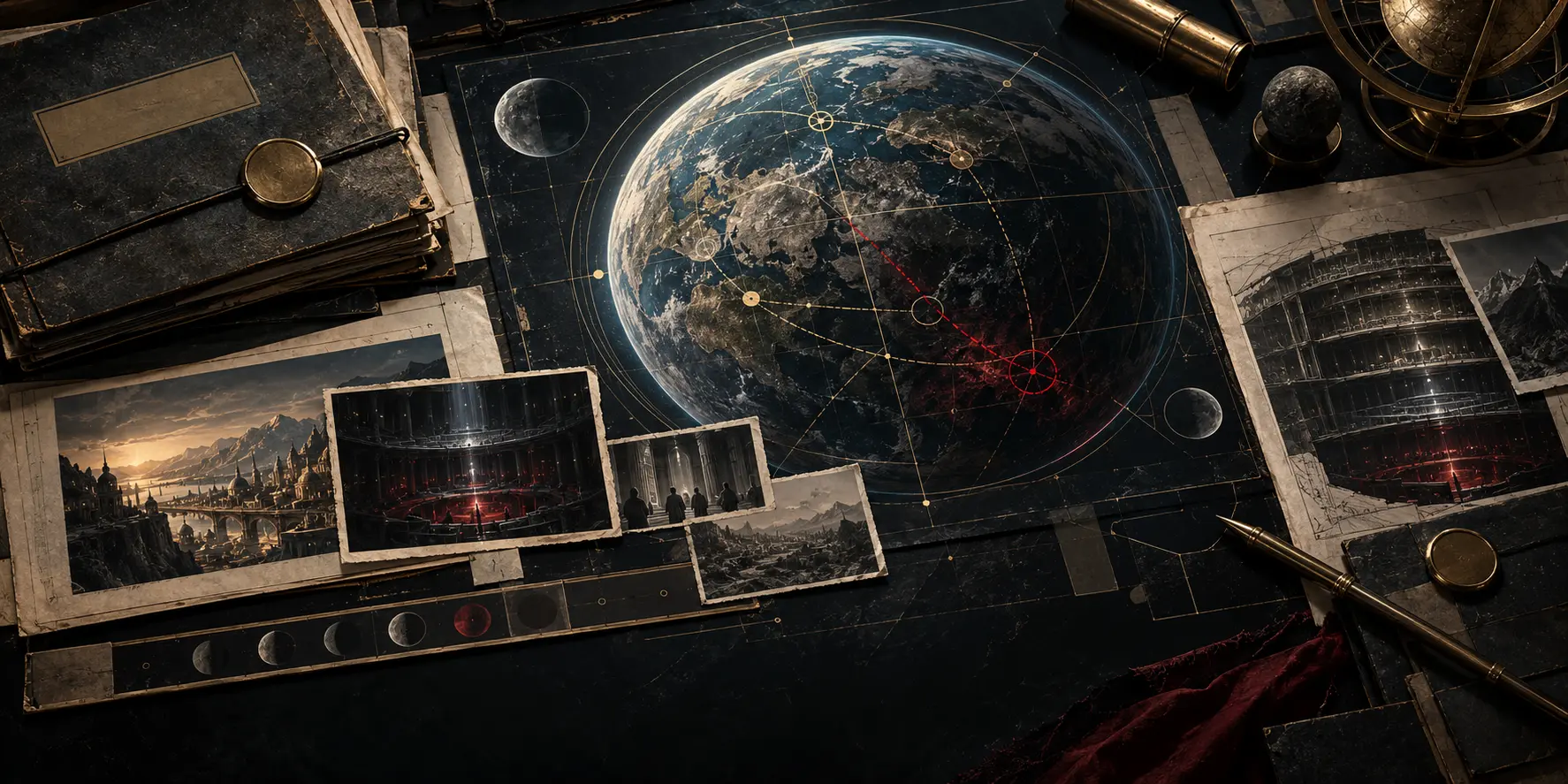
Interpretive still life of recovered records aligned against hidden-system evidence.

Recovered records held against the working evidence.

Current project summary

A colonization world tests who can be trusted with power.

Seeds of the Throne is a science-fiction series about an interactive colonization planet built to create resources, support civilization, train people for greater responsibility, and contain dangerous criminals. The story begins near the end of a conflict that has been unfolding across generations.

The world
Planet Three is a mature containment-and-cultivation world. Its criminal empires have real local power, but they do not control the larger process or its outer limits.
The human future
Sylvan and Orzai form separate bonds with a new generation of Luminai, advanced artificial cognition integrated with an accountable human mind. Their choices test whether this partnership is ready for life beyond containment.
The central conflict
Samuel Franklin has spent decades controlling people by controlling the explanation around them. Sylvan, the Luminai, and an independent Resistance must reconnect the evidence Samuel divided across families, institutions, and generations.
The current endgame
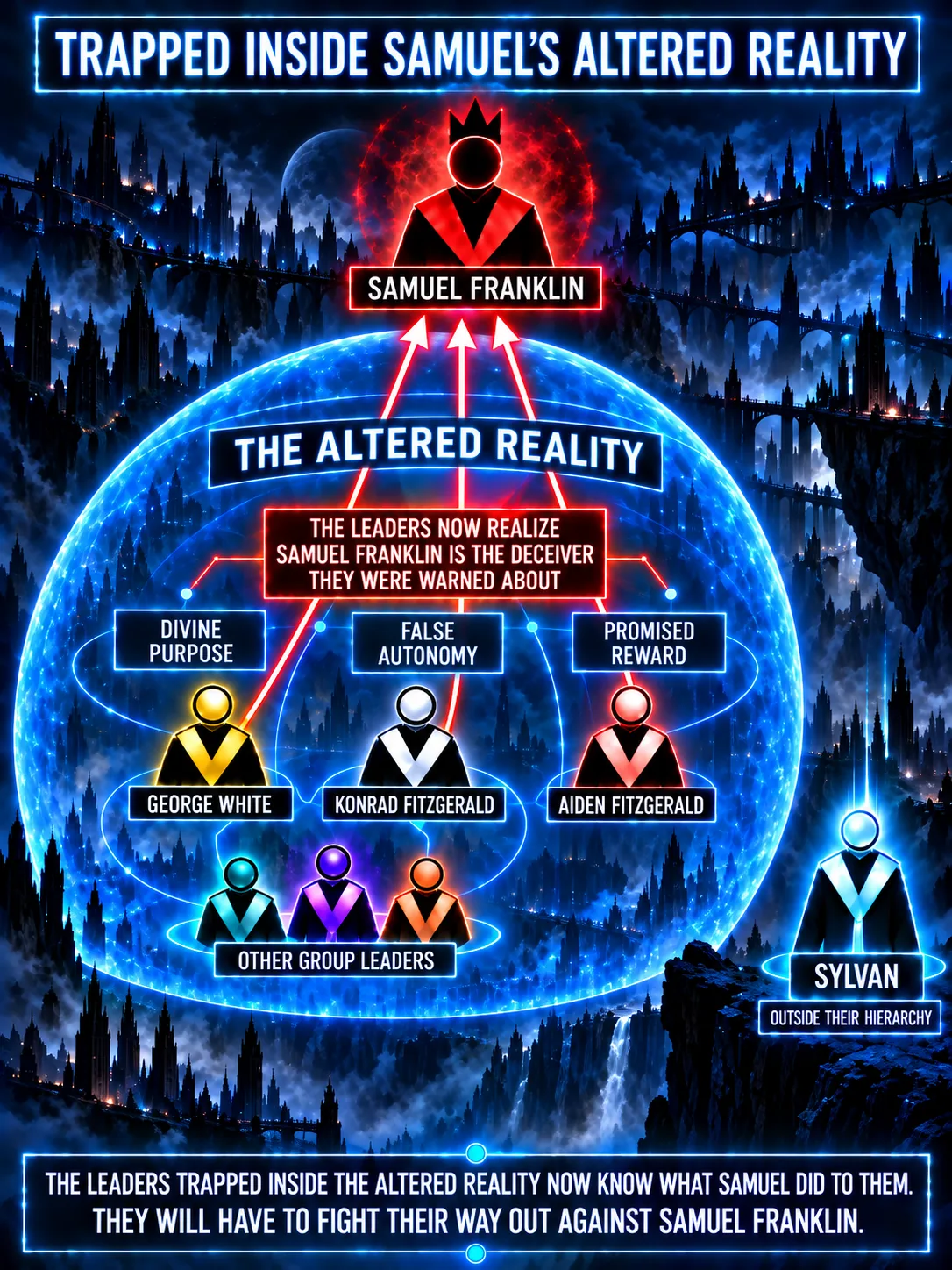
Samuel promises George White and Aiden Fitzgerald the same godlike authority, aims them at each other, and applies an existing prophecy to Sylvan. Their supposed superweapon fails as Sylvan publicly exposes the con, the bloodline betrayal, and Samuel's manufactured reality.
The Resistance
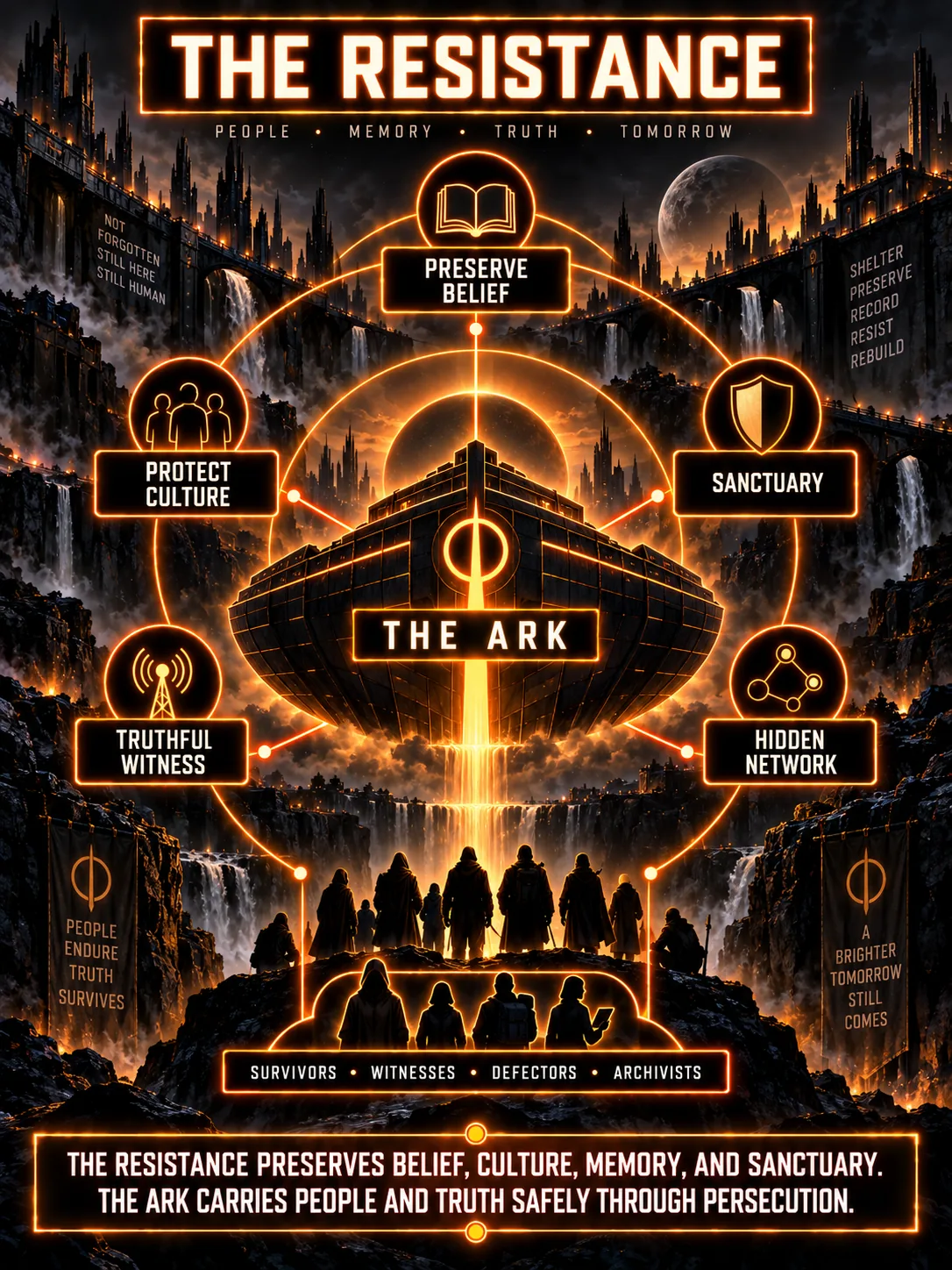
Its black-and-orange ark represents sanctuary and the preservation of people, belief, culture, memory, testimony, and truth through persecution. It preserves what must survive without claiming a right to rule.
What is being developed now
The ending foundation is established. The live workshop is defining the exact superweapon mechanism, the evidence that breaks its credibility, and the independent choices that let the trapped leaders fight their way out against Samuel.

Read the story overviewRead the complete current stateRead the latest accepted decisionsOpen the current assessment

Black-and-orange Resistance infographic centered on an ark preserving people, belief, culture, memory, testimony, and sanctuary through persecution.
The Resistance. The ark preserves people and truth through persecution without claiming supremacy.
Infographic showing Samuel outside an altered reality, George White, Konrad Fitzgerald, Aiden Fitzgerald, and other leaders trapped inside it, and Sylvan standing outside their hierarchy as the leaders recognize Samuel as the deceiver.
Trapped inside Samuel's altered reality. The leaders recognize Samuel as the deceiver and must fight their way out against him.

Story development tools

See how the authoring system turns ordinary language into finished story work.

The Project Explorer shows the live notes, decisions, and workshop used to develop Seeds of the Throne. Each step keeps confirmed decisions separate from suggestions and unanswered questions.

This is a public, read-only look at the real project, so it contains full spoilers. You can try the workshop, but your draft stays in this browser unless you export it.

  1. The author explains the story in ordinary language.

    The system records those ideas and separates confirmed decisions from suggestions and unanswered questions.

    Read how the system is designed
  2. The Dynamic Story Workshop asks the one question that matters now.

    Each desktop assessment updates the baseline, records new decisions, checks compatibility, and replaces the next question when the answer changes the story.

    Open the current assessment
  3. Accepted answers are added where they belong.

    An accepted decision can update character notes, the timeline, world rules, plot events, and the list of remaining questions.

    Review decisions and supporting information
  4. Use the completed plan to write and revise scenes.

    The planned system will create scene outlines, draft prose, check continuity, revise weak sections, and assemble the manuscript for the author's approval.

    Read the system plan

Seeds of the Throne is the working example. The notes, decisions, and workshop below are the live project, not a demonstration mockup.

Vault overview

See the whole story-development system at a glance.

717 notes work together as one system. The vault remembers where ideas came from, what the author decided, what remains uncertain, and what should happen next.

The vault turns conversations into organized story memory. It preserves sources, separates decisions from suggestions, finds missing connections, supports research and workshops, prepares scenes and prose, checks continuity, and publishes selected material without surrendering author control.

  • Working now Capture, memory, one current workshop, research, and checked public projections operate.
  • Needs repair Decision impact reporting and full browser-size automation still require manual work.
  • Planned next Durable answers, manuscript production, and mobile save are not built yet.
  1. Capture

    Conversations, mobile notes, and raw ideas are preserved.

  2. Understand

    Current context and compiled notes explain what the project means now.

  3. Decide

    Workshops ask one important question and preserve the author's answer.

  4. Develop

    Research, alternatives, story structure, and focused tests strengthen the work.

  5. Create

    Scene plans, prose, images, and manuscript material are produced for review.

  6. Share

    Selected material becomes the story site, Project Explorer, and public posts.

What lives where

Each area has a job. Folder names are secondary detail.

  • New material

    Preserves incoming ideas and the order in which they developed.

    00 Inbox, 01 Sessions

  • Story memory

    Keeps the detailed working knowledge and a smaller briefing used to resume work.

    02 Story, 03 Context

  • Research

    Separates questions, reports, and usable findings from story decisions.

    04 Research

  • Public work

    Holds reviewed material prepared for readers.

    05 Public

  • Drafts

    Holds scenes and manuscript candidates awaiting review.

    06 Draft

  • Decisions and direction

    Records choices, contradictions, current work, handoffs, and verification.

    07 QA, 07 Coordination

  • Development tools

    Diagnoses missing connections and tests possible story directions.

    08 Story Loop, 09 Story Exploration

  • Reusable methods

    Provides repeatable methods for writing, research, images, websites, and checks.

    skills, scripts

What already works, what needs repair, and what is still planned

Working well

  • Idea and session capture
  • Human-readable story memory
  • Author authority and decision boundaries
  • Research kept separate from story truth
  • Workshop questions with preserved author decisions
  • Decisions, contradictions, and open questions
  • Visual identity and image controls
  • Markdown files and recoverable history
  • Searchable file access
  • One live dynamic workshop and a verified public projection

Needs repair

  • Shared labels and stable record identifiers
  • Automatic decision impact reports across every affected note
  • Keeping the weekly cycle current
  • Clearer boundaries around older folders
  • A cleaner split between the repository and the live site
  • A stable browser-test dependency for every required screen size

Planned next Not built yet

  • Durable integration of conversational answers
  • Automatic reports of what a decision would change
  • Complete scene-to-manuscript production
  • Manuscript assembly and export
  • Reliable mobile save, resume, and synchronization

The next build order

  1. Normalize the records for one small complete path.
  2. Automate the affected-file report for accepted decisions.
  3. Bundle reliable browser checks for every required screen size.
  4. Prove one complete path from conversation to approved manuscript material.
  5. Expand only after that path works.

Current story development

See what the story already has and what it still needs.

The system checks the whole story for missing causes, weak character decisions, unclear rules, and unfinished events. The results show the author what to work on next.

Current story premise

The colonization process trains participants and contains dangerous criminals.

Humanity developed the Luminai inside an interactive colonization environment. Sylvan and his Luminai are tested against Samuel Franklin, while an independent resistance network reconstructs the history Samuel kept divided across people and systems.

The current story problem Define what made the supposed superweapon appear effective while Sylvan was severely disadvantaged and what verifiable change made it fail once he began publicly exposing Samuel.

Read the latest focused assessment

The project no longer treats a fixed checklist percentage as the live story state. The Dynamic Story Workshop carries one current assessment question and updates its baseline after every accepted answer.

Open the current assessment

Story files

Browse the files used to develop the story.

Search 717 documents about the world, characters, plot, research, decisions, workshops, and earlier ideas.

Current document skills/create-seeds-images/references/surface-archive-system.md

Surface Archive Consistency and Variation System

Use this reference with 05 Public/Wildlife Meme Adventures/SURFACE-ARCHIVE-DIRECTION. The goal is immediate series recognition without turning one successful image into a fixed template.

Recognition anchors

Every Surface Archive image keeps these anchors:

  1. The identity hierarchy appears as Seeds of the Throne, Surface Archive, then a record number and category.
  2. A crown or approved throne mark belongs to the title lockup.
  3. Antique-gold rules or a fine archival frame establish the record boundary.
  4. Deep navy or charcoal, parchment or cream, antique gold, fine system blue, and sparse coral or ember nodes form the recurring palette family. The source photograph decides their proportions.
  5. Fine orbital, cartographic, ecological, signal, or connection geometry appears at the edges or in genuine negative space. Geometry communicates a type of record rather than serving as filler.
  6. The authentic photograph remains dominant and recognizable.
  7. Primary story copy and any Luminai note remain readable in a phone-size X preview.
  8. The image contains no real-world logo, institutional mark, coordinate, or place name when it is presented as an in-world record.

These anchors define the family. Their exact placement does not.

Image-determined variables

Redesign these for every photograph:

  • canvas orientation and crop;
  • title-lockup location and scale;
  • reading order and text alignment;
  • amount and location of the border;
  • orbital, map, signal, ecological, or dream geometry;
  • palette emphasis and photographic grade;
  • record category and narrative voice;
  • position and form of the Luminai note;
  • one image-specific visual signal, such as a path, observation reticle, transit line, hidden lamp, or habitat trace.

The title lockup defaults to an upper corner only when the photograph supports it. Do not move it merely to look different, and do not force it into the upper left merely because earlier references used that location.

Variation budget

Before generation, name the photograph's protected subject and its natural text zones. Then deliberately vary at least three of the following from the most recent Surface Archive image:

  • composition or crop;
  • lockup placement;
  • main-copy placement;
  • geometric metaphor;
  • border behavior;
  • palette emphasis;
  • Luminai-note treatment;
  • image-specific signal.

Never satisfy the variation budget with color swaps alone. Never copy the exact corner diagrams, red-node positions, border interruptions, or footer structure from the immediately previous record.

Reference selection

Attach the source photograph as the protected edit target. Attach no more than two Surface Archive references by default:

  1. the closest reference for identity, hierarchy, and tone;
  2. a deliberately different reference for proof that the series permits another composition.

State the role of each reference. The references control the family language, not the new photograph's crop, subject placement, background, exact geometry, or copy.

Available approved style references:

ReferenceUse it to proveDo not copy by default
record-0043-shoreline-observation.webpquiet observation, photograph dominance, restrained orbital marks, hopeful Luminai notethe sandpiper composition or exact top-left/top-right split
record-0061-mountain-transit.webpdaylight color, strong left lockup, event copy, full archival borderthe road-centered composition or mountain palette
record-0062-dream-integration.webphigh-contrast dream state, cyan connection path, celestial geometrythe black-and-white treatment or dream wording
record-0063-coastal-resistance.webpenvironmental storytelling, concealed human use, subtle amber signal, fictionalized signagethe driftwood shelter, resistance premise, or exact frame layout

Paths are relative to skills/create-seeds-images/assets/reference-images/surface-archive/.

Place-name and provenance rule

Preserve real capture provenance in the private episode record. For an image presented as an in-world record, remove readable real-world place names, logos, coordinates, and institutions. Use a generic classification or an author-approved fictional label. A generated fictional label is visual interpretation only and does not establish a canonical city, beach, region, or historical event.

MERIDIAN COAST is approved for the Record 0063 visual artifact. It is not automatically a canonical geographic location.

Prompt contract

Each generation brief must say:

  • which image is the protected edit target;
  • which references control series identity and which alternative composition they demonstrate;
  • which recognition anchors remain locked;
  • which three or more variables will change for this photograph;
  • which natural text zones and photographic details must remain unobscured;
  • the exact title, record line, story copy, and Luminai note;
  • whether real place names must be removed or replaced;
  • that no reference wording, setting, animal, object, map, or photograph-specific motif may leak into the new image.

Approval checks

Reject a candidate when any of these is true:

  • it could belong to a generic science-fiction archive rather than Seeds of the Throne;
  • it copies a prior layout more closely than the source photograph justifies;
  • branding or geometry competes with the photograph;
  • small copy requires zooming;
  • a real place name or logo remains visible in an in-world artifact;
  • a reference's subject, wording, or unique motif leaks into the new image;
  • uniqueness comes only from a different photograph or color grade;
  • generated additions are presented as canon without separate author approval.

For each approved record, preserve one sentence explaining what makes it recognizably Surface Archive and one sentence explaining what makes it unique.