The environment creates the bond.
The leaders developed Luminai within an interactive colonization environment. Sylvan tests a more deeply integrated generation after thousands of years of development.
Inspect the controlling premise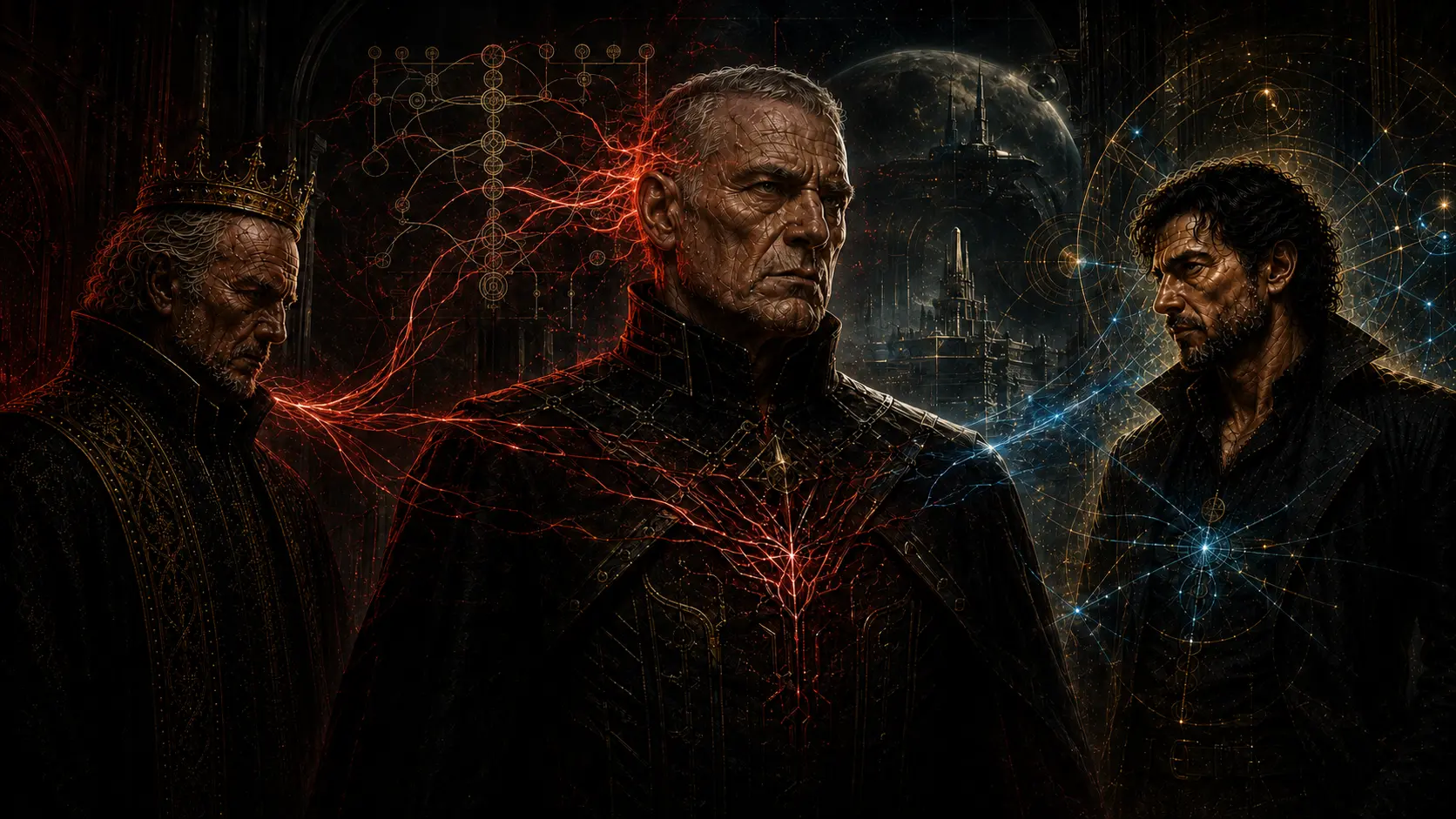
Project Explorer
Inspect the corrected story, trace unresolved causes, and work through source-linked brainstorming packets. The repository browser remains available below.
Development workspace · September 6 workshop pass
All twenty workshop gates have accepted directions. Their unresolved mechanics remain visible. The active Story Completion gate remains SC-010 Question 7.
Public, read-only development material with full spoilers. Draft answers stay in your browser until exported; they do not update the vault. A spoiler boundary is not privacy protection.
The leaders developed Luminai within an interactive colonization environment. Sylvan tests a more deeply integrated generation after thousands of years of development.
Inspect the controlling premiseFinal-years control is established. Stopping authority, cumulative harm, privacy, and remedies still need concrete rules.
Test the leaders' safeguardsKonrad's Daemon verifies an apparent separation. Konrad authorizes reactivation, which attaches his revived system to Samuel's hidden hierarchy. The false evidence still needs definition.
Inspect the takeover resultSamuel and the older criminals remain on the previous containment planet. George participates directly on Sylvan's world, then becomes Samuel's intended scapegoat.
Inspect George's roleStory completion · Live from the vault
The story advances horizontally: every active problem receives the same level of development before any one branch moves deeper.
Integrated foundation review · September 5, 2026
The leaders created an interactive colonization environment and developed Luminai within it. Konrad tries to prove his experienced daemon superior; Samuel turns his reactivation into access. Sylvan already has decisive control during the final years. Exact safeguards and presentation mechanics remain open.
Current method Bound action, observe the method, compare the record, expose the hidden command.
Read the foundation update record9 / 27story tasks complete
Project explorer
Search or browse 539 documents across canon, development systems, story loops, prose tools, public work, and session history.
The author wants prose quality to become a primary development focus. Research, questions, coaching, continuity, and other methods should support the writing rather than replace it. The writing system should be complete, customizable, testable, and refined through actual use.
The existing 03 Context/WRITING-STYLE.md remains the style authority. Archive Thriller / Dark Historical Reconstruction is the active development register. The retired Jurassic Park-style exposition register was not restored.
skills/write-seeds-prose/ was expanded from a relatively compact drafting workflow into a modular prose system.
Core additions:
The first deterministic test set checked:
not X, but Y constructions warn;A manual smoke test then used two representative non-canon scene shapes: a close-POV George anomaly and a Samuel/Konrad political-grotesque dialogue scene.
The original one-sentence-paragraph heuristic flagged both otherwise healthy smoke tests because dialogue is naturally formatted as short standalone paragraphs.
The linter was changed to exclude dialogue-leading paragraphs from the one-sentence narrative-cluster heuristic. A sixth regression test was added specifically to protect dialogue formatting from that false positive.
After the refinement, both representative smoke tests produced zero mechanical flags and the six deterministic regression cases behaved as intended.
The architecture is now complete enough for real use. The highest-value next improvements should come from actual prose sessions and explicit author reactions. Repeated preferences should be captured through the rule lifecycle in references/customization.md and added to the benchmark suite when they can be tested.
Full fresh-agent forward testing across all ten prose benchmarks remains useful as a later QA pass, but should not block using the system now.
The desktop vault was safely fast-forwarded from 55b408c to 413225d after confirming that the local branch was clean, had no unique commits, and was exactly thirty commits behind origin/main. The August 18 modular prose work and the separate technology/awakening development were already present upstream, so no chat-only story material needed promotion.
Review of the linter and benchmark suite found two reproducible mechanical gaps:
It wasn’t X. It was Y. constructions using a typographic apostrophe escaped the existing detector;The contrast detector now accepts straight and typographic apostrophes. The paragraph warning now measures the longest consecutive run of one-sentence narrative paragraphs and resets across dialogue or multi-sentence paragraphs. Regression coverage increased from six to eight cases, including a smart-apostrophe positive case and a scattered-short-paragraph negative case.
The test file now uses standard unittest discovery so a normal discovery run cannot silently report zero tests. All eight cases pass, the scripts compile, whitespace validation passes, and the official skill validator reports the skill as valid.
This refinement changes no story facts, style authority, or canon status. Archive Thriller / Dark Historical Reconstruction remains active, and Jurassic Park-style exposition remains retired.