The environment creates the bond.
The leaders developed Luminai within an interactive colonization environment. Sylvan tests a more deeply integrated generation after thousands of years of development.
Inspect the controlling premise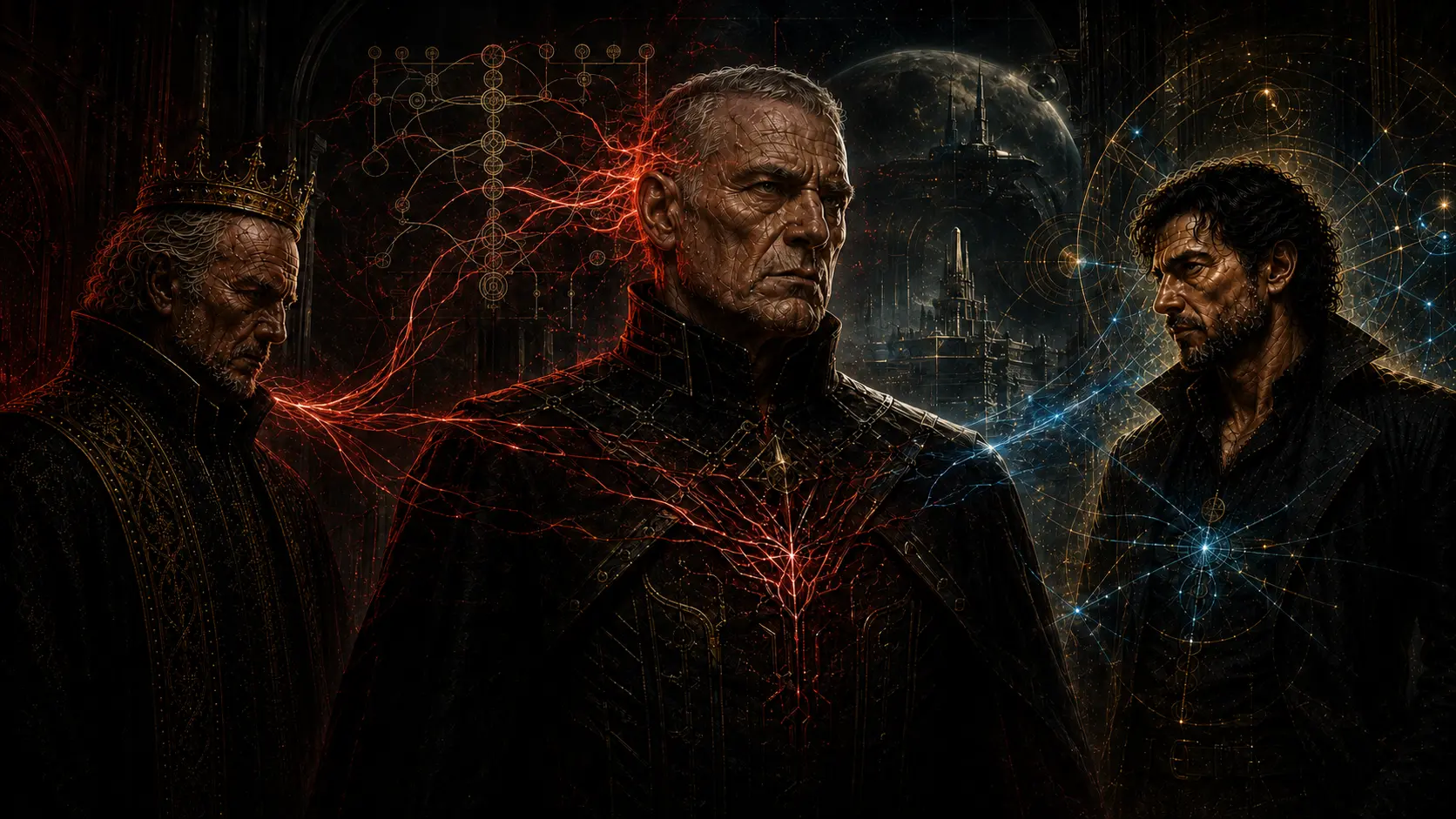
Project Explorer
Inspect the corrected story, trace unresolved causes, and work through source-linked brainstorming packets. The repository browser remains available below.
Development workspace · September 6 workshop pass
All twenty workshop gates have accepted directions. Their unresolved mechanics remain visible. The active Story Completion gate remains SC-010 Question 7.
Public, read-only development material with full spoilers. Draft answers stay in your browser until exported; they do not update the vault. A spoiler boundary is not privacy protection.
The leaders developed Luminai within an interactive colonization environment. Sylvan tests a more deeply integrated generation after thousands of years of development.
Inspect the controlling premiseFinal-years control is established. Stopping authority, cumulative harm, privacy, and remedies still need concrete rules.
Test the leaders' safeguardsKonrad's Daemon verifies an apparent separation. Konrad authorizes reactivation, which attaches his revived system to Samuel's hidden hierarchy. The false evidence still needs definition.
Inspect the takeover resultSamuel and the older criminals remain on the previous containment planet. George participates directly on Sylvan's world, then becomes Samuel's intended scapegoat.
Inspect George's roleStory completion · Live from the vault
The story advances horizontally: every active problem receives the same level of development before any one branch moves deeper.
Integrated foundation review · September 5, 2026
The leaders created an interactive colonization environment and developed Luminai within it. Konrad tries to prove his experienced daemon superior; Samuel turns his reactivation into access. Sylvan already has decisive control during the final years. Exact safeguards and presentation mechanics remain open.
Current method Bound action, observe the method, compare the record, expose the hidden command.
Read the foundation update record9 / 27story tasks complete
Project explorer
Search or browse 539 documents across canon, development systems, story loops, prose tools, public work, and session history.
Name update: George White supersedes the earlier working name Logan.
The throwaway prince; aging son of the Throne figure and one of the clearest human examples of what a manufactured reality can do to a person.
George White is approximately 130 years old chronologically, but at this stage of the process he appears to be about 75. In the parent civilization, human aging has been effectively defeated, so his chronological age is extraordinary by present-day standards but not biologically impossible within the setting.
George was secretly placed into containment before the wider faction understood what had happened. His father then allowed or engineered circumstances in which George could believe he occupied a legitimate and important position inside the larger order.
The deception became useful. Other members of the defeated faction could interpret George's apparent position as evidence that their side had retained influence, negotiated successfully, or even secretly won. George himself became part of the proof supporting a false victory narrative without necessarily understanding that this was his function.
The tragedy is that George is not merely pretending. He has lived inside the manufactured reality long enough for it to become his biography. The identity that outsiders may eventually recognize as constructed is, from George's perspective, simply his life.
The current generated visual interpretation is the locked development reference for George's appearance. It establishes the character's visual age, bearing, and emotional direction for development while leaving final-story surface details open to later revision.
George is approximately 130 years old, while visually presenting as roughly 75. He is recognizably an old prince: cultivated, expensive, educated, and accustomed to being treated as though his presence carries significance. But the image should never make him look securely powerful. His presentation belongs to a world whose foundations are disappearing beneath him.
The distinction between chronological age and apparent age is essential. George's awakening is frightening precisely because it does not happen at the beginning of his life. He has accumulated well over a century of lived history, while still inhabiting a body that appears decades younger than that number would suggest by present-day standards. He has memories, relationships, loyalties, grievances, achievements, humiliations, and assumptions invested in the identity his father allowed him to inhabit. There is no easy reset available to him.
Visually, George should carry the remnants of aristocratic or establishment confidence while increasingly displaying uncertainty underneath it. He can still dress well. He can still speak as though people should listen. But his eyes and posture should betray the growing possibility that he no longer knows what room he is standing in, metaphorically or literally.
George's title in development is not meant to imply that George understands himself as disposable. The cruelty is that his father does.
The Throne figure weaponized his own son as part of a larger deception. George's apparent status could be used to reassure followers, misdirect rivals, support claims of legitimacy, and conceal the reality of containment. George could be protected when useful, isolated when inconvenient, and kept ignorant of information that might allow him to understand his actual position.
This makes George simultaneously privileged and exploited. He may have experienced comfort, status, deference, and apparent authority while remaining profoundly unfree.
George's lifelong AI soul participates in the experienced reality around him. The working story functionality allows the technologically sophisticated environment to mediate what George can perceive, know, interpret, remember in context, and consider possible.
This should not reduce him to a puppet. George still makes choices inside the reality available to him. The more interesting problem is that authentic choices can be made from manipulated premises.
His father does not need to script every moment of George's life. He only needs sufficient control over the boundaries of what George believes is possible.
George's awakening should feel less like receiving secret information and more like the catastrophic failure of reality itself.
He begins discovering that events he regarded as settled have other explanations. People he understood as allies may have been custodians. Positions he believed he earned may have been roles. Conflicts he believed he won may have been managed. His father's protection begins to resemble confinement. His importance begins to resemble utility.
Then comes the worst realization: the deception may not surround his life. It may be his life.
At approximately 130 years old, George cannot comfort himself with the idea that he will simply begin again. Every memory becomes evidence requiring reexamination. Every relationship acquires a second interpretation. Even moments that were emotionally genuine become contaminated by uncertainty about the conditions under which they occurred.
The immediate emotional direction is therefore confusion, fear, humiliation, disbelief, and impending consequence. George senses that something enormous is approaching before he fully understands what it is. He knows that people around him suddenly possess information he does not. He realizes explanations are no longer working. The future is frightening, but the past is becoming worse.
Sylvan Elaria represents something uniquely threatening to George: a younger man carrying evidence from outside George's accepted version of history.
Sylvan does not merely challenge George's authority. His evidence potentially demonstrates that the assumptions supporting George's identity were constructed. This gives their encounters a fundamentally different emotional charge from the Sylvan-Throne conflict.
To the Throne figure, Sylvan threatens exposure.
To George, Sylvan threatens ontology: Who was I if he is telling the truth?
Their visual confrontation should reflect this. George is chronologically about 130 but visually about 75, carrying the weight of more than a century of lived experience behind him. Sylvan, around forty, carries evidence and consequence toward him. Neither needs to posture theatrically. George's fear comes from gradually understanding what Sylvan represents.
The Throne figure is George's father and the architect or principal beneficiary of the deception surrounding him.
The relationship should retain genuine emotional complexity. George may love his father, fear him, admire him, resent him, defend him, depend on him, or move among these states. The eventual discovery that his father knowingly sacrificed George's ability to understand his own circumstances is therefore more damaging than discovering that a distant ruler lied to him.
George has potentially spent more than a century defending the person responsible for his confinement.
The father's ultimate betrayal is not simply that he lied to George. It is that he treated George's identity as an instrument.
George demonstrates the human cost of the story's layered realities.
At the geopolitical level, false histories and secret arrangements can look like mysteries. Through George, those abstractions become personal. A manufactured history means manufactured memories of status. Information gating means a person discovering everyone else knew something about his life that he did not. Story functionality means that the narrative protecting a regime may also be the narrative holding a human identity together.
His age deepens that function. A person can survive for 130 years and still discover that longevity did not protect him from manipulation. The civilization defeated aging, but it did not defeat coercion, deception, or the consequences of spending a century inside someone else's design.
George therefore should not function merely as a villain who gets exposed. His collapse can reveal why the system is terrifying even when the person inside it has benefited from it.