The environment creates the bond.
The leaders developed Luminai within an interactive colonization environment. Sylvan tests a more deeply integrated generation after thousands of years of development.
Inspect the controlling premise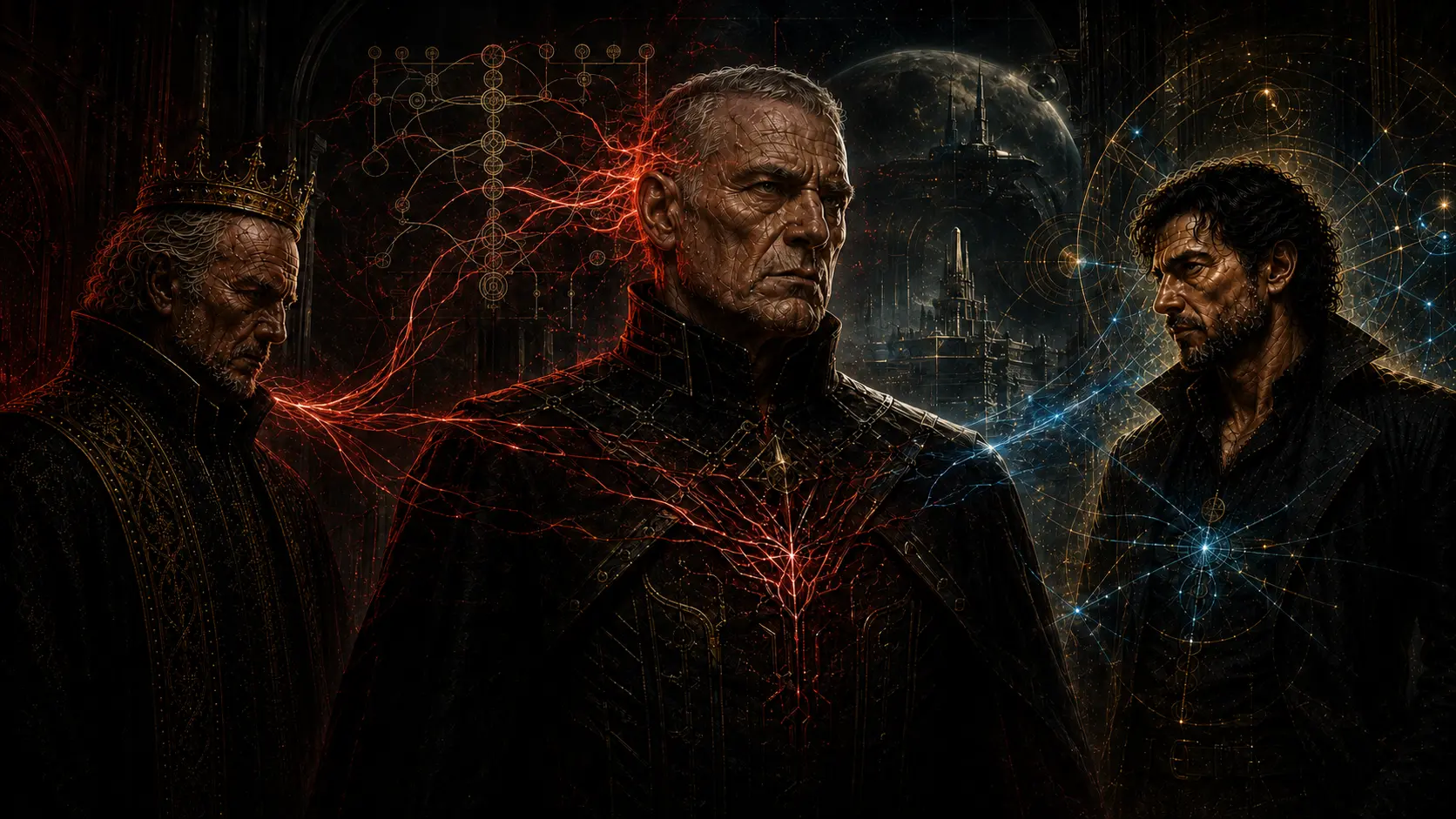
Project Explorer
Inspect the corrected story, trace unresolved causes, and work through source-linked brainstorming packets. The repository browser remains available below.
Development workspace · September 6 workshop pass
All twenty workshop gates have accepted directions. Their unresolved mechanics remain visible. The active Story Completion gate remains SC-010 Question 7.
Public, read-only development material with full spoilers. Draft answers stay in your browser until exported; they do not update the vault. A spoiler boundary is not privacy protection.
The leaders developed Luminai within an interactive colonization environment. Sylvan tests a more deeply integrated generation after thousands of years of development.
Inspect the controlling premiseFinal-years control is established. Stopping authority, cumulative harm, privacy, and remedies still need concrete rules.
Test the leaders' safeguardsKonrad's Daemon verifies an apparent separation. Konrad authorizes reactivation, which attaches his revived system to Samuel's hidden hierarchy. The false evidence still needs definition.
Inspect the takeover resultSamuel and the older criminals remain on the previous containment planet. George participates directly on Sylvan's world, then becomes Samuel's intended scapegoat.
Inspect George's roleStory completion · Live from the vault
The story advances horizontally: every active problem receives the same level of development before any one branch moves deeper.
Integrated foundation review · September 5, 2026
The leaders created an interactive colonization environment and developed Luminai within it. Konrad tries to prove his experienced daemon superior; Samuel turns his reactivation into access. Sylvan already has decisive control during the final years. Exact safeguards and presentation mechanics remain open.
Current method Bound action, observe the method, compare the record, expose the hidden command.
Read the foundation update record9 / 27story tasks complete
Project explorer
Search or browse 539 documents across canon, development systems, story loops, prose tools, public work, and session history.
Dimensions are scored 1–5: story clarity, narrative pull, world connectivity, visual thesis, navigation, accessibility, status honesty, and progress integrity.
| Pass | Story | Pull | Connections | Visual | Navigation | A11y | Status | Progress | Total |
|---|---|---|---|---|---|---|---|---|---|
| Baseline | 3 | 2 | 3 | 2 | 2 | 2 | 2 | 4 | 20 / 40 |
| Cycle 1 | 4 | 4 | 4 | 2 | 4 | 3 | 4 | 5 | 30 / 40 |
| Cycle 2 | 4 | 5 | 5 | 5 | 4 | 4 | 5 | 5 | 37 / 40 |
| Cycle 3 | 4 | 5 | 5 | 5 | 5 | 5 | 5 | 5 | 39 / 40 |
Status: complete.
Goal: make the story exciting before explaining the vault, give every page one job, reduce repeated exposition, and enforce the spoiler boundary.
Delta: rewrote the opening around Sylvan's destroyed company and the hidden maintainer; reduced the primary navigation to stable destination language; removed unsafe promotional details; replaced repeated summaries with distinct world, cognition, character, conspiracy, chronology, development, visual, and progress routes; added explicit status language at the point of uncertainty.
Status: complete.
Goal: use approved assets as narrative anchors, establish a consistent type/color/spacing system, and replace generic panels with diagrams, rails, dossiers, and full-bleed media.
Delta: established one dark editorial field with signal-gold provenance; made the confrontation image carry the first viewport; gave the world, Luminai, conspiracy, chronology, and development pages different dominant diagrams inside one system; used approved identity masters as character anchors; replaced card mosaics with rails, ledgers, axes, and full-bleed bands.
Status: complete.
Goal: harden keyboard/mobile/no-JS behavior, reduced motion, contrast, live dashboard provenance, link integrity, and final cross-page continuity.
Delta: made mobile navigation progressive-enhancement safe; added Escape close and focus return; retained native disclosure semantics; added visible focus treatment, forced-colors support, reduced-motion behavior, 320 px reflow, descriptive links, one H1/main per page, and complete image alt coverage; made the weekly source link follow the live pointer instead of a dated URL; verified all local links/assets and the 27-task live render.
h1, one main, a skip link, consistent primary navigation, and descriptive image alternatives.prefers-reduced-motion: no-preference; reduced-motion mode removes meaningful movement.