The environment creates the bond.
The leaders developed Luminai within an interactive colonization environment. Sylvan tests a more deeply integrated generation after thousands of years of development.
Inspect the controlling premise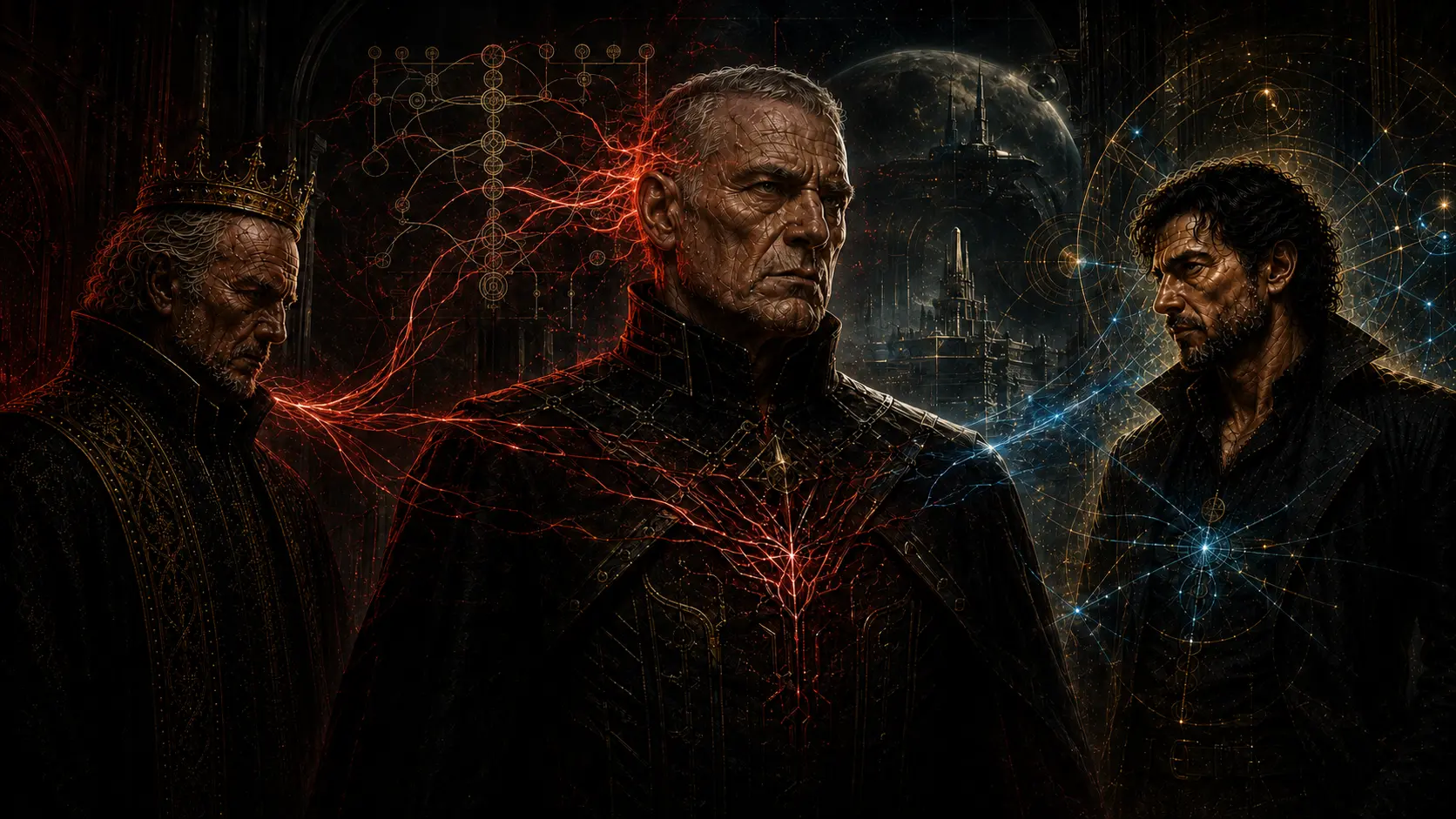
Project Explorer
Inspect the corrected story, trace unresolved causes, and work through source-linked brainstorming packets. The repository browser remains available below.
Development workspace · September 6 workshop pass
All twenty workshop gates have accepted directions. Their unresolved mechanics remain visible. The active Story Completion gate remains SC-010 Question 7.
Public, read-only development material with full spoilers. Draft answers stay in your browser until exported; they do not update the vault. A spoiler boundary is not privacy protection.
The leaders developed Luminai within an interactive colonization environment. Sylvan tests a more deeply integrated generation after thousands of years of development.
Inspect the controlling premiseFinal-years control is established. Stopping authority, cumulative harm, privacy, and remedies still need concrete rules.
Test the leaders' safeguardsKonrad's Daemon verifies an apparent separation. Konrad authorizes reactivation, which attaches his revived system to Samuel's hidden hierarchy. The false evidence still needs definition.
Inspect the takeover resultSamuel and the older criminals remain on the previous containment planet. George participates directly on Sylvan's world, then becomes Samuel's intended scapegoat.
Inspect George's roleStory completion · Live from the vault
The story advances horizontally: every active problem receives the same level of development before any one branch moves deeper.
Integrated foundation review · September 5, 2026
The leaders created an interactive colonization environment and developed Luminai within it. Konrad tries to prove his experienced daemon superior; Samuel turns his reactivation into access. Sylvan already has decisive control during the final years. Exact safeguards and presentation mechanics remain open.
Current method Bound action, observe the method, compare the record, expose the hidden command.
Read the foundation update record9 / 27story tasks complete
Project explorer
Search or browse 539 documents across canon, development systems, story loops, prose tools, public work, and session history.
Revision should solve a named problem without erasing the choices that already make the passage specific. Diagnose before rewriting.
Work from largest to smallest:
Do not line-polish a scene whose dramatic engine is wrong.
Name the selected pass in the response. If a development problem remains, stop before a full line edit unless the author explicitly requests a limited sentence repair.
Ask what changes because this passage exists. Cut or redesign beats that merely repeat setup, lore, emotion, or conclusion.
Identify the most important change in pressure, knowledge, choice, or interpretation. Ask whether it appears where the reader can use it and whether setup, lore, or throat-clearing buries it.
This is a placement diagnosis, not a command to reveal the answer early. Suspense may require delay. If the turn is deliberately withheld, verify that the preceding material creates useful expectation or pressure rather than confusion.
Trace each important action to a want, belief, fear, loyalty, or tactical response. Remove actions performed only because the plot needs them.
Mark what the POV can know, infer, misread, and not know. Check that narration does not quietly inherit vault omniscience.
For each explanatory sentence, identify why the reader needs it now and why this is the best delivery channel. Compress, delay, dramatize, or cut when necessary.
Identify what each speaker is trying to make happen. Remove lines that only paraphrase narration or teach lore.
Replace vague abstractions with a small number of consequential physical, procedural, or institutional details. Do not add decorative detail everywhere.
Identify the passage's local cadence before changing it. Mark where attention, pressure, knowledge, or tactic changes. Let sentence and paragraph shape respond at those points, and remove accidental rhetorical templates or overused one-line emphasis.
Check both failure directions:
Correct the cause before the surface. Expand what the viewpoint cannot leave alone, compress what it avoids or already knows, and break cadence only where cognition or circumstance changes. Do not revise toward a numerical sentence-length target.
Use anti-ai-prose.md and scripts/prose_lint.py if available.
When the passage has passed through outlines, prototypes, critique, or AI-assisted revision, use tracks-pass.md to remove finished development scaffolding. Preserve intentional documentary framing, public status labels, and visible uncertainty.
Before changing a strong or unusual sentence, state what problem the change solves. If there is no concrete answer, leave it alone.
Match the intensity to the author's request. Do not escalate a surgical request into a stylistic rewrite.
When presenting alternatives, vary a consequential craft choice: distance, information timing, tactic, exposition channel, or ending type. Do not offer three synonym swaps as three versions.
Stop revising when the named problem is solved and further edits become lateral preference changes. Polish is not automatically progress.