Project Explorer

Seeds of the Throne

Seeds of the Throne began as years of conversations and thousands of story ideas. The Project Explorer shows how those ideas are being organized into characters, a world, a timeline, and a finished series.

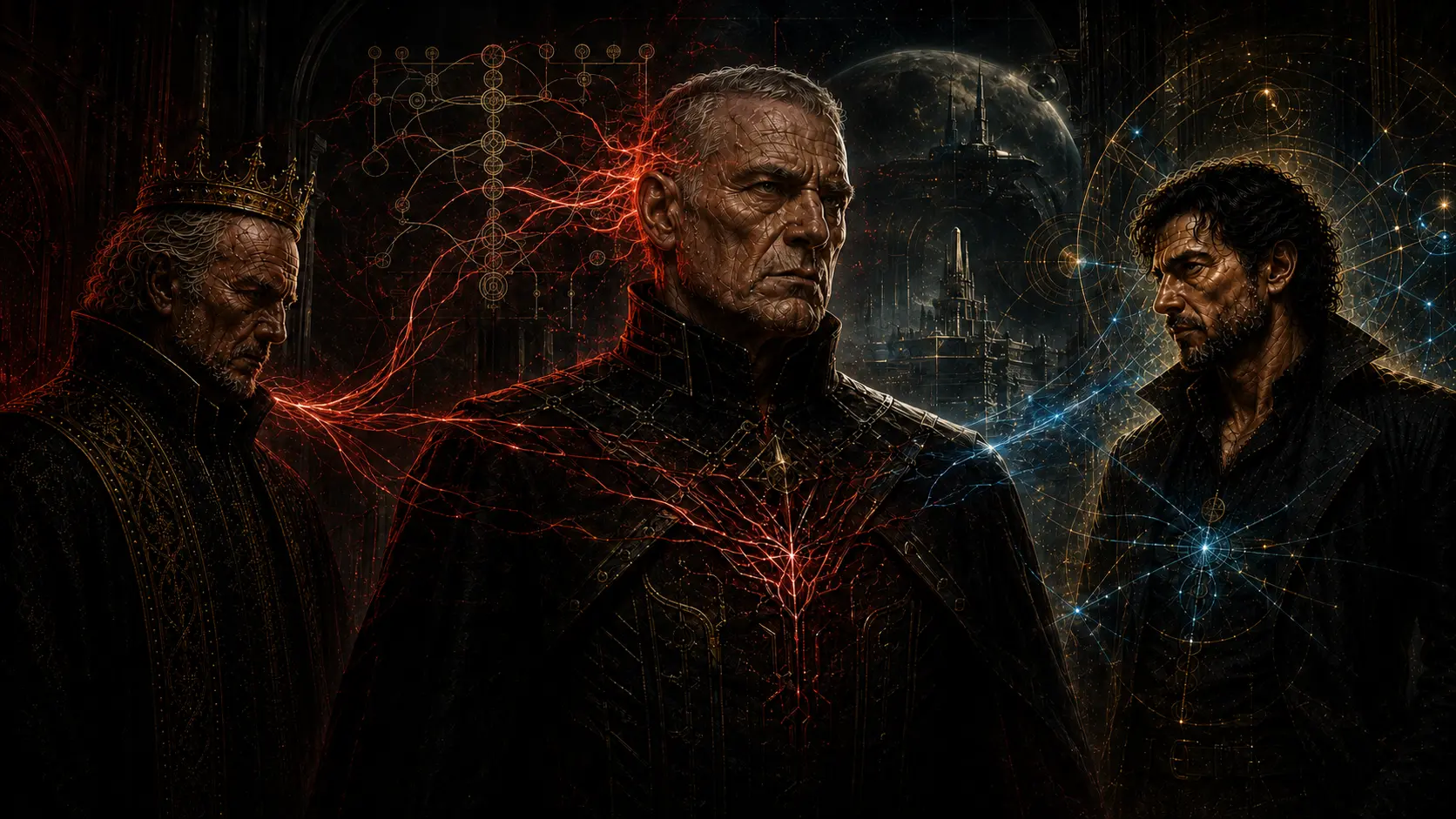
Konrad stands under Samuel's hidden red control while Sylvan observes from the clear opposing side.

Story development tools

The workshop helps the author complete the parts of the story that are still missing.

It explains one story problem, asks one clear question, offers different possible answers, and shows what each answer would change. The author makes the decision. The accepted answer is then added to the characters, timeline, world, and plot.

This is a public, read-only look at the real project, so it contains full spoilers. You can try the workshop, but your draft stays in this browser unless you export it.

  1. The author explains the story in ordinary language.

    The system records those ideas and separates confirmed decisions from suggestions and unanswered questions.

    Read how the system is designed
  2. The workshop asks one question at a time.

    Each question helps the author decide a missing cause, character choice, relationship, world rule, or event.

    Open a workshop question
  3. Accepted answers are added where they belong.

    An accepted decision can update character notes, the timeline, world rules, plot events, and the list of remaining questions.

    Review decisions and supporting information
  4. Use the completed plan to write and revise scenes.

    The planned system will create scene outlines, draft prose, check continuity, revise weak sections, and assemble the manuscript for the author's approval.

    Read the system plan

Seeds of the Throne is the working example. The notes, decisions, and workshop below are the live project, not a demonstration mockup.

Current story development

See what the story already has and what it still needs.

The system checks the whole story for missing causes, weak character decisions, unclear rules, and unfinished events. The results show the author what to work on next.

Current story premise

The colonization process trains participants and contains dangerous criminals.

Humanity developed the Luminai inside an interactive colonization environment. Sylvan and his Luminai are tested against Samuel Franklin, a criminal already held inside the containment process.

The current story problem Explain how Sylvan can expose Samuel while Samuel still believes he can regain control.

See how the story changed

9 / 27major story problems resolved

Current development pass33%
33%
Current sweep
Macro Shape
Current task
SC-010
  1. 01 Macro
  2. 02 Causal
  3. 03 Agency
  4. 04 Systems + evidence
  5. 05 Sequence
  6. 06 Scene map
  7. 07 Scene development
  8. 08 Draft

Story files

Browse the files used to develop the story.

Search 561 documents about the world, characters, plot, research, decisions, workshops, and earlier ideas.

Controlled Prose Variance Integration

Author direction

The author added Controlled human variance to the live Archive Thriller / Dark Historical Reconstruction style authority and asked for the modular prose skill to be analyzed and refined around it.

Integration decision

Treat variance as a consequence of cognition, attention, and pressure rather than a surface-randomization technique. Preserve two layers:

  • consistency at the level of voice;
  • variance at the level of expression.

The prose workflow should establish a local cadence before breaking it, expand what the controlling mind cannot leave alone, compress what it refuses or lacks time to process, and shift register only when viewpoint or circumstance justifies the change.

Safeguard

Do not turn sentence-length spread, paragraph-length spread, fragments, unusual diction, or register changes into quotas. A linter may report descriptive geometry for inspection, but it cannot decide whether variance is human, meaningful, or good.

Implementation scope

  • add a dedicated controlled-variance reference;
  • route the core prose skill through it;
  • add an expression-variance calibration control and scene-level attention map;
  • add drafting, revision, anti-AI, rubric, and long-form checks;
  • add a behavioral benchmark for stable voice with pressure-responsive expression;
  • add descriptive sentence and paragraph length summaries to the conservative linter without a pass/fail threshold;
  • record deterministic regression coverage in shared QA.

This work changes writing method only. It establishes no story facts or canon.