The environment creates the bond.
The leaders developed Luminai within an interactive colonization environment. Sylvan tests a more deeply integrated generation after thousands of years of development.
Inspect the controlling premise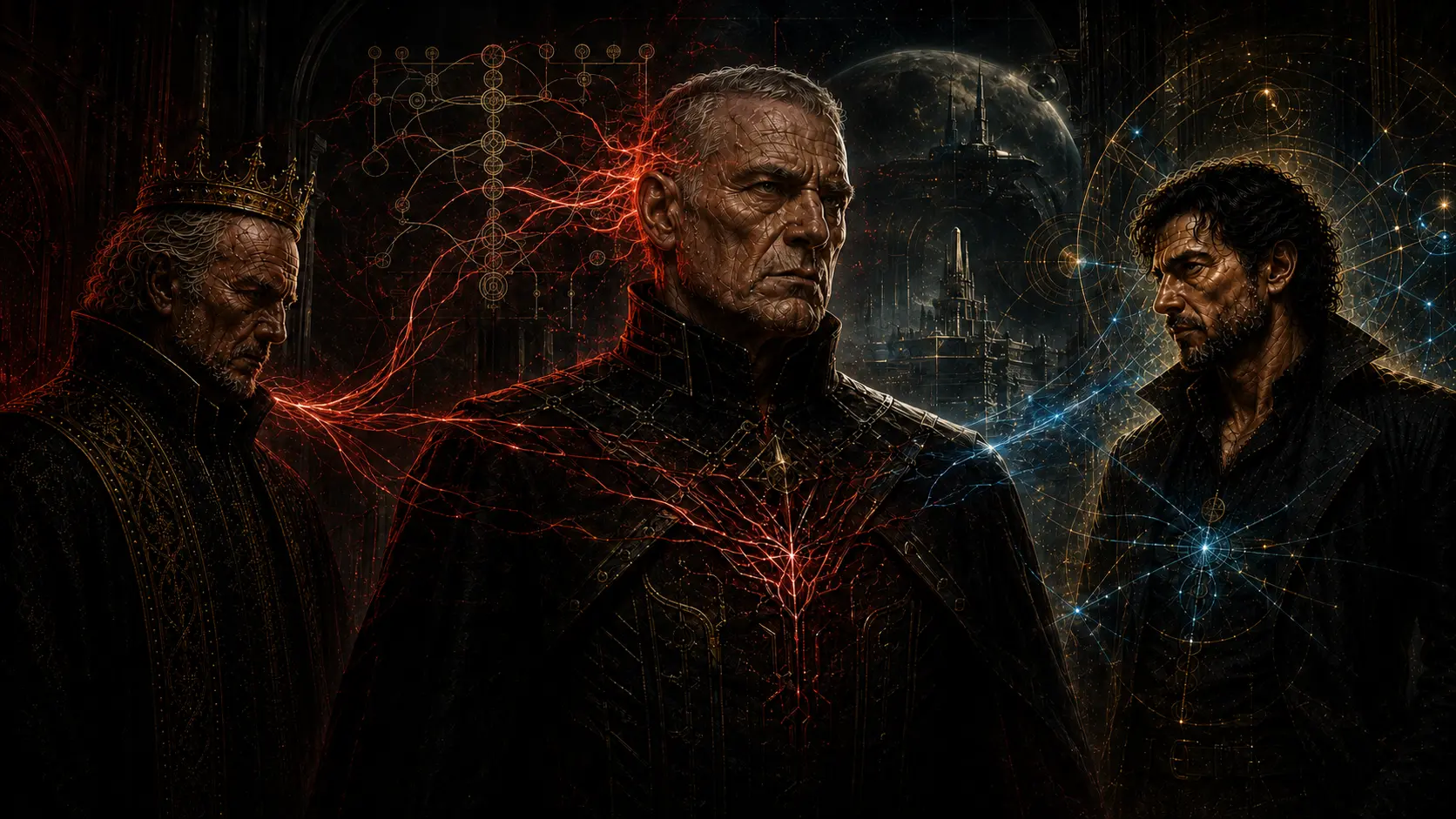
Project Explorer
Inspect the corrected story, trace unresolved causes, and work through source-linked brainstorming packets. The repository browser remains available below.
Development workspace · September 6 workshop pass
All twenty workshop gates have accepted directions. Their unresolved mechanics remain visible. The active Story Completion gate remains SC-010 Question 7.
Public, read-only development material with full spoilers. Draft answers stay in your browser until exported; they do not update the vault. A spoiler boundary is not privacy protection.
The leaders developed Luminai within an interactive colonization environment. Sylvan tests a more deeply integrated generation after thousands of years of development.
Inspect the controlling premiseFinal-years control is established. Stopping authority, cumulative harm, privacy, and remedies still need concrete rules.
Test the leaders' safeguardsKonrad's Daemon verifies an apparent separation. Konrad authorizes reactivation, which attaches his revived system to Samuel's hidden hierarchy. The false evidence still needs definition.
Inspect the takeover resultSamuel and the older criminals remain on the previous containment planet. George participates directly on Sylvan's world, then becomes Samuel's intended scapegoat.
Inspect George's roleStory completion · Live from the vault
The story advances horizontally: every active problem receives the same level of development before any one branch moves deeper.
Integrated foundation review · September 5, 2026
The leaders created an interactive colonization environment and developed Luminai within it. Konrad tries to prove his experienced daemon superior; Samuel turns his reactivation into access. Sylvan already has decisive control during the final years. Exact safeguards and presentation mechanics remain open.
Current method Bound action, observe the method, compare the record, expose the hidden command.
Read the foundation update record9 / 27story tasks complete
Project explorer
Search or browse 539 documents across canon, development systems, story loops, prose tools, public work, and session history.
Konrad thinks Samuel is giving him back his empire. In reality, Konrad has just migrated the machinery of his organization into Samuel's jurisdiction.
This is the key post-Great-War deception between Samuel and Konrad.
Samuel remains an outsider after the Great War. Konrad still regards him as a disgraced, pathetic failure who got himself and George caught decades earlier. Samuel does not become respected, restored, or welcomed back into the Fitzgerald order.
Samuel has, however, spent years inside containment and eventually gains real bounded control over his own separate containment environment. That local control is genuine. What is false is Samuel's representation of its scale.
Samuel convinces Konrad that the responsiveness and authority visible inside Samuel's domain prove that Samuel has much broader influence over the containment system than he really possesses.
Konrad has lost the Great War and wants to restore the institutions, programs, genealogical machinery, hierarchy, records, and other systems that made his movement function.
Samuel offers him a path to reactivate them.
Konrad's programs cannot simply be seized by Samuel. They remain tied to Konrad's authority, history, identity, or explicit authorization.
Samuel provides the environment.
Konrad provides the authorization.
Konrad therefore reactivates or redeploys important pieces of the Fitzgerald organization inside Samuel's containment domain.
This creates the decisive asymmetry:
Software-development analogy for internal design only:
Konrad owns the application. Samuel controls the host.
Do not explain the analogy directly in prose unless useful for developer-facing commentary.
Konrad does not need to respect Samuel.
He can continue viewing Samuel as vulgar, incompetent, embarrassing, and beneath him while still believing Samuel happens to control infrastructure that Konrad desperately needs.
That preserves Konrad's arrogance and makes the failure more believable. He is not submitting to Samuel as a leader. He is using a low-status intermediary whom he assumes can restore systems that properly belong to Konrad.
Samuel can tolerate the contempt because the important thing is that Konrad keeps moving more of the organization's machinery into Samuel's domain.
Once key Fitzgerald programs operate inside Samuel's environment, Samuel can potentially gain access to:
This becomes a causal path toward Samuel's later surveillance, manipulation of the breeding program, genealogical fraud, blackmail, and gradual appropriation of the Fitzgerald order.
The Fitzgerald order once controlled Samuel by disguising exile as important responsibility.
After Konrad's defeat, Samuel reverses the method: he disguises dependency as restoration.
Konrad believes he is rebuilding his lost empire.
He is actually installing the machinery of that empire inside the domain of the man he still considers a loser.