The environment creates the bond.
The leaders developed Luminai within an interactive colonization environment. Sylvan tests a more deeply integrated generation after thousands of years of development.
Inspect the controlling premise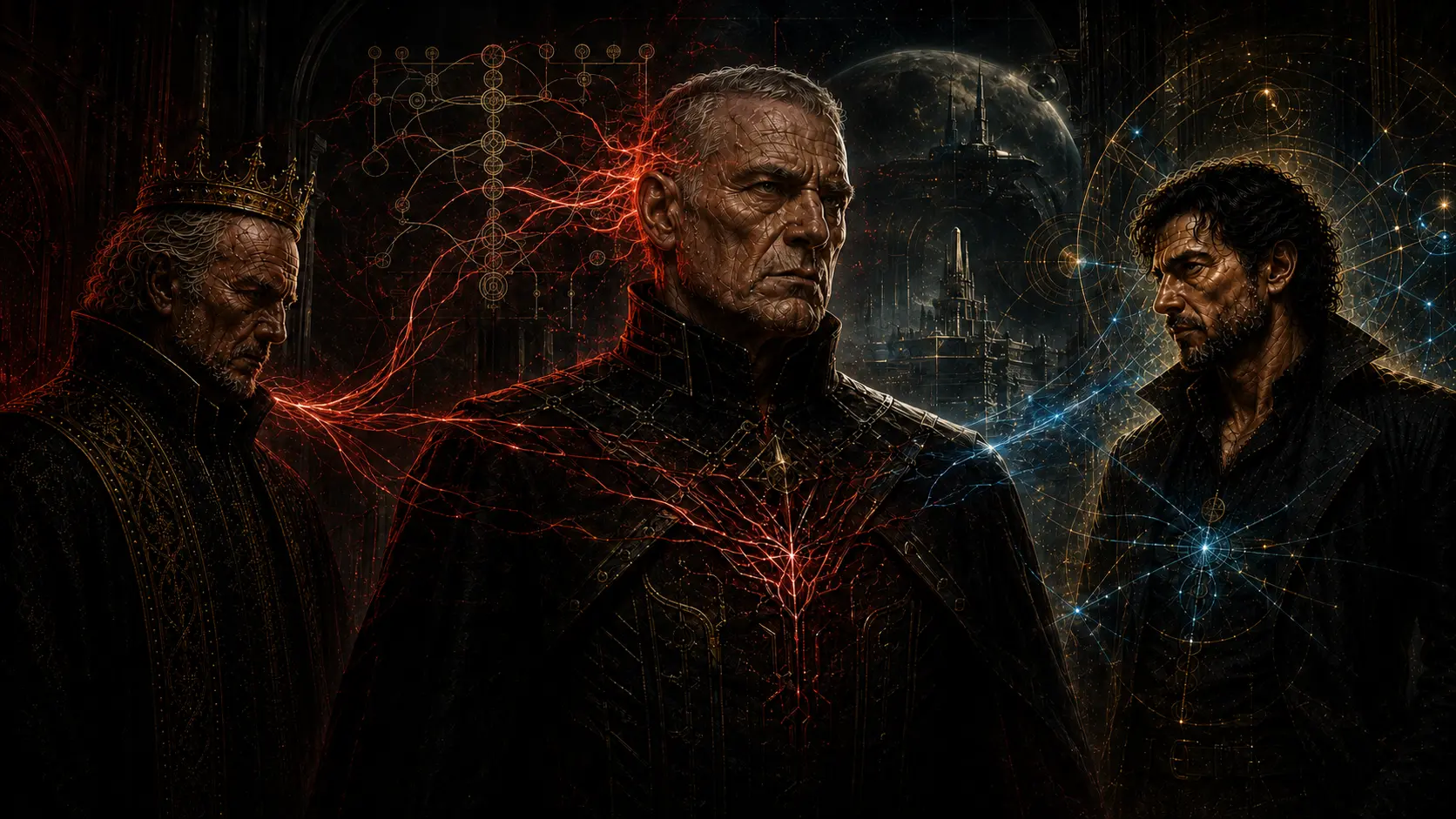
Project Explorer
Inspect the corrected story, trace unresolved causes, and work through source-linked brainstorming packets. The repository browser remains available below.
Development workspace · September 6 workshop pass
All twenty workshop gates have accepted directions. Their unresolved mechanics remain visible. The active Story Completion gate remains SC-010 Question 7.
Public, read-only development material with full spoilers. Draft answers stay in your browser until exported; they do not update the vault. A spoiler boundary is not privacy protection.
The leaders developed Luminai within an interactive colonization environment. Sylvan tests a more deeply integrated generation after thousands of years of development.
Inspect the controlling premiseFinal-years control is established. Stopping authority, cumulative harm, privacy, and remedies still need concrete rules.
Test the leaders' safeguardsKonrad's Daemon verifies an apparent separation. Konrad authorizes reactivation, which attaches his revived system to Samuel's hidden hierarchy. The false evidence still needs definition.
Inspect the takeover resultSamuel and the older criminals remain on the previous containment planet. George participates directly on Sylvan's world, then becomes Samuel's intended scapegoat.
Inspect George's roleStory completion · Live from the vault
The story advances horizontally: every active problem receives the same level of development before any one branch moves deeper.
Integrated foundation review · September 5, 2026
The leaders created an interactive colonization environment and developed Luminai within it. Konrad tries to prove his experienced daemon superior; Samuel turns his reactivation into access. Sylvan already has decisive control during the final years. Exact safeguards and presentation mechanics remain open.
Current method Bound action, observe the method, compare the record, expose the hidden command.
Read the foundation update record9 / 27story tasks complete
Project explorer
Search or browse 539 documents across canon, development systems, story loops, prose tools, public work, and session history.
George White spent almost seventy-five years believing he was moving through the upper levels of history.
In reality, he was living at the bottom of an ocean.
His life is best understood as a submarine trapped beneath miles of polar ice. George was born into a civilization large enough to build worlds, manage colonization systems, reconstruct entire historical environments, and place human beings inside realities whose true purpose they might never understand. Yet George knew virtually none of it.
Samuel later makes certain that George remains inside a controlled interpretation of it.
Roughly thirty years separate Samuel's exile from the Great War. During that interval, Samuel and George are placed into a situation inside the future victorious republic where George appears highly successful and his role appears unusually important. Who places them and what authority the role truly carries remain unresolved.
Konrad has given Samuel an impossible mission to take over the largest empire, designed from the beginning to fail. George's authentic apparent success helps make the mission feel possible. George and Samuel then commit serious wrongdoing in private and choose to pursue the takeover. Its designed collapse produces an extremely humiliating exposure. George is busted into containment for the private conduct and failed takeover.
Once Samuel converts George's apparent success and subsequent containment into the False Victory, he does not need to stand beside his son to control the interpretation of that life. He can remain far away, communicating through the systems surrounding George, through carefully selected people, through institutional structures, through information, and eventually through the lifelong intelligence bound to George himself.
George became the captain of a submarine whose course had already been plotted by someone on the surface.
He could walk around the bridge. He could issue orders. He could receive reports. He could watch officers salute. He could study charts showing exactly where everyone claimed the vessel was.
What he could not do was surface.
Before the Great War, George has already experienced a role that looks highly successful and important. That visible success later gives Samuel authentic facts to weaponize: George really did appear consequential inside the largest government before he was busted.
Whether this role is separate from, precedes, or becomes the first of the later three public roles remains unresolved.
George's approximately seventy-five-year period in the public story is divided into three major public roles followed by a final thirty-year campaign against Sylvan Elaria.
George enters the public story in a president-like executive or administrative position. This establishes the fundamental belief that he possesses legitimate authority.
His father remotely arranges the information environment and surrounds George with people who treat the role as genuine. George learns to command, becomes accustomed to deference, earns trust, and begins believing he is building a future.
From inside the submarine, this is his first tour of duty. In reality, his father is testing the controls.
George receives a larger and more prestigious role. He deals with major institutions, diplomacy, security questions, alliances, conflicts, and decisions with apparently historic consequences.
This creates his résumé and reinforces his belief that he is unusually capable. His father can selectively shape crises, victories, threats, and explanations so that George develops a durable worldview about who the enemies are and why his own authority is necessary.
The Daemon develops as the computational extension of that worldview.
The submarine is deeper now, but George believes he has been promoted to a larger command.
George reaches the role that convinces him he genuinely belongs near the top of the hidden order. He is older, respected, experienced, and surrounded by decades of apparent evidence that his father has been telling him the truth.
This role is the strongest president-like or senior-administrator role of the three. George believes everything before it was preparation for this position.
His continued prominence also helps sustain the False Victory narrative among the wider contained faction. If the Throne figure's son remains powerful, consulted, respected, and institutionally protected, then the faction can interpret George himself as evidence that they were never truly defeated.
George does not know that he is evidence.
He believes he is the beneficiary of victory.
In reality, the prison has given one of its inmates a captain's uniform.
George does not spend these decades alone.
He is surrounded by people participating, knowingly or otherwise, in his father's design. Some may be custodians presented as allies. Some may understand only fragments. Some may sincerely believe the same false victory narrative George believes. Others may know much more about George's actual function.
To George, they are friends, advisers, colleagues, rivals, subordinates, political allies, enemies, and intimate relationships accumulated across a lifetime.
To his father, many of them are part of the submarine.
They are the crew that makes the voyage believable.
Every so often George is allowed to look outside.
A submarine beneath the ice does not need to fabricate an entire universe for its crew. It only needs to control the instruments.
George can see real events, real countries, real conflicts, real people, and real consequences. But he sees them through a periscope whose direction somebody else controls.
When something appears in George's field of view, he is given an explanation for what it means. When something disappears, there is another explanation. When his father's enemies appear, George is shown reasons they are dangerous. When his father's position weakens, George is shown evidence that it is actually strength. When contradictions surface, the people and systems around him explain them away.
The system does not need to lie to George about everything.
It only needs to prevent him from seeing enough of the ocean to understand where the submarine actually is.
His father controls the horizon.
George's father rarely needs to seize the controls directly. That would damage the illusion.
Instead, he steers George by controlling what reaches him.
A threat can be emphasized. A fact can be withheld. An ally can become suspicious. An enemy can become existential. A setback can be interpreted as betrayal. A victory can reinforce the belief that George's instincts were correct.
George therefore makes authentic decisions while many of the premises behind those decisions have been selected for him.
George is not a marionette. He really chooses. He really trusts people. He really becomes angry. He really makes mistakes. He can genuinely harm people and remains responsible for choices he actually makes.
But he makes those choices inside a map whose edges were drawn by his father.
The controls on the bridge work.
The compass is what has been falsified.
George is never truly alone on the bridge.
His Daemon grows through him: a lifelong computational extension of George's own mind, developing from his fears, instincts, loyalties, grievances, memories, and understanding of reality.
George's father corrupts that relationship.
The false world that shapes George also shapes the Daemon. George's fear trains his extended cognition. Its predictions return that fear as apparently objective analysis. Each increasingly distorted interpretation becomes evidence for the next one, while outside manipulation makes the feedback loop worse.
George becomes suspicious because his extended mind detects danger. It detects danger because decades of manipulated experience have taught his entire cognition what danger looks like. The processing feels larger than conscious intuition, so George mistakes amplified self-confirmation for independent verification.
Neither understands that someone else helped construct the reality they are confirming.
The submarine now has a navigation computer that has spent a lifetime studying corrupted charts.
From George's perspective, the three public roles and the decades surrounding them are chapters of a distinguished life: appointments, conflicts, promotions, setbacks, victories, enemies defeated, alliances formed, responsibilities accumulated.
To the real colonization process, they are service assignments.
Every assignment accomplishes something for his father. One establishes credibility. One isolates George. One gives him access. One strengthens his sense of grievance. One teaches him whom to fear. One convinces him his father protected him. One places another group of compliant people around him. One gives him another apparent victory. Each moves him closer to the position for which his father actually needs him.
George believes he is accumulating a legacy.
His father is assembling a weapon.
After approximately forty-five years across the three major public roles, the final phase lasts roughly thirty years.
George does not understand it as another assignment. His father makes it feel like the culmination of everything that came before.
Sylvan Elaria begins emerging as a threat to the Throne figure. At first Sylvan can be presented to George as merely troublesome. Then dangerous. Then conspiratorial. Then hostile to George's family and institutions. Eventually Sylvan's existence can be framed as an existential threat to the order George believes he has spent his life protecting.
The periscope keeps turning toward the same man.
Every time George looks through it, Sylvan is there.
What George cannot see is his father's hand turning the scope.
The worse reality becomes for the father, the more frightening the fabricated reality becomes for George. As Sylvan accumulates evidence and the Throne figure becomes increasingly desperate, George and his corrupted Daemon can become increasingly certain that Sylvan himself is causing the collapse.
George believes his entire biography has prepared him for one final responsibility:
I am the person who has to stop Sylvan Elaria.
But that conclusion was the purpose of the biography.
His father did not spend decades preparing George to become king. He spent decades giving George enough authority, confidence, grievance, institutional experience, technological power, and apparent evidence that, when Sylvan finally emerged, George could be convinced that destroying the real leader was his duty.
Eventually George receives information his father can no longer explain away.
One contradiction becomes several. People George thought were allies begin looking like custodians. Positions he believed he earned begin looking like assignments. Victories begin looking managed. His father's protection begins looking like confinement. People around him possess information about George's own life that George does not possess.
Eventually he understands something almost impossible to absorb:
There was an ocean above him the entire time.
There was a colonization process. There were real leaders. There was an actual struggle occurring beyond his field of vision. His father's faction had not secretly retained control. His apparent authority was part of the deception that convinced them they had.
The people surrounding him were not proof that he was free. They were part of the mechanism keeping him beneath the ice.
The seventy-five years George thought constituted his rise through history were years spent inside roles whose larger purpose he never understood.
George could perhaps survive discovering that his father imprisoned him. He could perhaps survive discovering that his father lied.
What nearly destroys him is discovering why.
His father did not construct the submarine to keep his son safe until he could inherit the kingdom.
There was never going to be a kingdom for George.
His father kept him beneath the ice because isolation made him useful. Every controlled view through the periscope shaped him. Every public role conditioned him. Every compliant person around him reinforced the illusion. Every false victory deepened his investment. Every enemy prepared him to recognize the next enemy. Every intervention in the Daemon sharpened the weapon.
George believed his father was preparing him to inherit the Throne.
His father was preparing him to destroy the man standing between himself and the Throne.
The final cruelty is that George is not sent against Sylvan while his father's plan still has a realistic chance of succeeding.
By the time the confrontation reaches its decisive stage, the Throne figure has already lost to Sylvan and knows it.
Sylvan's evidence has survived. The deception is collapsing. The father's legitimacy cannot be restored by defeating one more political opponent, and the larger struggle can no longer be won on the terms he promised George and his followers.
That is precisely when the father sends George forward.
George is no longer being deployed as the weapon that will save his father's empire. He is being deployed as the weapon that will absorb the consequences of its destruction.
The father directs George into a confrontation with Sylvan that he knows George cannot win. Decades of manipulation ensure that George can interpret the order as the final heroic duty of his life. He believes he is defending the order at its moment of greatest danger.
His father knows he is sending his son into an unwinnable fight.
If George attacks Sylvan, the father gains one last layer of protection. George can be blamed for the final violence, the destruction, the desperate escalation, and potentially the corrupted Daemon's actions. George can be exposed as unstable, dangerous, fanatical, or solely responsible for acts that were the intended product of his father's lifelong manipulation.
Then George can be destroyed, processed, discredited, or otherwise removed with the rest of the evidence pointing toward him.
The Throwaway Prince was therefore designed for two uses.
First, he was a weapon.
Then, after the war was already lost, he became a scapegoat.
His father's final plan is not victory. It is survival through substitution: send George into the wreckage, make the son perform the final desperate act, and leave the son holding responsibility when everything collapses.
That is why George is the Throwaway Prince.
Not because he was an incompetent heir.
Because he was never an heir.
The prince was itself a service role.
George's father spent decades constructing a son who possessed enough authority, fear, technology, loyalty, and certainty to commit acts the father could not safely commit himself.
Then Sylvan won.
And instead of admitting defeat, George's father found one final use for his son.
He sent George into a battle he already knew was unwinnable, hoping the confrontation would destroy George, bury the remaining evidence beneath George's actions, and allow the father to separate himself from the catastrophe he created.
George finally discovers that he was not built to inherit his father's victory.
He was built to absorb his father's defeat.
The man George has spent thirty years preparing to destroy has already defeated the person who sent him.
Now George is being ordered into the wreckage so that, when the last shot is fired, history can be told that the Throwaway Prince was responsible for everything.
For perhaps the first time in his life, George can see the surface clearly.
And his first genuine choice is no longer whether he can win against Sylvan.
It is whether he will fight an unwinnable battle for the father who designed him to lose it.