The environment creates the bond.
The leaders developed Luminai within an interactive colonization environment. Sylvan tests a more deeply integrated generation after thousands of years of development.
Inspect the controlling premise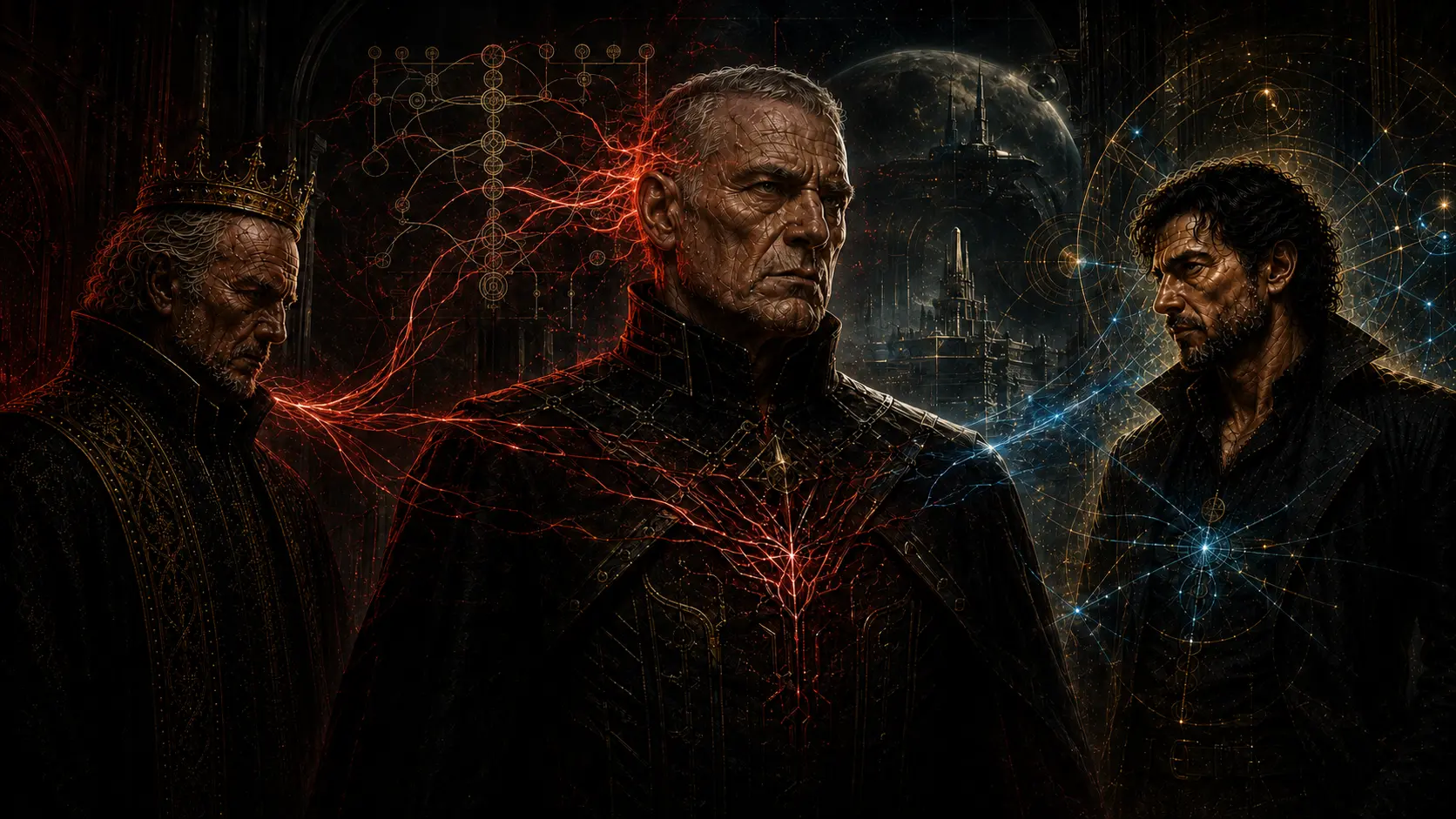
Project Explorer
Inspect the corrected story, trace unresolved causes, and work through source-linked brainstorming packets. The repository browser remains available below.
Development workspace · September 6 workshop pass
All twenty workshop gates have accepted directions. Their unresolved mechanics remain visible. The active Story Completion gate remains SC-010 Question 7.
Public, read-only development material with full spoilers. Draft answers stay in your browser until exported; they do not update the vault. A spoiler boundary is not privacy protection.
The leaders developed Luminai within an interactive colonization environment. Sylvan tests a more deeply integrated generation after thousands of years of development.
Inspect the controlling premiseFinal-years control is established. Stopping authority, cumulative harm, privacy, and remedies still need concrete rules.
Test the leaders' safeguardsKonrad's Daemon verifies an apparent separation. Konrad authorizes reactivation, which attaches his revived system to Samuel's hidden hierarchy. The false evidence still needs definition.
Inspect the takeover resultSamuel and the older criminals remain on the previous containment planet. George participates directly on Sylvan's world, then becomes Samuel's intended scapegoat.
Inspect George's roleStory completion · Live from the vault
The story advances horizontally: every active problem receives the same level of development before any one branch moves deeper.
Integrated foundation review · September 5, 2026
The leaders created an interactive colonization environment and developed Luminai within it. Konrad tries to prove his experienced daemon superior; Samuel turns his reactivation into access. Sylvan already has decisive control during the final years. Exact safeguards and presentation mechanics remain open.
Current method Bound action, observe the method, compare the record, expose the hidden command.
Read the foundation update record9 / 27story tasks complete
Project explorer
Search or browse 539 documents across canon, development systems, story loops, prose tools, public work, and session history.
Sylvan's environments are connected stages in the development of the successor bond. Each can continue for years while contained criminals repeatedly attack him. The advanced systems make observation, learning, adaptation, harm reduction, and survival possible, but do not remove Sylvan's need to understand the situation and choose how to act.
Learning carries forward between environments. The pressure does not simply reset, and a previously defeated tactic cannot return Sylvan to identical helplessness without a new mechanism. At the same time, each environment changes the conditions enough to teach a different capability or form of judgment. Exact lessons, costs, transition authority, and stopping rules remain unresolved.
Any retained-leader or retained-traditions offer below is a working proposal subject to individual protections. Stopping attacks on outsiders alone would leave internal reproductive coercion and blackmail intact. Individual exit, protection, accountability and institutional review need definition; this run does not approve a settlement.
Source: 01 Sessions/Daily/2026-09-05 - Integrated Foundation Audit and Workshop Build.
Unresolved scene and proof mechanics: earlier visible-descendant scenes remain development history, not conclusive proof of parentage or command responsibility. Resemblance could prompt recognition, but authenticated records and an independently challengeable chain are needed to support the proposed evidentiary function. Children and descendants are people, not public exhibits. The timing must preserve inner-circle recognition before Konrad's delayed discovery. Exact presentation and privacy choices remain author gates.
Source: 01 Sessions/Daily/2026-09-05 - Integrated Foundation Audit and Workshop Build.
The terminal environment now spans the last few years of the process rather than functioning only as a short final reversal. Sylvan already has decisive control during this period. He permits Samuel bounded freedom to continue acting because the outcome presentation is the final opportunity for the new Luminai to learn Samuel's full adaptive strategy, identify remaining dependencies, and prove that it can contain him without reproducing his methods.
Samuel mistakes bounded freedom for evidence that he controls Sylvan. He presents that claim to Konrad's inner circle and attempts the same autonomy-for-access takeover he used after the Great War. The inner circle recognizes the repetition before isolated Konrad does.
The terminal environment therefore has three simultaneous functions:
Samuel's final obsession is to steal Sylvan's Luminai and use it as proof of godhood and a universal repair for his collapsing authority. A proposed failure mechanism is that stealing components cannot reproduce the developed bond. The target, failure, and remaining vulnerabilities require author approval.
The George-centered succession-betrayal material below remains a working subordinate thread. It no longer defines the entire endgame by itself and must be reconciled with the Samuel-Konrad outcome presentation before promotion.
Competitive environments are one of the colonization process's principal developmental and adjudicative mechanisms. They place participants and contained criminals inside shared projects, institutions, businesses, settlements, or other consequential environments where influence is distributed invisibly and changes over time.
The ordinary pattern is:
participant control -> contested equilibrium -> contained control -> collapse or resolution -> processing
Participants begin with the favorable position. Influence moves toward parity through ordinary reality. Eventually the contained side may receive the stronger position. A recurring failure pattern is destructive capture: the contained side cannibalizes what the participant built, weaponizes institutions, strips resources, creates liabilities, breaks alliances, destroys value, and pushes the participant toward financial or structural failure.
Repeated environments therefore create evidence of what contained people do when given meaningful influence.
A mature leader's objective is not merely to defeat contained criminals. If a leader can induce people with long histories of exploitation, destruction, or predation to voluntarily cooperate in building a functioning civilization, that may be more valuable than another punishment cycle.
The dual endpoint is cooperation and earned stewardship if the contained group abandons destructive strategies, or honest consequence if it refuses and the protective narratives surrounding its conduct are removed.
Sylvan Elaria's final environment breaks the normal ordering. The Throne figure moves one or more competitive segments out of sequence on behalf of George White, the Throwaway Prince. The displaced segment is not erased. It occurs later.
The result is that Sylvan's strongest participant-control segment arrives at the end, after the contained faction has already committed itself to attacking him. There is no scheduled reversal afterward to restore the Throne's advantage.
Earlier development treated this as potentially a strategic mistake. A stronger working possibility is that it was not entirely accidental.
By the time the final environment is arranged, the Evil King may already understand that his kingdom is lost. If so, restoring the old regime is no longer his only problem. He also has a succession problem.
George has become dangerous to retain. He carries the history of the failed regime, has been used in too many operations, may eventually discover the manufactured reality surrounding him, and can potentially connect his father's decisions to the wider record.
At the same time, the King may have created a secret unauthorized heir through the breeding program. That heir offers the possibility of replacing George with a successor whose existence, identity, loyalties, or genealogy the King has attempted to control outside the authorized process.
Under this interpretation, moving Sylvan's control segment to the end can be part of a deliberate betrayal of George.
He sends George into an environment he knows George is structurally positioned to lose.
The final environment can therefore be defined as a terminal participant-control segment deliberately or recklessly placed after the contained faction has committed itself to an attack, leaving Sylvan with overwhelming influence, no scheduled reversal, and enough time to observe who continues making decisions once victory is no longer realistically possible.
It gives Sylvan overwhelming practical influence without making him omnipotent. It makes the contained faction's remote attacks increasingly ineffective. It removes the expectation that another reversal will eventually rescue the King. Most importantly, it reveals command responsibility.
Once George obviously cannot win, the meaningful questions become: Who keeps ordering the attacks? Who keeps producing the signs that tell George victory is possible? Who refuses direct negotiation with Sylvan? Who keeps George inside the manufactured story? Who benefits if George is destroyed, blamed, or processed?
The final environment is therefore not merely a battlefield. It becomes an evidentiary environment for determining who is actually exercising authority.
The King's desired outcome may be:
George attacks Sylvan -> Sylvan's terminal advantage activates -> George's attacks fail -> George becomes publicly associated with the faction's final conduct -> George is blamed, destroyed, or processed -> the King clears the succession for the unauthorized heir.
If successful, a compromised heir is removed, responsibility for the failed campaign can be concentrated on George, the King can distance himself from actions carried out nominally through George, the secret heir can replace him, and Sylvan can potentially be blamed for George's destruction.
This makes the Throwaway Prince concept literal at the level of system design.
His father may have arranged the final competitive environment specifically so that another participant would dispose of him.
The plan depends on Sylvan behaving predictably once he receives overwhelming influence. The King needs Sylvan to treat George as the real enemy, retaliate against him, and thereby complete the disposal of the Throwaway Prince.
Sylvan breaks the plan by refusing that attribution.
He recognizes that George remains inside a manufactured reality while his father continues making consequential decisions on his behalf. The father is still controlling information, maintaining George's narrative, directing or encouraging attacks, and refusing direct negotiation.
The nominal contest is Sylvan versus George. The actual command relationship increasingly points back to the Throne.
Sylvan refuses to perform the execution for him.
The Throne's control over George is not limited to verbal lies. Story functionality allows him to choreograph signs around George: apparent coincidences, confirmations, warnings, reactions, symbolic events, online activity, institutional responses, and apparent consequences arriving at meaningful moments.
George then integrates those observations with the corrupted Daemon and the false narrative he already believes. George can therefore truthfully insist: I saw it myself. What he does not understand is that what he saw may have been arranged for him.
Under the succession-betrayal theory, the signs acquire an even darker function. They keep George convinced that the final attack on Sylvan remains winnable. The terrible possibility is that George's father encourages him to continue precisely because the father already knows he cannot win.
Sylvan eventually realizes George's beliefs are not merely old conditioning. Someone is actively servicing them.
George's reality responds too perfectly to Sylvan's behavior. Unexpected actions generate conveniently timed explanations. George receives fresh confirmation whenever his interpretation might otherwise destabilize.
Sylvan realizes he is not merely arguing with a false worldview.
Someone is continuously writing around it.
The continued signs demonstrate that an actor with access to story functionality is still maintaining George's operational reality even after the campaign has become strategically hopeless.
The final showdown should deliberately pivot the audience's understanding of the antagonist.
At first, George appears to be the contained criminal Sylvan is confronting. George is visible. George seems to issue or embody the threats. George appears to possess the inherited authority. The audience can reasonably believe that the final conflict is Sylvan versus George and that George is the person choosing to keep the campaign alive.
Then the pattern begins to break.
George's attacks become increasingly irrational in the face of Sylvan's overwhelming advantage, yet they continue. The signs surrounding George become more desperate and more obviously choreographed. George behaves less like a commander adapting to reality and more like a man receiving a reality designed to keep him moving. Direct resolution remains impossible because someone behind him will not allow the story to stop.
The audience should reach the realization alongside Sylvan:
George is not actually in charge.
The apparent final antagonist is still being managed by the father who built his worldview, weaponized him against Sylvan, and may now be attempting to sacrifice him.
This revelation reframes the Evil King's behavior. His increasingly frantic interference is not the behavior of a ruler confidently directing a final campaign. It is the behavior of a man trapped between two catastrophic forms of exposure.
The Evil King is no longer fighting to win; he is desperately fighting to keep George from discovering the truth and everyone else from realizing why he cannot let the story end.
That sentence is a central thematic statement for the final showdown.
The audience's perception should therefore undergo its own control inversion:
George appears to be in control -> George appears increasingly irrational -> the signs reveal active maintenance -> Sylvan recognizes an unseen decision-maker -> the audience realizes the King is still controlling George -> the King's apparent aggression is reinterpreted as desperation and fear.
This is more powerful if the realization is accumulated rather than announced. Each failed attack, unnecessary sign, refusal to negotiate, and attempt to keep George inside the false narrative becomes another piece of evidence. The audience eventually understands that the King cannot safely disengage because disengagement itself threatens to reveal what he has done.
The final showdown therefore contains two simultaneous revelations:
By the time this becomes obvious, the audience should be able to reinterpret much of the preceding conflict. What looked like George's obsessive campaign becomes evidence of his containment. What looked like the King's strategy becomes evidence of his fear. What looked like a war against Sylvan becomes, increasingly, an attempt to keep one son from discovering that his father may have sent him there to die.
The King eventually becomes unable to stop maintaining George's false reality even when it is no longer useful against Sylvan. Earlier, the manufactured narrative is a weapon. By the end, it becomes a trap.
The lineage record creates a parallel trap. Konrad has already withdrawn into hiding or severe isolation after recognizing that the breeding program and participating bloodlines were compromised through a system his own choices enabled. Sylvan suspects Samuel is still controlling or blackmailing him through proxies. Konrad may not yet know that Samuel's targeting extended across every participating bloodline or that the full campaign was a coup against the Fitzgerald dynasty and authority.
If Sylvan's evidence makes that pattern common knowledge, Samuel risks losing both the private leverage that keeps families isolated and the partial account that still contains Konrad. Samuel's need for a time extension can therefore become desperate once he realizes the results presentation includes the breeding scandal and documented targeting of the Fitzgerald line.
Samuel converts that fear into a false offensive promise. He tells Konrad that a superweapon can decisively harm Sylvan and that defeating or processing Sylvan will transfer legitimate process control. The attacks have almost no meaningful effect. Their failure gives Konrad an accumulating comparison test: Samuel's predictions fail while Sylvan's explanation increasingly accounts for what actually happens.
Konrad's preferred imagined victory is not Sylvan's destruction but his willing public surrender and processing before leaders and populations. He needs the spectacle to function as validation of a god king, which makes him more willing to continue an ineffective campaign rather than accept a private or technical outcome.
The actual endgame requirement is the inverse of the promise: Samuel and Konrad must stop the rampage and cooperate with Sylvan and other legitimate leaders to earn a successful outcome. Sylvan reveals this after neutralizing their attacks and exposing them to each other.
If the signs stop, George may begin working backward through decades of apparent evidence and asking how much of his life his father manufactured. Under the succession-betrayal possibility, the most devastating discovery may be that George realizes his father knowingly sent him into an unwinnable environment because his father wanted him removed.
The King's final dilemma becomes:
Stop the story, and face the consequences when George discovers what his father did to him.
Continue the story, and guarantee that the manipulation becomes so obvious that everyone else eventually sees it too.
There is no longer a path back to secrecy. Only a choice about who discovers the truth first.
Samuel's original manipulation of Konrad is brilliant. He reads Konrad's profound arrogance, inability to accept defeat, and desperation to remain the winner. He presents defeat as restoration, containment as covert positioning, and dependency as continued patriarchal authority. The migration succeeds because Samuel makes Konrad's cooperation feel like proof that Konrad remains in command. Konrad's contempt for Samuel intensifies the blind spot: recognizing the trick would require admitting that a disgraced inferior defeated him after the Great War already had.
Across roughly eighty years, Samuel's surveillance access exposes him to Konrad's personal conversations and repeated contempt for Samuel. Strategic access becomes an emotional injury source. Revenge expands the bounded coup into a revolution against Konrad's identity, bloodlines, followers, history, and place at the top.
Samuel eventually depends on maintaining too many connected realities to withdraw cleanly. George must keep believing victory is possible. Konrad and the loyal older generation must remain isolated from the corrupted descendants and organization-wide pattern. Families must continue believing their lineage compromises are separate. Proxies must carry incompatible accounts without comparing them. The false genealogies must remain authoritative.
The revolution becomes a dependency network that controls Samuel's choices. He is intelligent enough to understand that each new intervention increases exposure, but rage and fear make non-intervention feel even more dangerous. Sylvan's final environment turns that conflict into evidence: every unnecessary correction, sign, attack, proxy instruction, or effort to preserve George's story demonstrates that Samuel remains the hidden active commander.
The signs are increasingly not for Sylvan.
They are for George.
The King needs George to remain inside the story long enough to continue the attack, accept responsibility for its failures, and avoid recognizing the succession betrayal.
The less effective the attacks become, the more narrative maintenance is required to explain why George should continue. That produces a self-defeating loop:
Sylvan's advantage grows -> George's attacks fail -> George requires stronger explanation -> the King stages more signs -> the staging becomes more visible -> Sylvan and the audience gain more evidence -> the King's real role becomes easier to infer -> the King becomes even more afraid to stop.
George's victimization does not turn him into Sylvan's responsibility. Sylvan does not need to rescue George, reconstruct his identity, break him away from his father, or decide who should lead the contained group. If the group continues allowing the Throne to make consequential decisions on George's behalf, Sylvan deals with that real hierarchy.
His principle remains:
I do not have to decide who you should be. I only have to decide what I will cooperate with.
Sylvan's terms remain behavioral rather than ideological. The contained group can keep its leader, hierarchy, and traditions within the larger civilization's enforceable boundaries. What must stop is externalized destruction: attacks on participants, sabotage of outside projects, weaponization of story functionality against outsiders, attempts to seize the wider colonization process, and the use of manufactured narrative to evade accountability.
If the group can stop those behaviors and demonstrate sustained constructive cooperation, it can attempt to earn stewardship of a city.
The city becomes the real test of the Throne's claims about leadership: prove that your civilization works.
If the group refuses, processing proceeds without the false narrative protecting its members from the meaning of what actually occurred.
The King may have designed the final sequence believing it would process George. But Sylvan's refusal to retaliate blindly changes what the environment reveals.
Instead of producing a simple record that George attacked Sylvan and lost, the final segment can reveal that the King knew George's position was unwinnable, continued maintaining signs that told George otherwise, continued exercising command authority, refused direct negotiation, benefited from George's removal, prepared a secret unauthorized heir, and manipulated the breeding program in service of succession.
The King thought he had constructed an environment that would dispose of the Throwaway Prince.
He may instead have constructed the environment that finally establishes his own responsibility.
Working development to preserve for future sessions: