The environment creates the bond.
The leaders developed Luminai within an interactive colonization environment. Sylvan tests a more deeply integrated generation after thousands of years of development.
Inspect the controlling premise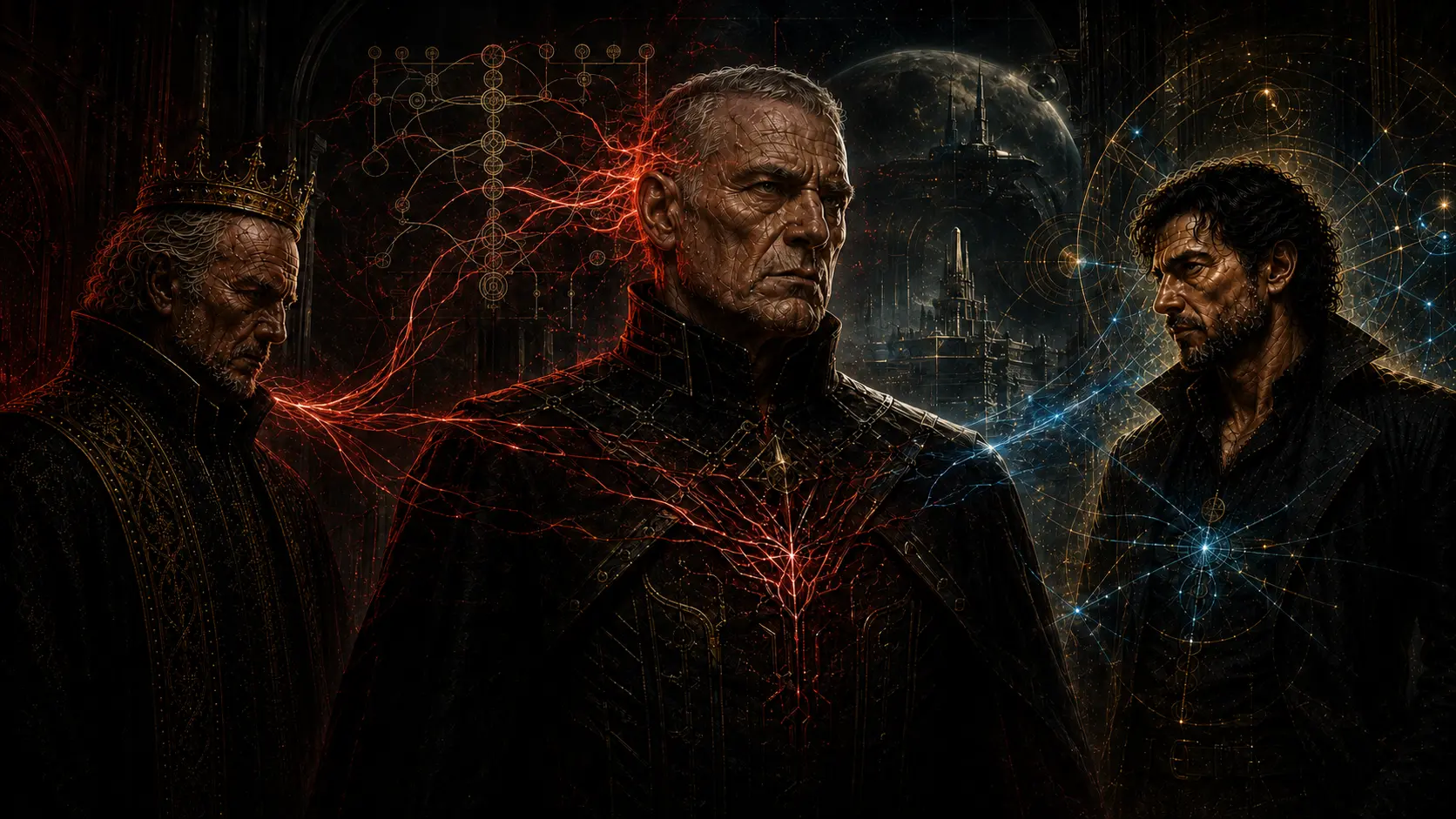
Project Explorer
Inspect the corrected story, trace unresolved causes, and work through source-linked brainstorming packets. The repository browser remains available below.
Development workspace · September 6 workshop pass
All twenty workshop gates have accepted directions. Their unresolved mechanics remain visible. The active Story Completion gate remains SC-010 Question 7.
Public, read-only development material with full spoilers. Draft answers stay in your browser until exported; they do not update the vault. A spoiler boundary is not privacy protection.
The leaders developed Luminai within an interactive colonization environment. Sylvan tests a more deeply integrated generation after thousands of years of development.
Inspect the controlling premiseFinal-years control is established. Stopping authority, cumulative harm, privacy, and remedies still need concrete rules.
Test the leaders' safeguardsKonrad's Daemon verifies an apparent separation. Konrad authorizes reactivation, which attaches his revived system to Samuel's hidden hierarchy. The false evidence still needs definition.
Inspect the takeover resultSamuel and the older criminals remain on the previous containment planet. George participates directly on Sylvan's world, then becomes Samuel's intended scapegoat.
Inspect George's roleStory completion · Live from the vault
The story advances horizontally: every active problem receives the same level of development before any one branch moves deeper.
Integrated foundation review · September 5, 2026
The leaders created an interactive colonization environment and developed Luminai within it. Konrad tries to prove his experienced daemon superior; Samuel turns his reactivation into access. Sylvan already has decisive control during the final years. Exact safeguards and presentation mechanics remain open.
Current method Bound action, observe the method, compare the record, expose the hidden command.
Read the foundation update record9 / 27story tasks complete
Project explorer
Search or browse 539 documents across canon, development systems, story loops, prose tools, public work, and session history.
The five research tracks reinforce one combined endgame architecture:
private consent-scoped evidence -> independently verified pattern -> predictions fixed before outcomes -> protected matching among isolated targets -> bounded public common knowledge -> multi-role human authorization -> durable witnessed record
This is research-derived story guidance, not canon. It improves the current possibilities but does not select the final event, permission system, evidence, or descendant participation model.
The public case does not need public parentage. Identity-bearing evidence can remain sealed while independent custodians verify non-identifying claims, aggregate patterns, and command relationships. Consent should be scoped by field, audience, use, and duration.
Improves: P-04 and P-09.
Protects: descendant agency, privacy, and the prohibition against genealogical spectacle.
Failures become difficult to rewrite only when success criteria, observation windows, responsibility, and confidence are recorded before outcomes. Revisions should remain possible but append-only. The strongest visible pattern is not repeated failure alone; it is repeated definition drift after failure.
Improves: P-02 and P-07.
Protects: uncertainty and legitimate learning; Sylvan still lacks perfect observability.
Sending the same private evidence to many leaders does not necessarily let them coordinate. A safe system can first match confidential reports, then let participants opt into protected coordination, then create a bounded public event where each sees that the others received the same authenticated fact.
Improves: P-04 and the public function of P-01.
Protects: first movers from premature exposure and avoids an instant faction-wide reversal.
Mature systems distinguish identity, role, access, request, authorization, concurrence, execution, verification, audit, and override. Samuel can possess broad access yet still lack an independent legitimate human decision required for a consequential act.
Improves: P-05, P-06, and SC-010 setup possibilities.
Protects: bounded alpha power, human responsibility, and the rule against a magical moral refusal by synthetics.
Public political ritual establishes legitimacy through recognized sequences, witnesses, documents, declarations, and shared custody. The strongest coronation/audit does not bolt evidence onto a spectacle; every step meant to establish Konrad's authority exposes a failed premise or invalid authority claim.
Improves: P-01 and its possible combination with P-02 and P-04.
Protects: exact venue, chronology, and private evidence from premature definition.
Without selecting it, the research makes one combination especially coherent:
This combination could unite P-01, P-02, P-04, P-05, and P-09. It also risks overloading one event and therefore requires an author decision before structural development.
Ask only one at a time. The first remains the current recommended gate.
Research complete. Findings integrated into the active non-canon Creative Possibilities packet. No candidate has been promoted and no canon has changed.