The environment creates the bond.
The leaders developed Luminai within an interactive colonization environment. Sylvan tests a more deeply integrated generation after thousands of years of development.
Inspect the controlling premise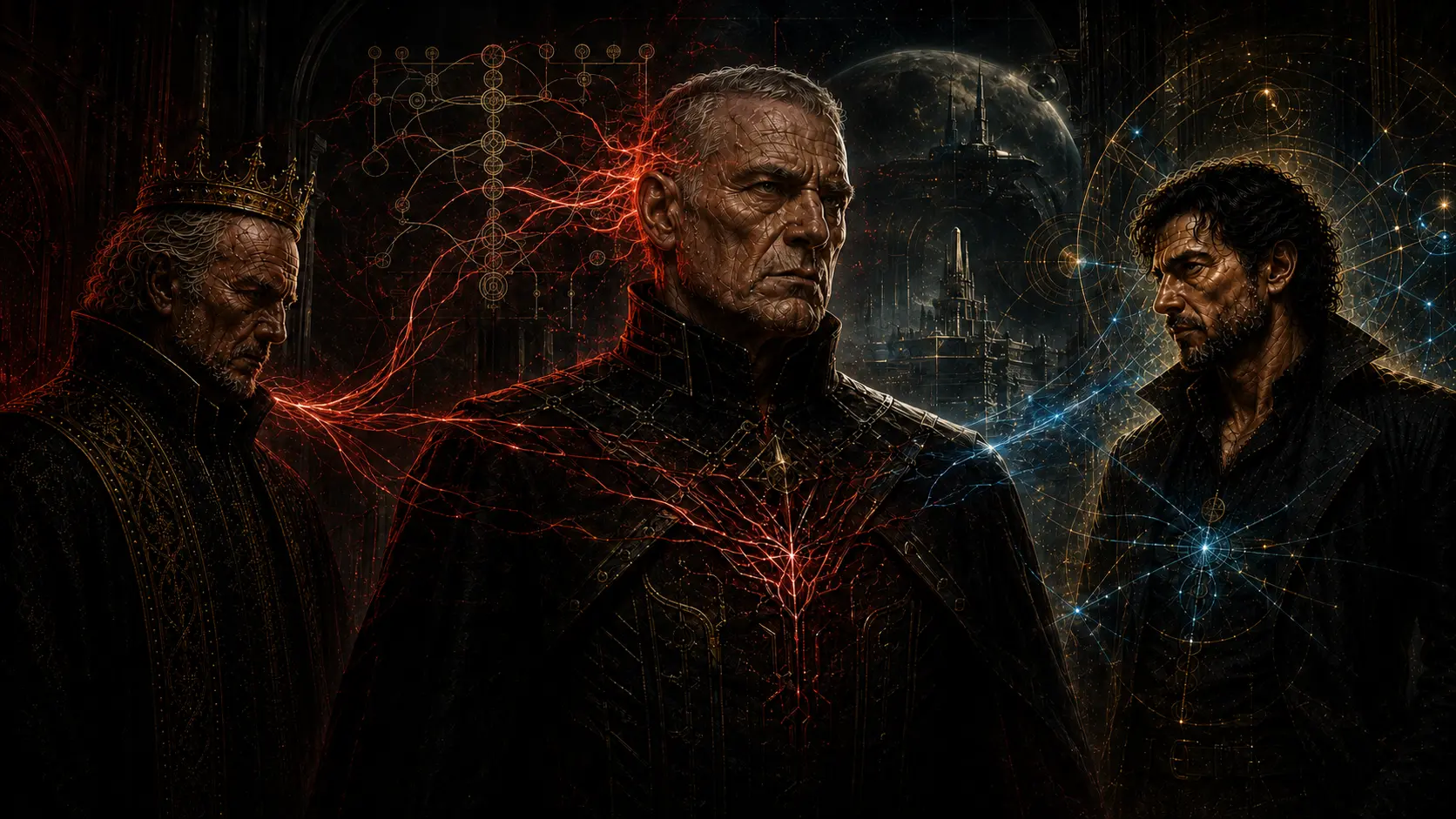
Project Explorer
Inspect the corrected story, trace unresolved causes, and work through source-linked brainstorming packets. The repository browser remains available below.
Development workspace · September 6 workshop pass
All twenty workshop gates have accepted directions. Their unresolved mechanics remain visible. The active Story Completion gate remains SC-010 Question 7.
Public, read-only development material with full spoilers. Draft answers stay in your browser until exported; they do not update the vault. A spoiler boundary is not privacy protection.
The leaders developed Luminai within an interactive colonization environment. Sylvan tests a more deeply integrated generation after thousands of years of development.
Inspect the controlling premiseFinal-years control is established. Stopping authority, cumulative harm, privacy, and remedies still need concrete rules.
Test the leaders' safeguardsKonrad's Daemon verifies an apparent separation. Konrad authorizes reactivation, which attaches his revived system to Samuel's hidden hierarchy. The false evidence still needs definition.
Inspect the takeover resultSamuel and the older criminals remain on the previous containment planet. George participates directly on Sylvan's world, then becomes Samuel's intended scapegoat.
Inspect George's roleStory completion · Live from the vault
The story advances horizontally: every active problem receives the same level of development before any one branch moves deeper.
Integrated foundation review · September 5, 2026
The leaders created an interactive colonization environment and developed Luminai within it. Konrad tries to prove his experienced daemon superior; Samuel turns his reactivation into access. Sylvan already has decisive control during the final years. Exact safeguards and presentation mechanics remain open.
Current method Bound action, observe the method, compare the record, expose the hidden command.
Read the foundation update record9 / 27story tasks complete
Project explorer
Search or browse 539 documents across canon, development systems, story loops, prose tools, public work, and session history.
This report defines how advanced systems become visible consequences without forcing every capability into a glowing device or interface.
Technology should be modeled first by capability, interaction, access, controller, affected entity, operating state, and visible consequence. Appearance is a separate optional layer. The W3C Web of Things model is useful because it separates a thing's metadata from interaction affordances: properties, actions, and events. SysML similarly emphasizes traceability among structure, behavior, requirements, interfaces, and verification.
For Seeds, the decisive addition is observer-specific visibility. A technology may operate, affect a person, or shape an environment while remaining hidden, disguised, mediated through ordinary systems, or perceptible only through consequences.
technology_id: technology:example
kind: personal | institutional | environmental | biological | colony-scale
status: working
capabilities: []
properties: []
actions: []
events_emitted: []
controllers: []
authorized_users: []
affected_entities: []
dependencies: []
operating_states: []
failure_states: []
appearance_definition: null
visible_consequences: []
source_refs: []
Capabilities state what the system can accomplish. Affordances state how an authorized participant can sense or act through it. Events state what changes can be observed. None of these automatically defines casing, screens, beams, rooms, or symbols.
visibility:
  mode: hidden | consequence-only | disguised | mediated | controlled | explicit
  observers: [participant-or-role]
  conditions: [scene-state]
  perceptible_evidence: []
  forbidden_inferences: []
Visibility must be resolved for the scene's observer and camera viewpoint. Audience-only visualizations, diagnostic views, subjective cognition views, and literal in-world visibility are different modes.
Projection should prefer:
For rejuvenation, healthy tissue, movement, recovery, and apparent age are currently defined consequences. A chamber or beam remains undefined. For Luminai/Daemon manifestation, energy around the integrated human is a visual-production representation, not proof of literal observer perception.
The graph should identify who can invoke, interrupt, audit, override, or be affected by a capability. This allows imagery to show control through doors, workflow, human response, environmental changes, or denied access instead of generic command holograms.
Advanced Technology Ecology.md and ENVIRONMENTS-AND-TECHNOLOGY.md.This report does not define new devices, interfaces, rejuvenation procedures, or manifestation visibility canon.