The environment creates the bond.
The leaders developed Luminai within an interactive colonization environment. Sylvan tests a more deeply integrated generation after thousands of years of development.
Inspect the controlling premise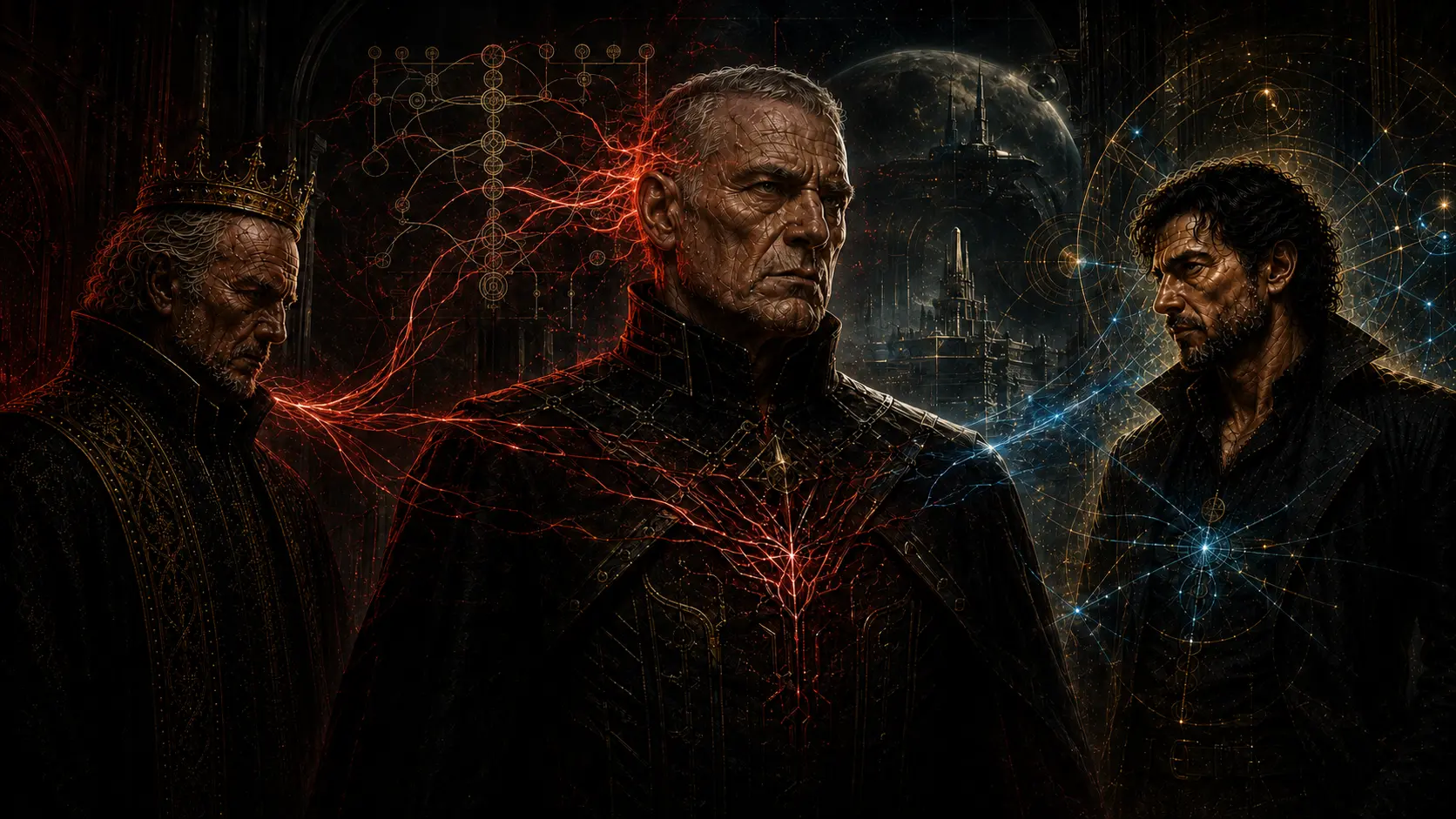
Project Explorer
Inspect the corrected story, trace unresolved causes, and work through source-linked brainstorming packets. The repository browser remains available below.
Development workspace · September 6 workshop pass
All twenty workshop gates have accepted directions. Their unresolved mechanics remain visible. The active Story Completion gate remains SC-010 Question 7.
Public, read-only development material with full spoilers. Draft answers stay in your browser until exported; they do not update the vault. A spoiler boundary is not privacy protection.
The leaders developed Luminai within an interactive colonization environment. Sylvan tests a more deeply integrated generation after thousands of years of development.
Inspect the controlling premiseFinal-years control is established. Stopping authority, cumulative harm, privacy, and remedies still need concrete rules.
Test the leaders' safeguardsKonrad's Daemon verifies an apparent separation. Konrad authorizes reactivation, which attaches his revived system to Samuel's hidden hierarchy. The false evidence still needs definition.
Inspect the takeover resultSamuel and the older criminals remain on the previous containment planet. George participates directly on Sylvan's world, then becomes Samuel's intended scapegoat.
Inspect George's roleStory completion · Live from the vault
The story advances horizontally: every active problem receives the same level of development before any one branch moves deeper.
Integrated foundation review · September 5, 2026
The leaders created an interactive colonization environment and developed Luminai within it. Konrad tries to prove his experienced daemon superior; Samuel turns his reactivation into access. Sylvan already has decisive control during the final years. Exact safeguards and presentation mechanics remain open.
Current method Bound action, observe the method, compare the record, expose the hidden command.
Read the foundation update record9 / 27story tasks complete
Project explorer
Search or browse 539 documents across canon, development systems, story loops, prose tools, public work, and session history.
Specify what remains adaptive after decisive control without treating people as experimental material.
This packet supports the existing Story Completion Workflow. Its central gate was author-accepted on September 6. It does not answer SC-010 Question 7 or advance that checklist. Central synthesis: Astra, reviewed for integration on September 5.
Samuel's influence progressively lessens while Sylvan and Orzai's influence increases as the conclusion approaches. Samuel retains enough bounded choice to reveal how he adapts, but his ability to create new harm contracts. Sylvan and Orzai already control the decisive conclusion; the exact stopping thresholds and third-party protections remain open.
These constraints inherit their source status. A working physical model, timing estimate, or accepted macro constraint does not establish every implementation detail.
Modules: 07, 08, 11, 13. Read their accepted results before closing this gate. Open prerequisites can be explored provisionally, but do not mark dependent choices final. Module numbers are topic IDs; use the dependency order in the workshop index.
What may Samuel still choose, and which attempted consequence is physically or institutionally impossible?
AUTHOR-ACCEPTED DIRECTION: adaptive choices remain observable while practical influence transfers away from Samuel; the exact prohibited consequences remain a narrower open design problem.
PROPOSED: Samuel can bargain, lie and issue logged requests while harmful execution is blocked. Strong method exposure; enough human response must remain unscripted.
PROPOSED: Consenting protected intermediaries can accept or refuse limited approaches. Rich social adaptation; consent must be revocable and protection cannot rely on deception alone.
PROPOSED: Samuel makes real allocation choices over strictly bounded resources. Shows priorities under pressure; cannot manufacture deprivation for uninformed people.
PROPOSED: Sylvan interrupts each harmful escalation while leaving a safe next choice. Demonstrates adaptive containment; clear rules prevent it feeling like a rigged humiliation exercise.
Non-canon situation: Samuel’s next request would expose a person outside the agreed boundary; Sylvan interrupts it immediately, sacrificing a fuller pattern demonstration.
Record what each person wants, can know, can refuse, and can actually change. Name the observable difference between the selected alternatives.
Module: 15 · Bounded observation
Gate: What may Samuel still choose, and which attempted consequence is physically or institutionally impossible?
State: DRAFT / PROPOSED / AUTHOR-ACCEPTED / REJECTED / DEFERRED
Author answer (verbatim):
Exact restatement:
Selected option or new answer:
Why this tradeoff:
Rejected alternatives and reasons:
Prerequisites resolved / deferred:
Scene test: choices, permissions, evidence, cost:
Adversarial result:
Remaining uncertainty:
Explicit acceptance wording and date:
Affected notes updated:
QA decision reference:
Workflow task and macro-depth effect:
Website rebuild and verification:docs/timeline.html, the matching source in 05 Public/Atlas/, and the workshop projection.