The environment creates the bond.
The leaders developed Luminai within an interactive colonization environment. Sylvan tests a more deeply integrated generation after thousands of years of development.
Inspect the controlling premise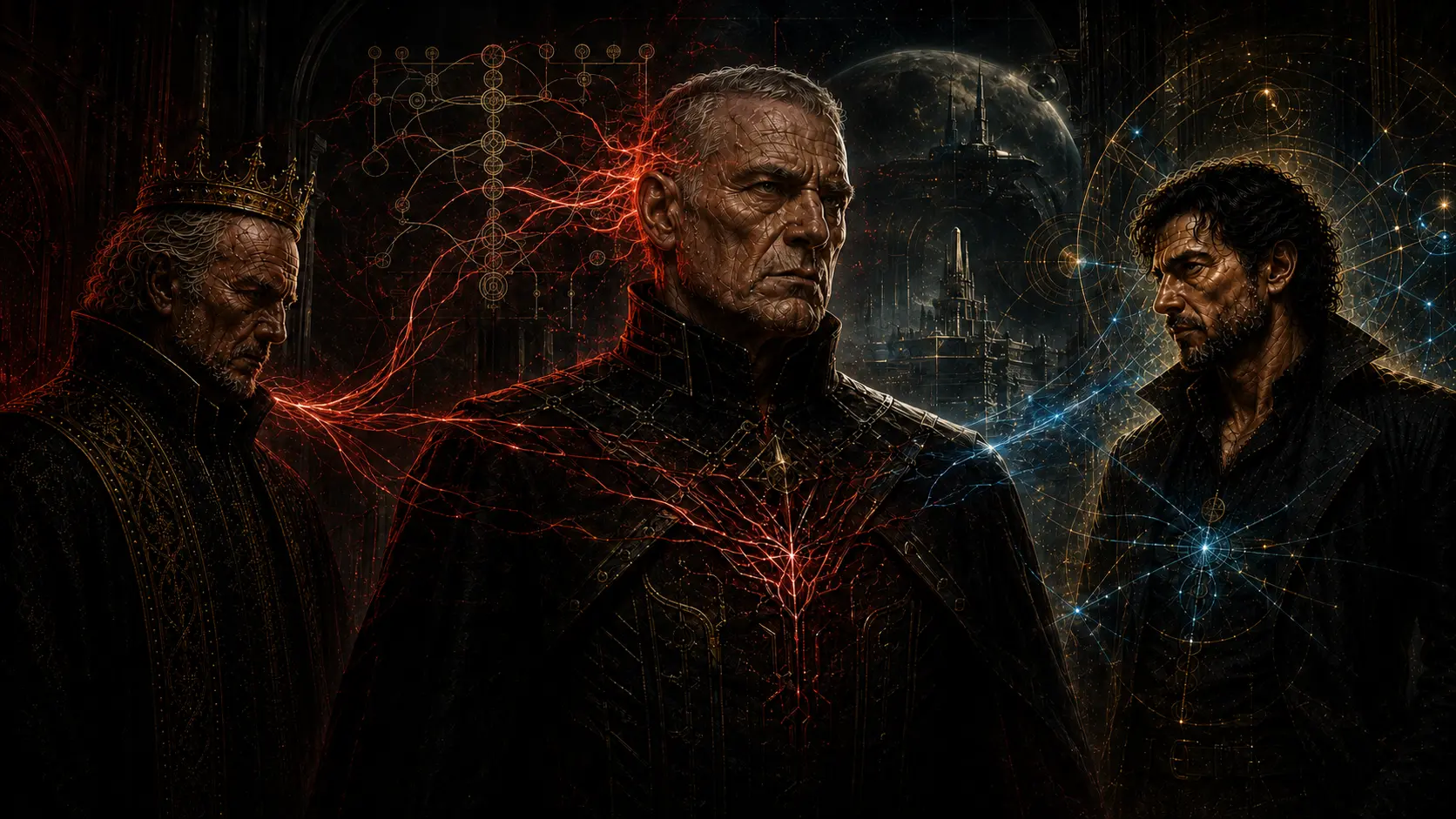
Project Explorer
Inspect the corrected story, trace unresolved causes, and work through source-linked brainstorming packets. The repository browser remains available below.
Development workspace · September 6 workshop pass
All twenty workshop gates have accepted directions. Their unresolved mechanics remain visible. The active Story Completion gate remains SC-010 Question 7.
Public, read-only development material with full spoilers. Draft answers stay in your browser until exported; they do not update the vault. A spoiler boundary is not privacy protection.
The leaders developed Luminai within an interactive colonization environment. Sylvan tests a more deeply integrated generation after thousands of years of development.
Inspect the controlling premiseFinal-years control is established. Stopping authority, cumulative harm, privacy, and remedies still need concrete rules.
Test the leaders' safeguardsKonrad's Daemon verifies an apparent separation. Konrad authorizes reactivation, which attaches his revived system to Samuel's hidden hierarchy. The false evidence still needs definition.
Inspect the takeover resultSamuel and the older criminals remain on the previous containment planet. George participates directly on Sylvan's world, then becomes Samuel's intended scapegoat.
Inspect George's roleStory completion · Live from the vault
The story advances horizontally: every active problem receives the same level of development before any one branch moves deeper.
Integrated foundation review · September 5, 2026
The leaders created an interactive colonization environment and developed Luminai within it. Konrad tries to prove his experienced daemon superior; Samuel turns his reactivation into access. Sylvan already has decisive control during the final years. Exact safeguards and presentation mechanics remain open.
Current method Bound action, observe the method, compare the record, expose the hidden command.
Read the foundation update record9 / 27story tasks complete
Project explorer
Search or browse 539 documents across canon, development systems, story loops, prose tools, public work, and session history.
America/Los_Angeles.| Mode | Use | Core reports | Optional modules |
|---|---|---|---|
| Standard | normal weekly reset | all 10, concise | none by default |
| Deep | substantial capacity remains | all 10, expanded | choose 1–2 |
| Exhaustive | deliberate end-of-cycle use | all 10, full | all 3 if evidence supports them |
Always read START HERE.md, 03 Context/CURRENT.md, 03 Context/RULES.md, 03 Context/OPEN-QUESTIONS.md, 07 Coordination/CURRENT-PICKUP.md, 07 QA/Decisions.md, 07 QA/Contradictions.md, and the prior synthesis manifest if one exists.
Then inventory, without treating all as equal authority:
CURRENT-WEEK-INTAKE.md;For a first run, use a full-vault inventory but summarize sources before analysis. Do not dump raw files into every critic pass.
A later date alone does not outrank an explicit decision. Report conflicts; do not flatten them.
Score 1–5 for causal leverage, downstream blockage, character importance, evidence/setup urgency, and author-decision readiness. Subtract 1–5 for assumption cost. Use the score as a recommendation, not authority.
These are analysis classifications, not parallel author TODO lists. Reconcile them into one proposed replacement completion checklist, deduplicated against the current task registry, and stop for author approval before changing the stable pointer.
Stop expanding a branch when it reaches a load-bearing author choice, source-authority conflict, missing mechanism that needs research, dedicated active brainstorm boundary, or unsupported canon proposal. Produce the exact next question instead.
Public-development ideas must label spoiler risk and source authority. Never expose private development, unresolved accusations as fact, raw transcripts, or real-person analogies.