The environment creates the bond.
The leaders developed Luminai within an interactive colonization environment. Sylvan tests a more deeply integrated generation after thousands of years of development.
Inspect the controlling premise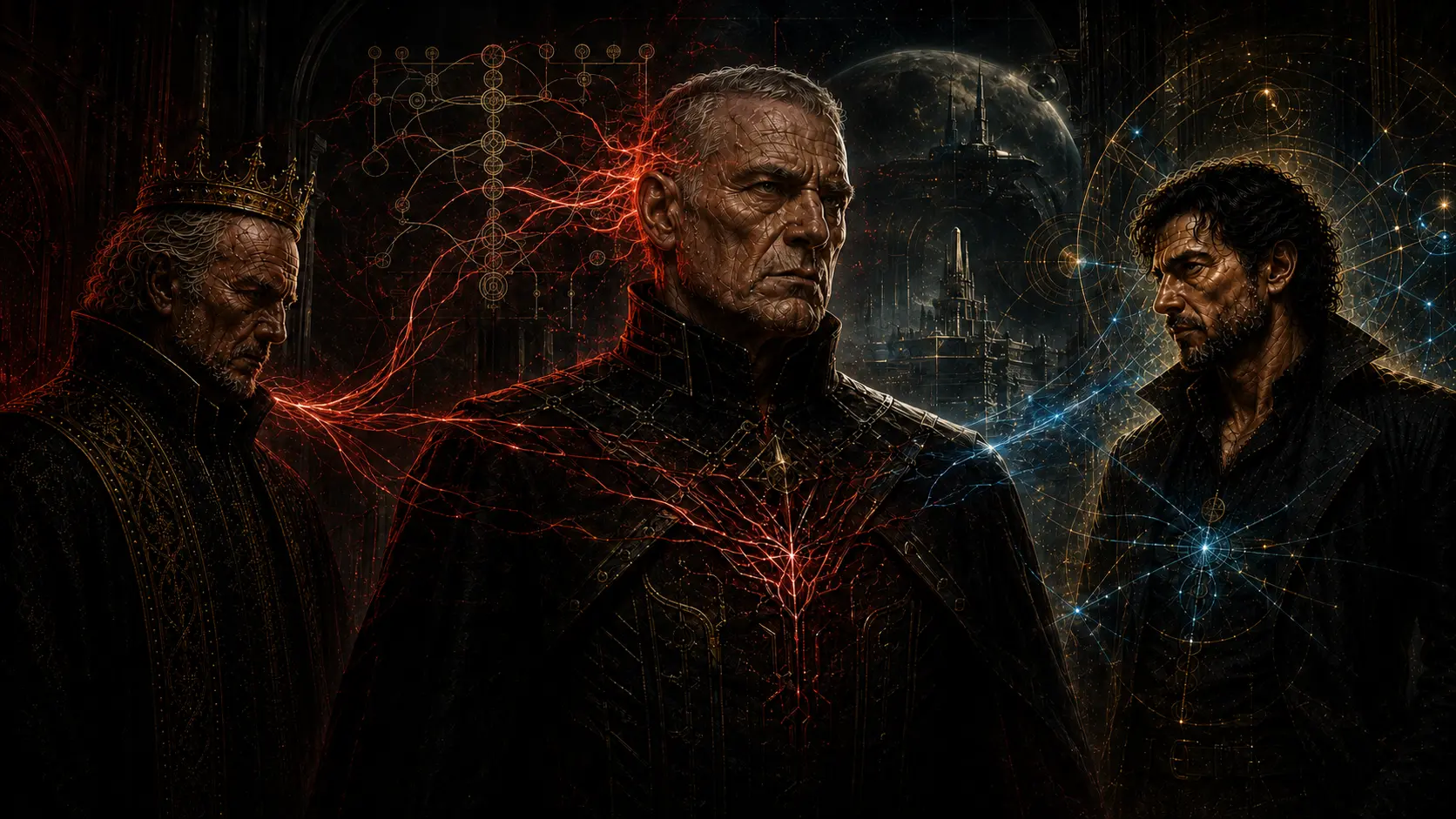
Project Explorer
Inspect the corrected story, trace unresolved causes, and work through source-linked brainstorming packets. The repository browser remains available below.
Development workspace · September 6 workshop pass
All twenty workshop gates have accepted directions. Their unresolved mechanics remain visible. The active Story Completion gate remains SC-010 Question 7.
Public, read-only development material with full spoilers. Draft answers stay in your browser until exported; they do not update the vault. A spoiler boundary is not privacy protection.
The leaders developed Luminai within an interactive colonization environment. Sylvan tests a more deeply integrated generation after thousands of years of development.
Inspect the controlling premiseFinal-years control is established. Stopping authority, cumulative harm, privacy, and remedies still need concrete rules.
Test the leaders' safeguardsKonrad's Daemon verifies an apparent separation. Konrad authorizes reactivation, which attaches his revived system to Samuel's hidden hierarchy. The false evidence still needs definition.
Inspect the takeover resultSamuel and the older criminals remain on the previous containment planet. George participates directly on Sylvan's world, then becomes Samuel's intended scapegoat.
Inspect George's roleStory completion · Live from the vault
The story advances horizontally: every active problem receives the same level of development before any one branch moves deeper.
Integrated foundation review · September 5, 2026
The leaders created an interactive colonization environment and developed Luminai within it. Konrad tries to prove his experienced daemon superior; Samuel turns his reactivation into access. Sylvan already has decisive control during the final years. Exact safeguards and presentation mechanics remain open.
Current method Bound action, observe the method, compare the record, expose the hidden command.
Read the foundation update record9 / 27story tasks complete
Project explorer
Search or browse 539 documents across canon, development systems, story loops, prose tools, public work, and session history.
Integrate heavily into Seeds of the Throne the story-development principles that make long-form science fiction easy to follow, highly propulsive, and especially effective in audiobook form, while preserving Seeds' own voice, tone, themes, and structural complexity.
This is not an instruction to imitate Craig Alanson's prose style or reproduce the voice of the Expeditionary Force series. The goal is to absorb the underlying storytelling engineering: clear immediate objectives, active problem-solving, escalating complications, conversational exposition, strong character dynamics, listener orientation, and recurring solution/consequence loops.
The system should influence development from high-level structure down through scenes and final prose rather than being added only as a late audiobook-readability pass.
Complex world, simple scene.
Seeds may contain centuries of history, hidden jurisdictions, containment systems, Luminai, Daemons, synthetics, planetary infrastructure, genealogical fraud, political collapse, evidence systems, and layered character deception.
The listener should not need to hold all of that in working memory to understand what is happening in the current scene.
At scene level, the audience should usually be able to answer quickly:
Deep complexity should emerge through accumulation rather than constant exposition burden.
Even when the larger story spans generations or civilizations, individual scenes and sequences should usually contain an objective understandable in seconds.
Examples:
The immediate problem gives the listener a stable handhold while the larger mystery remains complex.
Characters should frequently reason, test, argue, improvise, fail, revise, and try again.
A useful recurring engine is:
problem -> hypothesis -> attempt -> partial success/failure -> consequence -> revised problem
or, at larger scale:
constraint -> proposed workaround -> apparent success -> hidden cost -> larger constraint
Solutions should often create the next problem rather than simply closing a plot unit.
Whenever possible, let the audience first see a system behave.
Preferred sequence:
strange event -> repeated observation -> attempted explanation -> test -> result -> partial model -> later deeper explanation
Avoid explaining a complex system completely before it matters.
The audience should experience advanced systems as things characters interact with, not only concepts described to them.
Exposition should be attached to action, disagreement, consequence, discovery, or need.
Instead of explaining a system in isolation, place characters in a situation where understanding that system is necessary.
Example structural pattern:
Konrad demands a system obey him -> Samuel explains a limitation -> Konrad demands a workaround -> Samuel offers one -> it appears to work -> the workaround later proves to be the trap
The explanation therefore performs multiple jobs at once:
Information becomes easier to process when characters have distinct relationships to it.
Useful contrasts include:
Scenes should often let characters disagree about:
This makes technical material dramatic rather than instructional.
Seeds should allow capable people to actually be capable.
Competence can create suspense when the problem is difficult enough.
Show characters:
Sylvan's growth should be pleasurable partly because the audience experiences him becoming better at understanding the environment.
A useful Seeds pattern is:
problem -> workaround -> success -> dependency -> hidden consequence -> larger problem
This is particularly strong when an antagonist offers the workaround.
The Samuel/Konrad containment mechanism is a key example:
Konrad thinks Samuel is giving him back his empire. In reality, Konrad has just migrated the machinery of his organization into Samuel's jurisdiction.
Konrad is solving an immediate post-defeat problem: restore the systems that once made his authority real.
The restoration works well enough to encourage additional reactivation.
The success itself increases the scale of the later disaster.
Audiobook prose should periodically and naturally restore orientation without sounding repetitive.
Useful orientation anchors include:
The test is not whether the prose is simplistic. The test is whether a listener who cannot glance back three paragraphs can still follow the scene.
A chapter or substantial scene should usually end because the situation changed, not simply because enough words have passed.
Strong endings include:
Seeds is darker than Expeditionary Force, but darkness does not require characters to become humorless exposition vessels.
Human personality, irritation, absurdity, wit, gallows humor, petty conflict, and ordinary reactions can preserve readability and make characters feel alive.
Humor should emerge from character and situation rather than become a repeated catchphrase system.
The story may reuse satisfying forms such as debugging, testing, adversarial interpretation, planning, or failed workarounds.
The content and pressure must change.
Avoid long-series fatigue caused by repeating the same joke, same argumentative beat, or same impossible-problem structure with only cosmetic changes.
Each recurrence should alter one or more of:
Sylvan's modern story is naturally compatible with this approach.
A preferred recurring developmental cycle is:
observe anomaly -> preserve evidence -> build model -> test -> get something wrong -> revise -> discover capability -> antagonist interferes -> old model fails -> identify deeper rule -> carry improved state forward
This should create audience pleasure at several levels:
This integrates directly with the existing recursive Luminai loop:
experience -> preserve observation/provenance -> form hypothesis -> challenge hypothesis -> predict/test -> compare result -> identify failure -> update model -> carry improved state forward
The difference is emphasis: the Luminai loop defines cognitive reliability; the Problem-Solving Story Engine converts that process into entertaining reader-facing situations.
The Great War can use the same logic at institutional scale.
Possible recurring form:
Konrad encounters obstacle -> hierarchy produces solution -> apparent success -> hidden institutional cost -> Samuel or the enemy exploits weakness -> leadership misreads result -> next decision compounds problem
This allows the war to become a chain of understandable problems rather than an abstract historical summary.
Examples of scene-scale objectives can include:
The audience can understand each problem while gradually seeing the authoritarian system become incapable of correcting itself.
Samuel's sabotage should exploit existing failure modes rather than replace them.
The postwar transition is especially suited to this engine.
This section summarizes the accepted dramatic hinge, not the unresolved implementation. It may guide scene questions, but it must not decide the practical hierarchy architecture, definition of primary, exact lock event, transferred powers, precise lie, reset limits, or destruction chain. Those belong to 08 Story Loop/Brainstorms/Samuel-Konrad Containment Hierarchy - Needs Analysis.
At the immediate level, Konrad has a simple problem:
The machinery that made his authority real is gone or inactive. He wants it back.
Samuel offers a solution.
The solution should appear technically and procedurally successful.
That success encourages Konrad to restore more.
But the larger structure is:
genuine control in Konrad's own city -> unanticipated defeat -> loss of that city-based jurisdiction -> need to restore programs -> Samuel provides a path inside his separate bounded part of the largest empire's containment environment -> earlier first-primary lock gives Samuel structural priority there -> Konrad reactivates/migrates machinery inside Samuel's jurisdiction -> still-unresolved dependency, surveillance, and control consequences -> Fitzgerald group is permanently damaged
Samuel remains an outsider and may remain contemptible in Konrad's eyes throughout this process. The reader should understand the immediate success before fully understanding its hidden cost, but the exact success and cost must be selected through the author-led brainstorm rather than inferred here.
09 Story Exploration/ should evaluate generated possibilities for more than novelty.
Add these questions to exploration runs:
Do not promote an idea solely because the mechanism is clever. Prefer ideas that generate scenes, decisions, pressure, and consequences.
The structural Gauntlet should add a Problem-Solving / Listener-Clarity critic lens.
For each story unit or sequence, ask:
A structurally correct sequence can still fail if it lacks a reader-facing engine.
Before drafting a scene, define:
What concrete thing must be understood, achieved, prevented, survived, obtained, hidden, or decided?
What does the viewpoint character currently think is happening?
Why can they not simply solve it immediately?
What do they actually do?
What happens?
What does the character now believe that they did not believe before?
Why does the next scene begin in a different situation?
Does this scene teach, establish, or misdirect something that matters later?
Not every scene must use the same rhythm, but scenes containing complex systems should usually answer most of these questions.
Run after scene/prose generation as a separate pass.
This system does not replace the Seeds prose skill.
Story development and prose quality remain separate stages.
The development engine determines:
The prose system determines:
A scene should first work as story, then work as prose, then work by ear.
Do not ask the model to "write like Craig Alanson" or reproduce distinctive Expeditionary Force phrasing, recurring jokes, character voices, or sentence patterns.
Use the series only as a development reference for general techniques such as:
Seeds must remain recognizably its own work.
When developing a sequence, ask:
canon/context retrieval -> define immediate problem -> generate possible attempts -> choose character-pressure version -> map consequence -> Creative Interest Loop -> causality/continuity/system critics -> author gate -> scene development -> prose generation -> audiobook-readability pass
The desired result is a novel where: